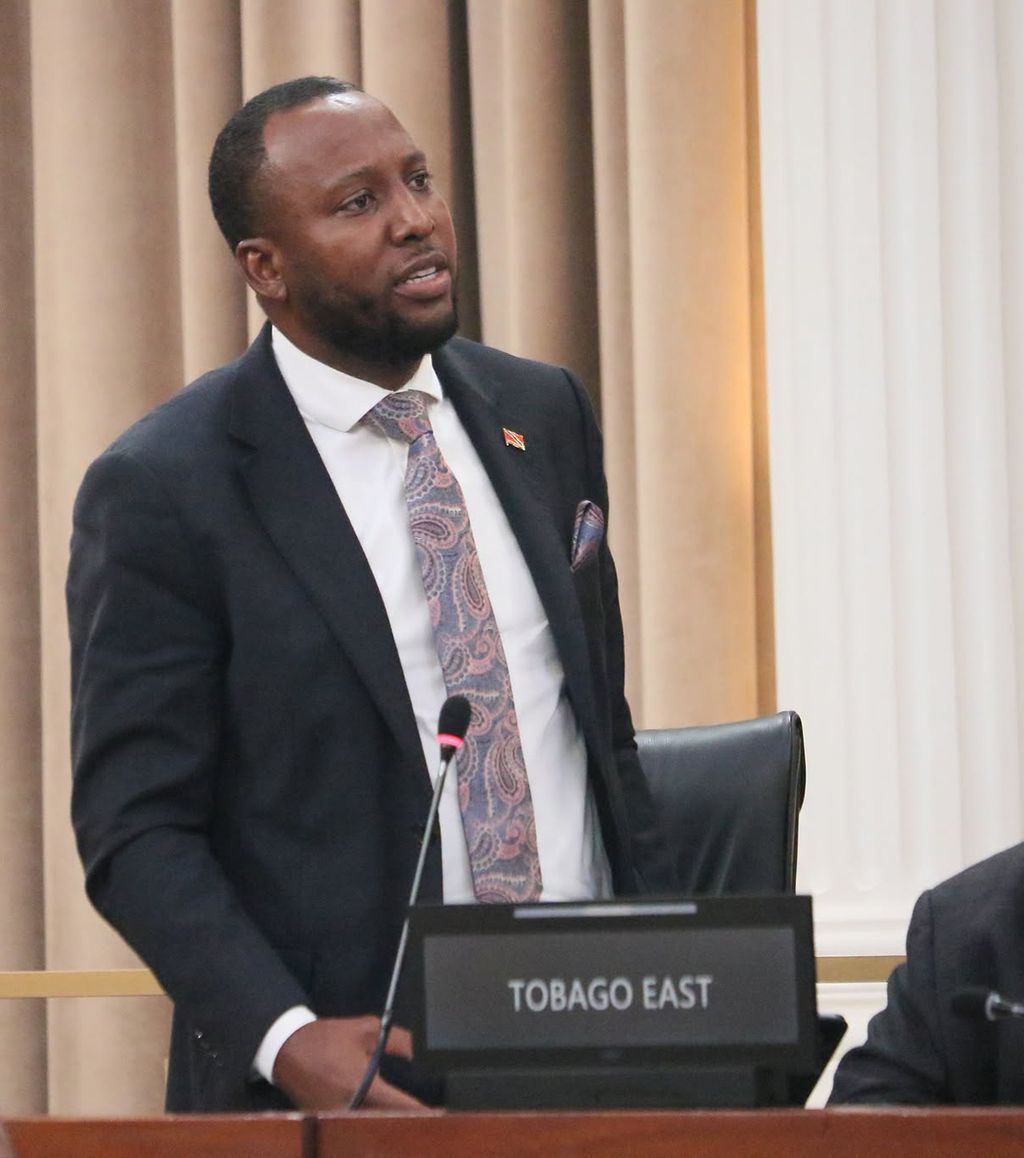

Tobago West MP Joel Sampson wants the Prime Minister or relevant national authority to consult Tobago’s Chief Secretary before declaring any Tobago community a closed area or imposing a curfew under the proposed Special Operations legislation.
Sampson, who supported the Special Operations Bill 2026 during debate in the House of Representatives on Friday, said the Tobago House of Assembly (THA) should have a formal role when extraordinary security measures affect the island and its residents.
While the THA has no authority over policing, Sampson said it should be involved because its responsibilities include health, emergency management, schools, social services, infrastructure, transportation and community development.
“A special operation could affect access to health centres, schools, workplaces, ports, tourism facilities, public transportation, food supplies, and emergency services,” Sampson said.
He proposed that where circumstances permit, the Chief Secretary be consulted before a declaration. If advance consultation is impossible because of urgency or operational sensitivity, he said the Chief Secretary should be confidentially notified as soon as practicable afterwards.
His comments came as the Special Operations Bill, 2026 was passed in the House following a marathon sitting, with Attorney General John Jeremie saying the Government is not promising perfection from its latest crime-fighting measure but will consider it a success if it delivers a steady and sustained reduction in violent crime.
The Bill was passed shortly after midnight on Saturday, after the House sat for more than 13 hours on Friday.
The legislation, which replaces the Government’s defeated Zones of Special Operations (ZOSO) Bill, establishes seven policing districts across Trinidad and Tobago and creates a framework for special operations to combat criminal activity.
Within those districts, specific locations can be declared “closed areas”, where enhanced law enforcement powers can be exercised for limited periods. Those powers include curfews, cordons, checkpoints, road closures, restrictions on entry and exit and, in specified circumstances, searches without warrants.
Jeremie said the ultimate objective was a return to peace, while acknowledging that no piece of legislation could completely eradicate crime.
“Success looks like the state which I described in my opening. It is a return to peace and the recognition that there is no perfection on earth,” Jeremie said.
“A continuing reduction in the levels of violent criminal activity in our country is what we seek.”
Sampson said the bill’s recognition of Tobago as District Seven was significant because of the island’s geography, population distribution, transportation network and security environment.
He said Tobago faced risks beyond conventional violent crime, including the movement of illegal firearms, narcotics and people through its territorial waters.
Sampson warned that Tobago was “at risk of being incorporated into a wider regional network of organised criminal activity” and could become a storage, transhipment, refuelling or recruitment point for regional criminal organisations.
But he stressed that his support for the legislation was not a call for a permanently militarised island.
“I do not support this legislation because I desire a militarised Tobago. I support it because I refuse to accept a criminalised Tobago.”
Sampson also cautioned against the indiscriminate use of the powers available under the bill, saying poverty, unemployment, youth or residence in a particular community could not be treated as evidence of criminality.
Jeremie said the Government had discussions with Tobago’s representatives, and there were non-legislative solutions that would allow the issues to be settled through discussion as partners.