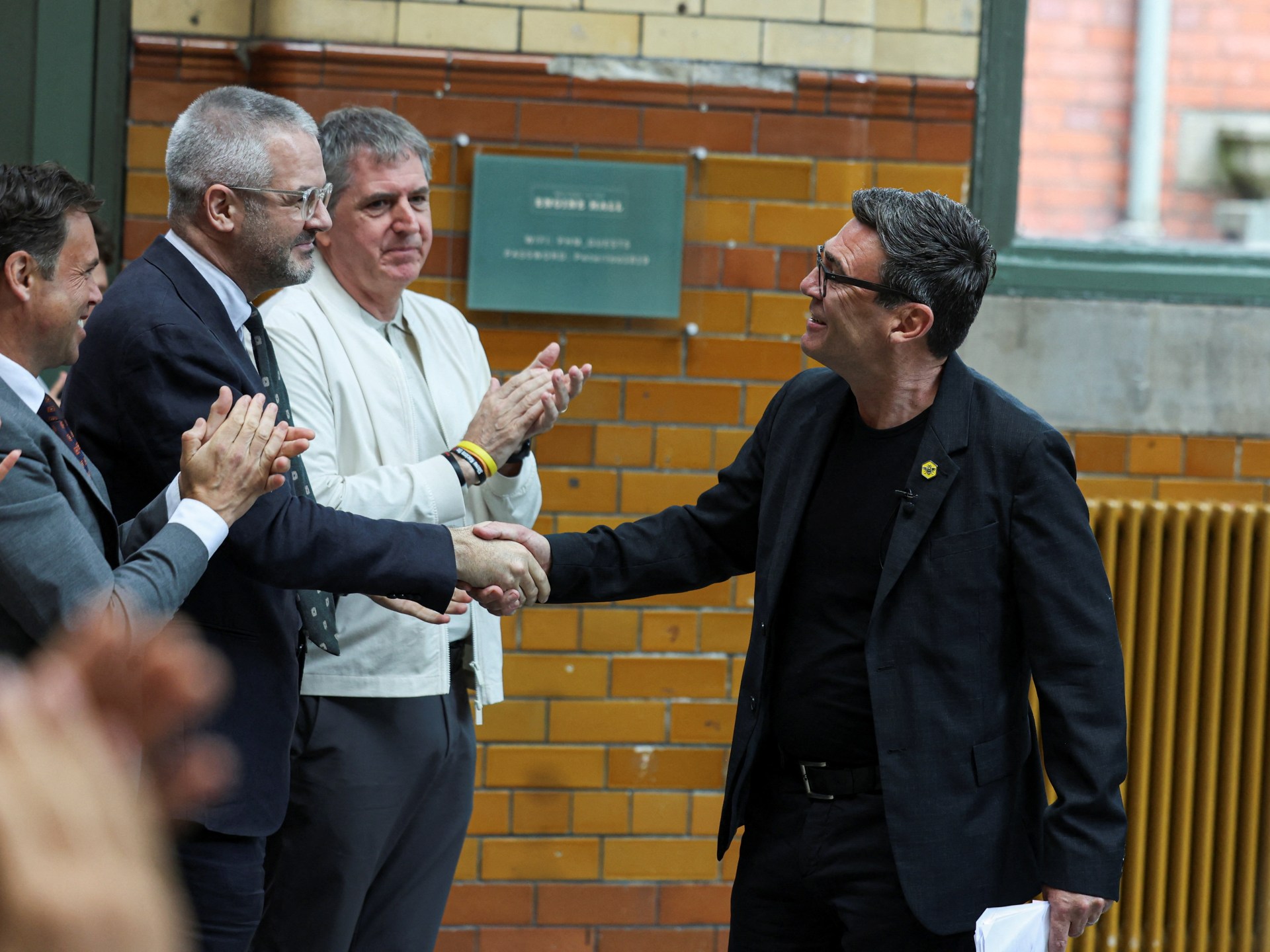

Andy Burnham, the frontrunner to become Britain’s next prime minister, has vowed to “bring about the biggest rebalancing of power our country has seen” by handing more autonomy to the regions if he succeeds Keir Starmer.
In a speech on Monday setting out his policy vision, in Manchester where he spent nine years as mayor, Burnham pledged fiscal discipline and promised to reduce Britain’s ballooning welfare bill, having already sought to calm markets by committing to the government’s current borrowing limits.
- list 1 of 4‘London cooking’: Why can’t the UK cope with the heat; when will it adapt?
- list 2 of 4Starmer couldn’t master the media. Can Burnham?
- list 3 of 4UK’s likely next leader Andy Burnham to unveil economic, devolution plans
- list 4 of 4Will Andy Burnham mark a shift in the UK’s Gaza policy?
end of list
“Growth cannot be ordered from the top down. Instead, it can only be nurtured from the bottom up,” Burnham said.
“If councils can’t fix potholes, what chance do they have of bringing forward major regeneration schemes to get growth going?”
He set out a 10-year plan to get “good growth in every postcode”, in a country where wealth and power are concentrated in London and the south of England.
Burnham won a by-election on June 18 to regain a seat in parliament, where he was sworn in on June 22, the same day Starmer announced that he will resign as soon as a successor is chosen.
Burnham is so far the only contender in the Labour Party leadership contest. If nobody challenges him, he will become prime minister by July 20.
Although he is considered more charismatic than Starmer, Burnham will face the same political and economic challenges, including a sluggish economy, tattered public services and a cost-of-living squeeze.
He will be constrained by the platform the Labour Party was elected on in 2024, with a pledge not to increase taxes on working people.
Advertisement
Like other NATO countries, Britain is also under pressure to dramatically increase defence spending to counter a more aggressive Russia and less reliable United States.
The government’s long-awaited defence investment plan is expected to be published before a NATO summit in Turkey on July 7 and 8. Starmer’s successor will be expected to stick to the commitments in the plan.
Burnham drew criticism from political commentators and opposition leader Kemi Badenoch of the Conservative Party for declining to take any questions after his speech.
“He doesn’t have a plan beyond telling the mayors to go and sort it out,” Badenoch said. “If he wants to be the leader of our country, it’s time to start acting like it.”
Related News
India’s Modi says he forgives students who abused him in Cockroach protests
At least 11 wounded by Colombia car bomb days before presidential election
Over 5,500 children displaced by fighting in Sudan’s el-Obeid, charity says