
Anna-Lisa Paul
Senior Reporter
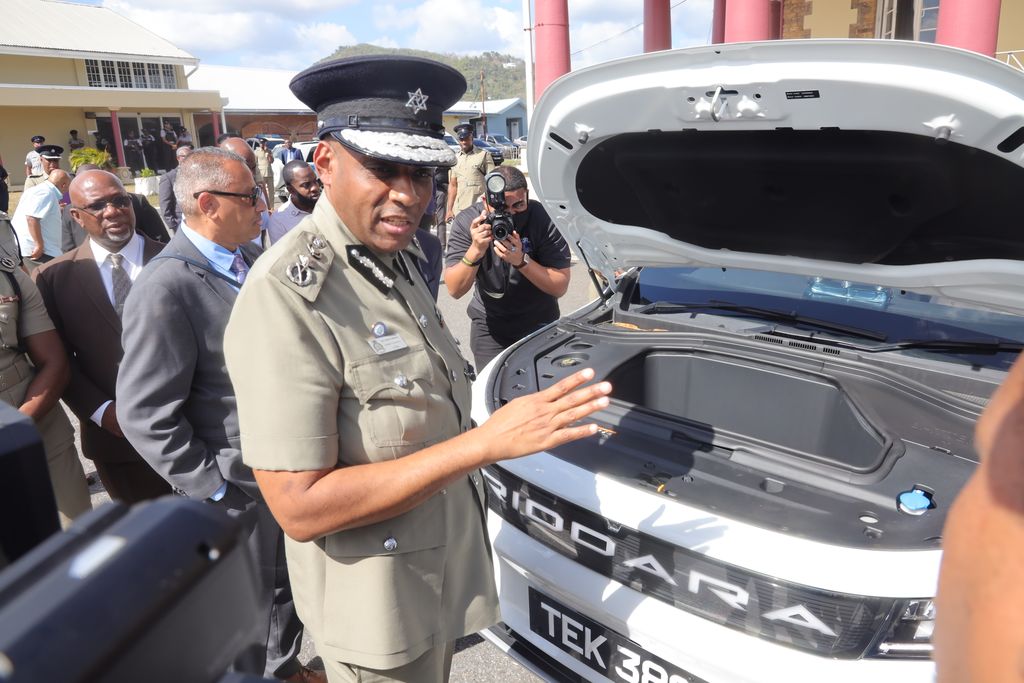
We continue our interview with Police Commissioner Allister Guevarro, who celebrated his first year in office last week. During a sit-down interview at the Police Administration Building, he told Guardian Media that he is not politically aligned and that, in addition to crime-fighting, his main focus is increasing manpower within the Police Service.
Why Can’t We Live Happily, In Unity?
Addressing the racial tensions that have surfaced in recent times, Commissioner Guevarro asked, “Why can’t we all live as one happy society?”
Describing himself as a “true Trinidadian” with East Indian, African and Spanish heritage, he pleaded, “Every creed and race find an equal place.”
“We must have tolerance of persons’ religion, ethnicity and status. You can’t look down at anyone because of your personal dignity.”
He said that while someone may not find themselves aligned with another person, that was no reason for discrimination.
“It’s one way you look at persons who may find themselves in a certain type of employment that others may want to look down on. There are certain types of employment that Trinidadians would not want to do here. You have persons from outside coming into our country and doing that employment, and they are being discriminated against.”
“So I just want to make a plea to members of the public. Let us show that tolerance to our fellow man, whether they be of a different ethnicity, religion, creed, race or whatever. Let us be tolerant of our neighbours.”
Laughing off claims that he was the Government’s “blue-eyed boy” and had been specially selected to do its bidding, as has been suggested in the public domain, Guevarro maintained that he is apolitical.
He swore, “I have never voted.”
“I have no intention of voting whatsoever in my lifetime, once I hold this position.”
He revealed that the decision, which was made years ago, stemmed from his assignment to the Special Branch.
“If government was to change, I would have to serve the government in power.”
Therefore, he said, “I felt it was necessary at that time not to have any political leanings or allegiances to anyone in particular, or any party in particular. And I maintained that throughout my career. Apolitical.”
He recalled the advice of former commissioner of police Stephen Williams upon his assumption of office that the TTPS was an independent organisation.
However, he reiterated, “You must understand that the government of the day has the policy-making authority. So if the government of the day’s policy is one that is looking to reduce homicides, reduce home invasions and reduce extortion, then the Police Service alignment should be placed in accordance with the policy direction of the government.”
He said common sense dictated that one could not be adversarial to policymakers.
Sitting where he is now, Guevarro joked that his professional life would be much easier if he were indeed “favoured.”
“I wish I was in a position where I got what I want,” he said.
“I do not see myself as an appointee of any particular government. It’s the House of Representatives. Both sides voted for the appointee.
“And if, within the first year, everything that is required of the TTPS is being done, and we are doing it in a right and proper way, then if the Prime Minister, the President, the minister, the Opposition Leader, the Chief Whip, whomever, wants to praise the TTPS for the results they are seeing, I will willingly accept it.”
Looking Ahead As He Moves Into His Second Year
Among his priority goals as he moves into his second year in office, Guevarro said he is focused on correcting the human resource anomaly within the TTPS that has existed since 1982.
As the demands of society have changed over the years, manpower resources have not kept pace, with the Police Service continuing to operate with a sanctioned strength of 7,884 officers.
Recognising that since 1983 dozens of specialist units, sections and branches have been added to the responsibilities of the TTPS, Guevarro said, “No one sought to correct that over the past 40 years.”
“Every time a problem occurs ... kidnappings became a problem back in the late 1990s, so we opened an Anti-Kidnapping Unit. We didn’t recruit additional police officers. We took police officers from other units and created an Anti-Kidnapping Unit.”
“We then had the introduction of computers, so we built an IT Department. We took police officers and opened this IT Department. Then we became IT-savvy and cybercrime started, so we had to have a Cybercrime Department. Financial investigations. You name it.
“Every single unit. Child protection. All of these units are recent units. Where did the staffing come from? From within the same sanctioned strength of 1980. And no one chose to correct it.”
This acute shortage of personnel, he claimed, has also led to ballooning overtime bills over the years.
Noting that there is never a full staff strength of 7,884 officers on duty at any given time because allowances must be made for officers on vacation, sick leave and other absences, Guevarro said, “We have an operational strength of between 4,000 and 5,500 officers at any given time, which is woefully insufficient.”
To overcome this issue, he said the sanctioned strength of the TTPS must be increased.
“So that we can have 7,800 officers working.”
To achieve that, he said, the TTPS would need approximately 10,200 officers on the payroll to maintain an operational strength of 7,800 officers at any given time.
Exploring ways to reduce mounting costs and make the TTPS more sustainable, Guevarro said it was his intention to establish a cadre of specialist officers recruited directly from universities and trade schools.
Having to utilise officers from the existing complement to perform duties in areas including polygraph testing, forensics, crime scene investigations and bomb disposal, he said, “When these officers go and do promotion assessments, they then become promoted out of the position that they’re in.”
“This is something that has permeated the ranks of the Police Service over the years, where we train persons for particular duties and responsibilities, and then they are promoted outside of that remit.”
The plan, he said, is to “recruit persons for particular positions, so you will now hear crime scene officer one or crime scene officer two, but the main thing is that the person remains a crime scene investigator.”
Priority Goals
With an extensive list of priorities before him, Guevarro highlighted several urgent areas he intends to address.
Among them is a plan to digitise the Police Service by utilising existing skill sets to save money.
Another is the reintroduction of vehicle repairs by police officers, which will coincide with the intention to recruit persons from trade schools who can assist in maintaining TTPS vehicles.
He also wants to improve training at the Police Training Academy by building partnerships with stakeholders from the United States, United Kingdom, Canada and France.
“We meet with them regularly to figure out how we can begin to build upon the capacity that currently exists in the academy, and in so doing, we have had several persons from other Caribbean islands coming to Trinidad to receive training.”
“So I envision that Trinidad and Tobago may soon become the hub of law enforcement training in this part of the world.”
Guevarro welcomed increased partnerships with foreign law enforcement agencies, noting that such relationships already exist and that he intends to expand them.
“We can’t do it alone. We can’t do it in silos. We can’t do it one-on-one-on-one.”
Courts Keeping Back Promotions
Following a meeting with the TTPS Social and Welfare Association last week, Guevarro acknowledged concerns regarding the promotion of police officers.
He said that while it was no fault of the current TTPS leadership, promotions at all levels—from corporal to sergeant, sergeant to inspector, inspector to assistant superintendent, and all the way to assistant commissioner—were before the courts.
He said while people may feel aggrieved by the assessment process and seek legal redress, the problem is that “these matters have now been before the court for over a year in some cases, over two years in some cases.”
If an officer is not promoted to the First Division by age 55, they lose the opportunity. As such, Guevarro confirmed, “I have lost a significant amount of experienced officers over the past year since I’ve been sitting here because the courts have failed to give a decision on these promotion matters.”
He is hopeful that the Association’s efforts to engage the judiciary and create some “sort of traction” will produce positive results for the service.
Adding his voice to those calling for relief, he said, “The Police Service is hurting as a result of these matters.
“It hurts me and the organisation that persons are being allowed to just walk out at 55 without being given the opportunity to serve within the First Division because they didn’t get promoted.”
Be Your Brother’s Keeper
Imploring officers to look out for one another following two incidents last week in which police officers reportedly took their own lives, the Commissioner said the developments were regrettable.
Aware of the pressures facing police officers, he admitted, “The Police Service as an entirety, as a unit, has been moving almost non-stop since 2020 with COVID.”
Coupled with duties spanning Christmas, Carnival, public holidays and special events—and now three states of emergency—he said, “This is the long-term effect.”
Revealing that he had spoken with Deputy Commissioner of Police (Administration) Junior Benjamin about not restricting vacation leave despite the ongoing state of emergency, he advised, “We are doing it on a leave management basis, case by case.”
He assured, “We are trying to manage the leave of officers in a manner that will still allow them the opportunity to get that much-needed rest and reflection.”
Referring to the murder of Cpl Anuska Eversley at the San Fernando Municipal Police Station, he said, “We recognise that mental health is indeed an issue that needs to be addressed, not only in the TTPS but in all of law enforcement and even all of society.”
He pleaded with the public to “observe the behaviours of your family and friends.”
“If you detect that anything is off, get assistance. Seek that help, that much-needed assistance. It could be counselling, it could be psychiatric assistance.
“Basically, someone just needs somebody to talk to. Reach out, have that conversation with the person and try to determine if that person needs greater intervention, whether it be a police officer, prison officer, member of the Defence Force, whomever.
“Because I can speak about law enforcement and say that we carry an even higher or deeper burden and the threshold is even greater than you would think.”
He said officers carry out their duties as a service to society, often without receiving the appreciation they believe they deserve.
“Because when you look at the negative comments on social media, it tends to leave an almost bitter taste in one’s mouth when you know that you, as a police officer, get up every single day and come to work and spend 12, sometimes 24 hours in some cases, serving members of the public, doing what needs to be done to keep them safe.
“And the reaction you get from members of the public via social media is by far always negative.”
Related News
Opposition Leader, La Brea MP join Mercedez’s vigil in Los Iros

Graduates urged to embrace new chapter with confidence
Trump threatens to charge U.S. tolls in Strait of Hormuz if final Iran deal not reached in...