
Senior Investigative Reporter
Shaliza.has[email protected]
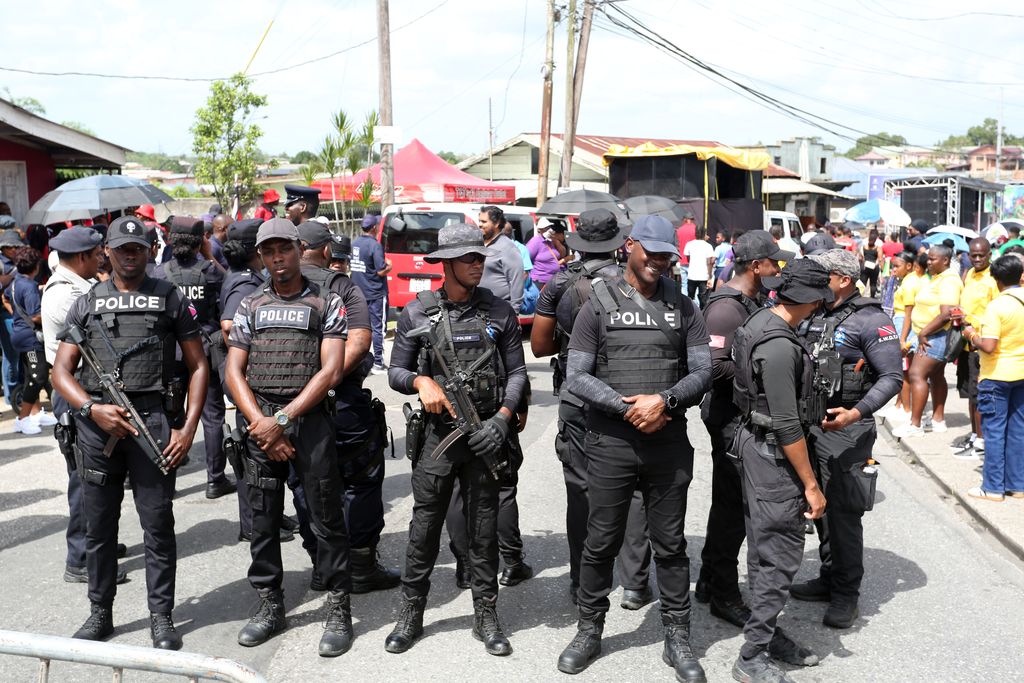
Between 2017 and 2026, the T&T Police Service (TTPS) has accumulated over $3.7 billion in overtime for its 7,884 officers.
While the TTPS’s overtime expenditure for its monthly-paid officers was estimated at $400 million in this year’s fiscal package, an additional $120 million was requested during last week’s Mid-Year Budget Review to pay outstanding overtime to law enforcement officers for two previous years.
This figure could be the largest overtime bill for the TTPS, as the country grapples with an extended State of Emergency (SoE).
Last year, taxpayers spent a revised estimate of $411 million on overtime for officers, during a year that recorded 359 murders, the lowest since 2011 under Guevarro’s watch, who marked one year in office on June 17.
A month after assuming office, Guevarro advised the Government to declare an SoE after receiving credible information about a crime syndicate involving prison officers.
The TTPS utilised the extra powers under the SoE to remove criminals from the streets and reduce serious reported crimes from 3,413 in 2025 to 2,397 in 2026 for the same period.
Violent crimes dropped from 1,219 in 2025 to 829, a 32 per cent national reduction.
There was also a 32 to 41 per cent reduction in serious reported crimes in six divisions.
A breakdown of the overtime bills in the ten years showed that the TTPS expended $418 million for its officers in 2024, marking it as the deadliest year in the country’s history with 615 murders.
The lowest overtime paid was in 2019, 2020 and 2021, with police officers pocketing $311 million, $313 million and $318 million, respectively.
In 2022, the overtime bill rose to $357.4 million, coinciding with 605 recorded murders, the second-highest total to date.
An overtime payout of $377.8 million was made in 2023.
Police officers collected $396 million and $366 million in 2017 and 2018, respectively.
In the 2026 budget, the TTPS was allocated $2.6 billion to pay its sanctioned strength of police officers, maintain law and order, prosecute offenders and prevent and detect crime.
The TTPS has nine divisions and 18 branches, squads and units.
On Friday, June 12, during the Standing Finance Committee of Parliament, MP for Port-of-Spain North/St Ann’s West Stuart Young challenged Homeland Security Minister Roger Alexander over the proposed increase in police overtime spending, questioning whether the figure was justified and how it compared to salary costs.
Alexander said the figure had to be viewed in context, adding that it was actually lower than the previous year and reflected wider pressures within the service.
Young compared the overtime figure to the TTPS’s $1.2 billion salary costs.
“So you are telling the population that the police service is running an overtime bill of $500 million, whereas the normal salary is just $1.2 billion?” Young asked.
On Monday, Arouca/Lopinot MP Marvin Gonzales described the TTPS’s $500 million overtime bill for 2026 as “nothing but a scandal” in the House of Representatives.
“You cannot have $500 million of taxpayers’ money being burnt up in overtime.”
He said something must be wrong for the TTPS’s management to approve such a significant overtime bill.
“Is it as a result of the SoE that has been in place for almost a year? Is it that police officers continue to accumulate huge amounts of money or hours in overtime because of extended hours?” asked Gonzales.
Gonzales, a former national security minister, wondered if police officers are spending so many hours working and claiming overtime.
“You have to ask yourself what is the state of mind and the quality of life for a lot of our law enforcement.”
The Opposition MP said if one organisation is accumulating half a billion dollars in overtime, we need to go deeper.
“Is it that we have abused the overtime?”
Given that the current murder rate had already reached 175, Gonzales said Parliamentarians need to scrutinise the overtime figures.
“We need to ask whether or not we are getting value for money because the detection rate in some divisions was poor.”
When he was appointed police commissioner in 2018, Gary Griffith said he rooted out overtime corruption in the TTPS.
The former top cop said a group of 300 officers claimed overtime for work they did not do.
These false claims were signed off by corporals, sergeants, inspectors and even an ACP.
“So everybody was getting a cut. And that is where I decided to micromanage it.”
Griffith claimed this was the reason why he was removed from office.
“The corrupt elements in the Police Service…there are rogue elements in the Police Service…I mean… it is a small percentage.”
These officers, he said, were taking home as much as $80,000 a month in overtime for years.
In a bid to put an end to the corruption, Griffith asked officers to undergo polygraph and drug testing.
Some officers were also transferred.
This led to officers pushing back.
“I stepped on many big toes in the Police Service. And because of that, that is where those officers formulate a plan to tell the government (PNM) that there was firearms corruption.”
His actions and interventions reduced the TTPS’s annual overtime bill from $400 million to $300 million.
The 100 police stations under Griffith’s control were also given an overtime cap.
Griffith said he had all boots on the ground during the pandemic and still managed to slash the overtime bill.
“During COVID, their (duties) were even more than what they had during the SoE,” Griffith pointed out.
A 2019 Public Administration and Appropriations Committee report on the expenditure and internal controls of the TTPS identified abuse of overtime duties by police officers, amounting to $33 million monthly.
The report stated that divisional commanders became accountable for assigning overtime duties to officers, thereby slashing the monthly overtime bill to $25 million without negatively affecting the Police Service.
President of the T&T Police Service Social and Welfare Association, ASP Ishmael Pitt, welcomed the supplementary allocation for police officers who have been working during the prolonged SoE with limited manpower.
In an SoE environment, Pitt said, the tasks and demands on an officer increase.
“At this point in time, we are under stress. We trust that within the shortest possible time, we would be able to come up to that strength to make it more manageable both for the organisation and the individual officer.”
While the TTPS is moving to bring new officers into the service, Pitt said the current strength has been “doubling up” on duties to get the job done.
Doubling an officer’s duties, Pitt said, can lead to burnout.
“It places management in a position where careful consideration must be given to our human resources. We have seen in recent times, police officers even taking their lives, in order to manage.”
He said officers who feel burned out, overwhelmed or unable to cope can apply for leave, reach out to their social workers or contact the association for help.
“What we have largely recognised is that a lot of officers may not necessarily feel comfortable reporting whatever circumstance they’re experiencing, for whatever reason.”
Asked if citizens were getting value for money with the billions spent on overtime, Pitt said, considering the TTPS has been operating with a shortage of officers, those on the force would have to go the extra mile.
“I think, given the capacity of the service at this point in time, strength-wise, citizens are getting value for money. Because I shiver to think, had it not been for the opportunity of police officers being able to double up and treat with the situation as it comes, how things would have been. We would have really been in a drastic situation, much worse than what we think we are in at this point in time.”
However, Pitt said there is room for improvement with appropriate staffing.
Criminologist Dr Randy Seepersad said the TTPS shortfall of officers has been contributing to its overtime bill.
He said the TTPS has been conducting several operations during the SoE, which would incur overtime costs for the service.
“When you put those two things together (staff shortfall and SoE)… It’s going to be a high overtime bill.”
He said hiring recruits can cut the overtime bill while easing the strain on officers who have been working beyond 40 hours per week.
In May, Homeland Security Minister Roger Alexander announced a phased, five-year recruitment drive to hire 2,316 new police officers. He said the expansion would increase the strength of the TTPS from 7,884 to 10,200 officers to improve response times and police visibility across the country.
At the University of the West Indies, where Seepersad works, he said that training a security officer for the campus is around $77,000.
“And training at the academy is far more expensive than what our officers on campus receive.”
Hiring and training, he said, is a slow process.
He cited a 2024 report on the Cost of Crime and Violence in Latin America and the Caribbean compiled by the Inter-American Development Bank, which showed that for every murder committed in T&T, it costs the State US$350,000.
He said, from removing the victim’s body to crime scene investigators collecting and analysing evidence, ballistic testing, the autopsy and police officers conducting their investigations, there is a heavy price tag attached.
He said if a suspect is arrested, charged and imprisoned, the State has to shoulder the legal and prison costs.
“When you start to think of crime happening in the hundreds… from murders, to sexual offences, robberies, home invasions…every offence…the cost of crime far outweighs anything you could pay the TTPS. People might watch it and say, wait, it’s so much money. Let me tell you, you’re still getting plenty value for money.”
Seepersad said one has to look at the overtime bill to determine if it is high or not.
On the issue of the large overtime bill the TTPS had so far racked up, Police Commissioner Allister Guevarro, in response to questions by Guardian Media last Thursday, said that the $120 million request for supplemental funding was “to pay overtime that was left outstanding for 2024 and 2025…so it was to pay bills.”
Looking at the current fiscal period, he said: “We don’t know at this point in time what the 2026 overtime bill will look like as yet.”
He explained that police officers have a six-month period to submit their overtime claims, which means the TTPS “will not know the full financial impact of the overtime bill as it relates to 2025/2026.”
Guevarro said with an annual overtime bill bordering on $400 million, “the cost to recruit and pay these officers is around 60 to 65 per cent of the annual overtime bills,” stating that “it makes more business sense to hire police officers to prevent the current officers from being overworked and overburdened and reduce the overtime bill.”
Out of 7,884 officers in the Police Service, Guevarro said they operate with a strength of between 4,000 and 4,500 law enforcement officers at any given time, which is woefully inadequate.
He said the TTPS needs to increase its operational strength to 10,200.
2026 – Estimated $500 M
2025 – Revised estimate $411 M
2024 – $418 M
2023 – $377.8 M
2022 – $357.4 M
2021 – $318 M
2020 – $313 M
2019 – $311 M
2018 – $366 M
2017 – $396 M
TTPS recurrent expenditure:
2017 – $2.6 B
2018 – $2.1 B
2019 – $2.1 B
2020 – $2.3 B
2021 – $2.2 B
2022 – $2.3 B
2023 – $2.6 B
2024 - $2.9 B
2025 – $2.5 B