
Senior Reporter
kay-marie.fletch[email protected]
Former finance minister Colm Imbert has accused the Government of dishonestly taking credit for Trinidad and Tobago’s improved Moody’s outlook from a negative to stable status, arguing that the international ratings agency’s decision was driven by higher oil and gas prices linked to conflict in the Middle East, rather than Government’s handling of the economy.
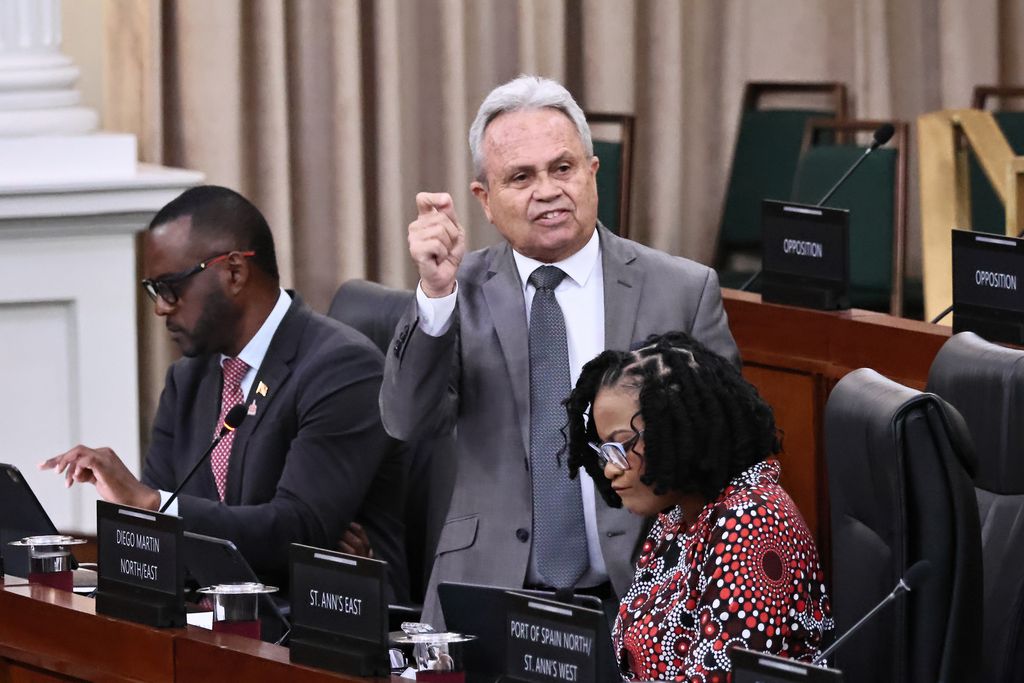
Contributing to the debate immediately following Finance Minister Davendranath Tancoo’s Mid-Year Review in Parliament yesterday, Imbert rebutted claims that there was an improvement thanks to the United National Congress (UNC).
He said T&T already held a stable outlook before it was revised to negative in December 2025, arguing that the latest adjustment returned the country to its earlier position.
“What the minister did not say is that when the UNC came into office, Trinidad and Tobago’s outlook was already stable, and they sent it negative.
“In December 2025, Moody’s reduced and revised T&T’s outlook from stable to negative. So, all that has happened is that we are back in the same place that we were in May of 2025. And why are we back in the same place? The minister said that the elevation, I don’t understand what that means, because he sent us negative, we now come back stable, is due to the great fiscal and financial management of the UNC Government. That is simply not true.”
He said the increase in energy prices was solely linked to the war in Iran.
Imbert also accused Government of understating the State’s finances, saying it had deliberately projected a false deficit that would later require billions in supplementary funding.
“What’s abnormal is that a Government cooks the books, projects a false deficit, knowing fully well that they have to come back later in the year and supplement the appropriation by billions of dollars. That is abnormal, and the minister is now confessing that the deficit this year will be at least $7 billion. I suspect it will be more.”
Imbert also rejected Tancoo’s claims that the economy is showing resilience, referencing data from the Central Bank he said indicates a weakening non-energy sector.
He said over the last year, several key indicators have declined, including cement sales, signalling a slowdown in construction activity.
Imbert also pointed to a contraction in the non-energy sector of as much as ten per cent, and warned that other indicators, including credit growth and the local stock market, were also declining.
“When you go and check the Central Bank reports, when you go and check the review of the economy published in 2025, we are seeing this ... that the index of retail sales fell year on year in fiscal 2025, a third straight negative quarter.
“Cement sales dropped to 92,000 tonnes by the end of 2025, the weakest in the series, confirming the construction slowdown ... Retail sales are down. Cement sales are down. Construction has slowed down. And what you are seeing is a contraction in the non-energy sector. You have a situation where the non-energy sector is contracting by as much as 10 per cent. So, all this set of old talk, if that war did not occur in Iran, what will be the Government telling us today?”
He added, “The worst-performing sector of our economy, which was the best-performing sector of our economy under the PNM, is the non-energy sector. Credit and money are decelerating. Private sector growth is slowing. It’s slowed from eight per cent to five per cent. The local equity market, which is an indication of confidence in the economy, the Stock Exchange, has dropped 12.5 per cent in total value year on year under them.
“Look at bank shares, look at shares of conglomerates, look at shares of manufacturing companies. They have all collapsed under this Government over the last 12 months.”
Imbert also noted a decline in foreign exchange reserves, which he said had fallen to the lowest level in more than 15 years at approximately US$4.7 billion.
While acknowledging a temporary boost from recent international borrowing, he warned that upcoming debt obligations would place further pressure on reserve levels.
Further criticising the Government’s $2.9 billion supplementary appropriation, Imbert said the majority of the funding was allocated to transfers, subsidies and statutory bodies, with only a limited portion directed towards development spending.
Imbert also questioned why the Government has not yet operationalised its $475 million employment fund, saying the delay means a key promise to support workers has not been delivered.
He added that the Government had nothing in place to help stimulate small businesses.
He said the war will soon come to an end, and he questioned what will happen when the price of oil returns to what it was.
He said the supplementation will do nothing to help T&T.