
OTTO CARRINGTON
Senior Reporter
otto.carring[email protected]
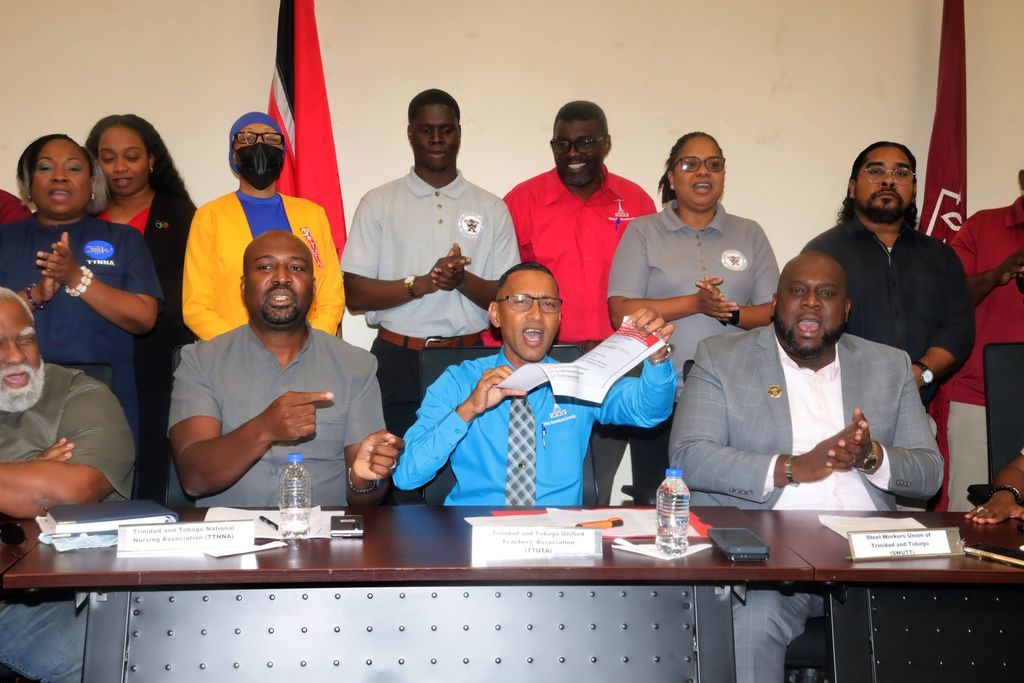
Thirteen trade unions, calling themselves the Progressive Independent Trade Unions, are now threatening legal action against the Government over the State of Emergency (SOE) regulations that restrict public protests at 15 designated locations nationwide. The unions warn that the measures undermine constitutional freedoms and severely limit traditional labour rights.
The unions held a news conference at the Trinidad and Tobago Unified Teachers Association (TTUTA) head office in Carlsen Field, where TTUTA president Crystal Ashe said they will not be silenced. He said the unions are prepared to act within the law if the regulations are not revised.
“We will not be moved. We will do what is necessary, all within the ambit of the law. I want to be very clear on that. We would have sought legal counsel before we came here. We didn’t just come here by vaps, we are here to explain to you, the national community, what is taking place,” he said.
Tearing up a copy of Legal Notice No. 40 of 2026, which lists the 15 State facilities where protests and demonstrations were not allowed, Ashe said the regulations effectively cripple the trade union movement.
“Every day that goes by, it basically puts a spoke in our wheel as trade unionists. We cannot do that which we must”, he said.
The locations where protests are prohibited are the Parliament, the Office of the President, the Office of the Prime Minister, the Diplomatic Centre, the Office of the Attorney General, the Ministry of Finance, the Ministry of Defence, the Ministry of Homeland Security, the Trinidad and Tobago Police Service Headquarters, the Trinidad and Tobago Defence Force Headquarters, the Trinidad and Tobago Prison Service Headquarters, the Office of the Director of Public Prosecutions, Piarco International Airport, ANR Robinson International Airport, and the Port Authority.
The legal notice was issued after protests following the police-involved fatal shooting of Joshua Samaroo and the announcement of charges to be laid against his partner, Kaia Sealy.
Steel Workers Union president Timothy Bailey stressed that the labour movement was not in conflict with the Government but was responding to what it saw as a constitutional overreach arising from the regulations.
He said the introduction of the 15 restricted protest zones stripped workers of a key negotiating tool.
“What has been done with the introduction of these 15 zones is to remove from workers who are working in essential industries their right to properly negotiate, because removal of the right to this tool, which may be picketing, marching or demonstrations, is to remove the right to leverage your point,” he said.
He claimed the regulations appeared to have been rushed and could benefit from review.
“And we are saying that it doesn’t appear that a lot of thought went into the forming of this legislation. And we are saying nothing is wrong; we are all human. We know the Attorney General is a well-renowned lawmaker. I don’t know if this did not pass before his desk,” he said. “We are saying if you, unfortunately, didn’t think about what we have mentioned today, please go back to the drawing board”, Bailey said.
He urged that amendments be made to preserve the rights of workers and activists.
Ashe added that the coalition had taken legal advice before addressing the public and was prepared to escalate the matter if necessary.
Meanwhile, Ashe clarified that while the Joint Trade Union Movement (JTUM) was not formally part of the announcement, there was no disagreement between the umbrella union and the coalition, even though JTUM leader Ancel Roget was notably absent.
The Oilfield Workers Trade Union, which Roget also leads, has supported the United National Congress Government.
But hours after the announcement, JTUM, in a statement, strongly condemned Legal Notice No. 40 of 2026 issued by the Commissioner of Police, which establishes 15 designated no-protest zones across T&T with a 500-metre exclusion radius.
The statement issued by JTUM Secretary, Ozzi Warwick, stated that while the union supports the State of Emergency to combat crime and violence, it argued that the order represents an overreach of authority that infringes on citizens’ constitutional rights and undermines the ability of trade unions to engage in lawful and peaceful protest.
JTUM warned that the restrictions could be expanded arbitrarily and said there is no evidence that the labour movement has acted unlawfully to justify such measures.
He further stated that the provisions go beyond the scope of the current SoE and called for Legal Notice No. 40 of 2026 to be immediately rescinded, arguing that sufficient emergency powers already exist for law enforcement to maintain public order.
• ↓Steel Workers Union of Trinidad and Tobago (SWUTT)
• ↓Communications Workers Union (CWU)
• ↓Trinidad and Tobago Nurses and Nursing Assistants Association (TTNNA),
• ↓Seamen and Waterfront Workers’ Trade Union (SWWTU)
• ↓Estate Police Association (EPA),
• ↓Aviation, Communications and Allied Workers Union (ACAWU)
• ↓Trinidad and Tobago Airline Pilots Association (TTALPA)
• ↓Banking, Insurance and General Workers’ Union (BIGWU)
• ↓Trinidad and Tobago Unified Teachers Association (TTUTA)
• ↓Contractors and General Workers’ Trade Union (CGWTU)
• ↓Maxi Taxi Association of Trinidad and Tobago
• ↓Prison Officers’ Association (POA) and
• ↓Amalgamated Workers Union (AMU)