
The U.S. government on Thursday announced sanctions against Cuba’s state-owned oil and gas company in a move some experts say will only deepen the island’s crises and hit vulnerable Cubans the hardest.
U.S. Secretary of State Marco Rubio asserted that key assets of the company, known as Cupet, were “unlawfully expropriated from American owners years ago.”
He also accused Cuba’s government of weaponising energy.
“While the Cuban people have suffered fuel shortages and blackouts because of decades of under-investment in critical infrastructure, Cuba’s Communist leaders have diverted energy resources to line their own pockets,” Rubio said in a statement.
He further noted, without providing evidence, that Cuban officials “resell countless barrels of scarce energy on the secondary market, hoarding energy supplies for its military, intelligence and repressive forces, and rationing energy as a tool of social control.”
The Cuban government did not immediately respond to a message seeking comment. It has previously said that sanctions punish all Cubans and are aimed at strangling the economy to destabilise both the government and its people.
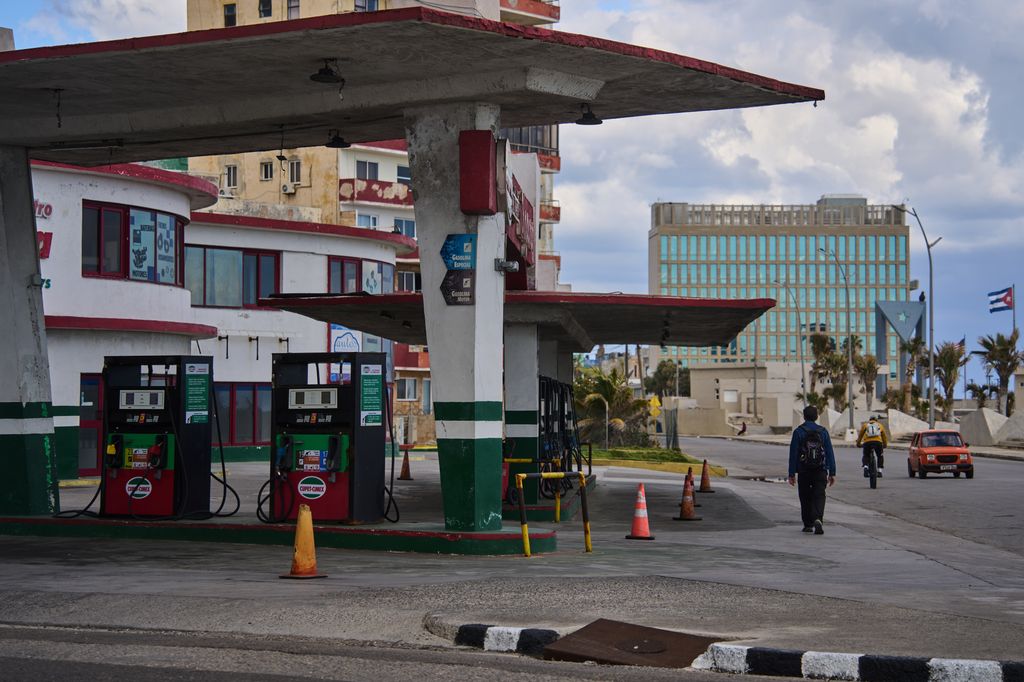
Cupet’s fuel sales to the public are almost non-existent and are currently rationed.
William LeoGrande, an expert on Cuba at the American University in the United States, said the latest U.S. measure seems like an effort to block any major oil shipments.
“It appears that they’re all in on strangling the Cuban economy,” he said. “Their policy is a contradiction. They claim they don’t want to create a humanitarian crisis, although that’s exactly what they’re doing.”
Ricardo Herrero, a Cuban economist based in the U.S. and executive director of the Cuba Study Group, a non-partisan organisation based in Washington, D.C., said he was “genuinely vexed” by the move.
“How are private importers supposed to store diesel and get it into vehicles without using CUPET facilities?,” he wrote on X. “This undermines what, until this morning, had been a humanitarian priority for the US. Either something much bigger is afoot, or we’ve entered the ‘indiscriminate cruelty’ phase of this policy.”
It’s unclear whether Cupet has any assets in the U.S., although it’s unlikely, LeoGrande said.
He said he could understand the logic of the measure to decentralise the government and strengthen and empower the private sector by enabling it to sell gasoline to state enterprises, or force those enterprises to move toward privatisation so they could be oil recipients.
“Now, the Cubans are not going to privatise Cupet in the hope that might work and that somehow the U.S. might allow oil to go through in that way,” LeoGrande said.
He noted that most private businesses in Cuba are small and don’t have the infrastructure to land an oil tanker, unload the product and distribute it.
“They’re running a huge risk of triggering mass migration,” he said of the U.S. government.
Thursday’s announcement comes almost a week after the U.S. government sanctioned Cuban President Miguel Díaz-Canel and other officials, as well as several institutions.
Rubio said in a statement that all property or interests of Cupet located in the U.S. or in possession or control of U.S. people are blocked.
“President Trump wants a new future for the Cuban people with greater economic and political freedom and opportunity,” Rubio wrote on X. “Until then, we will continue to target the Communist regime’s ability to leverage its energy trade to further its corrupt agenda and violently repress the Cuban people.”
Cuba is already struggling under a decades-old embargo and a lack of petroleum as the U.S. keeps pushing for a change in its economic and political model.
Power outages — already common given the economic and energetic crisis gripping the island for the past five years — have only intensified since U.S. President Donald Trump threatened tariffs in late January on any country that sells or provides oil to Cuba.
Both countries have acknowledged that they’ve held talks, but the scope of them is unknown.
Meanwhile, Trump has been threatening military action in Cuba ever since the U.S. military invaded Venezuela and arrested former President Nicolás Maduro.
Last Thursday, Trump said Cuba has “sort of collapsed” and said “we’re going to handle that as soon as we’ve finished” military operations in Iran. —SAN JUAN, Puerto Rico (AP)
_________
Story by DÁNICA COTO | Associated Press
Related News
Nurses consider protests at ministers’ homes over restrictions

DNRF warns sawmill operators of penalties for non compliance
Attorneys back DPP and warn: Public commentary risks fair trial in Sealy case