
Radhica De Silva
Migrants considering illegal entry into the United States through maritime routes are being warned that criminal networks transporting people by sea often place little value on human life, with some smugglers locking women and children into confined spaces or abandoning passengers when danger arises.
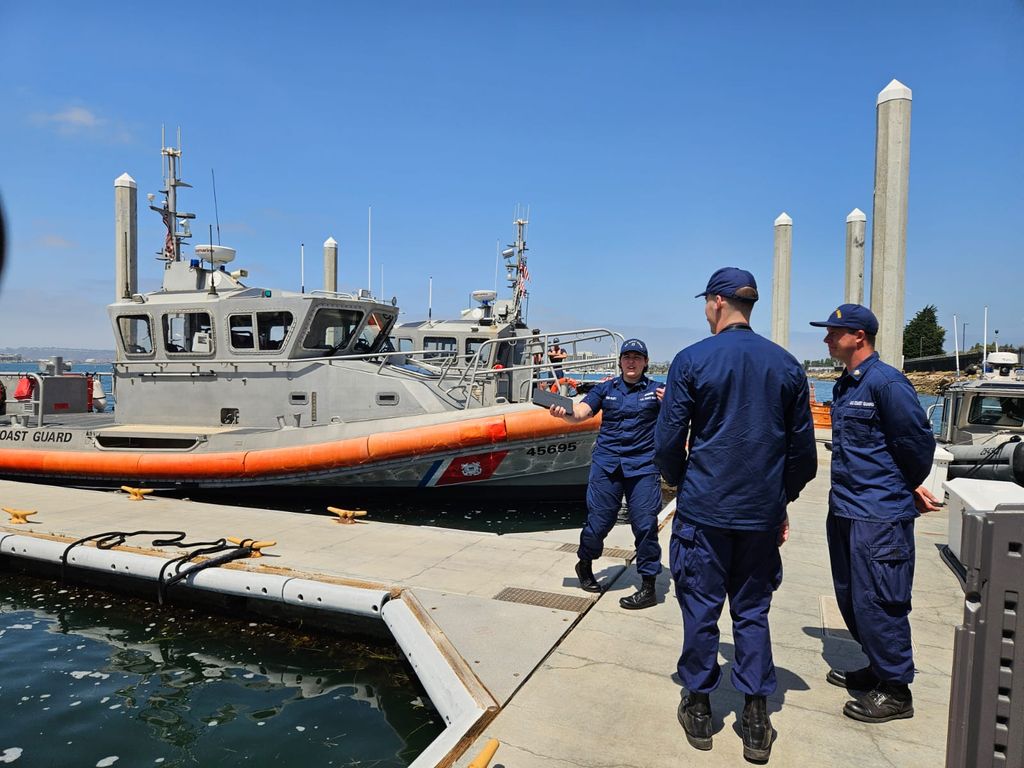
Speaking during a media briefing and demonstration in San Diego Bay on Thursday, Justin Brooks said migrant smuggling operations have repeatedly created life-threatening situations for people paying thousands of dollars to make the journey.
The warning comes as the US Coast Guard and Border Patrol continue expanding maritime enforcement using fast interceptor vessels, aerial surveillance, and technologies, including artificial intelligence-supported monitoring systems and sensors designed to detect illegal crossings.
Brooks said some of the most troubling cases involved migrants being treated as cargo rather than people.
He described one interdiction where authorities stopped a vessel carrying migrants hidden below deck in dangerous conditions.
"We had one instance where they crammed about 10 people into a forward compartment. Women and children were a part of that group, and they shut the door and had it padlocked," Brooks said.
Authorities said only two suspected smugglers were visible on the vessel while the migrants remained trapped below deck and unable to escape if an emergency occurred.
"If that boat starts taking on water or starts to sink, those individuals are locked in there," he said.
Brooks said such incidents create a dual responsibility for Coast Guard crews.
"We're charged with maritime border security, but we're also in charge of search and rescue operations," he said.
He said many operations take place at night, with officers pursuing vessels in difficult offshore conditions.
Brooks said illegal maritime migration had previously become significantly more active, with swimmers, jet skis, pleasure craft, and larger panga vessels regularly attempting to evade authorities.
According to Brooks, stronger enforcement and the perception of a greater risk of being caught appear to be discouraging crossings.
Migrants often pay thousands of dollars to smugglers or cartel-linked operators for passage, money that is lost if they are intercepted.
"Why are you going to waste money if you're hearing all the stories that the Coast Guard's much more effective at stopping it?" he asked.
Brooks also issued a direct warning to those considering the journey.
"Don't do it. It's unsafe. You're risking your life," he said.
"Do it in as legal ways as possible. Do not do it in illicit means, especially on the water.
Meanwhile, Christopher Cumberland said enforcement agencies use networks of radar systems, cameras, thermal imaging devices, aircraft, and other sensors to monitor activity at sea.
He said smaller vessels, including jet skis, remain difficult to detect because they can evade traditional radar systems.
"You're relying on cameras, FLIR, and visual cues," Cumberland said.
Authorities are also using newer technologies, including unmanned systems and AI-supported surveillance capabilities, to identify suspicious activity.
Cumberland said unmanned surface vessels and drone technology can remain deployed for extended periods and alert authorities when crossings occur.
Despite technological advances, he said the size of the maritime area remains one of the greatest challenges.
He described waters off Southern California as comparable to searching for "a needle in a haystack", where a single smuggling vessel can blend into large volumes of legitimate traffic.
"It's a square mileage problem," he said.
Cumberland added that increased resources and sustained enforcement have significantly reduced attempted crossings.
International journalists from Colombia, The Gambia, Kenya, Peru, Spain, the United Kingdom, Nigeria, Malaysia, Pakistan, Chile, India, and Germany have been touring border areas between Mexico and the United States. The visit was organised by the US Department of State Foreign Press Centre and coordinated by Meridian International Center.
Radhica De Silva is on assignment as part of the United States Foreign Press Centers’ Securing Our Borders reporting tour.
Related News

Tourism leaders push logistics network to keep tourism dollars in the region
“A waste of $60,000 a month”; PNM deputy leader slams Alexander’s ZOSO remarks

Industrial Court judge Bindimattie Mahabir dies