
As the Caribbean lags behind the rest of the world in adopting renewable forms of energy, the International Renewable Energy Agency (IRENA) will launch a Latin Ameca and Caribbean initiative this October.
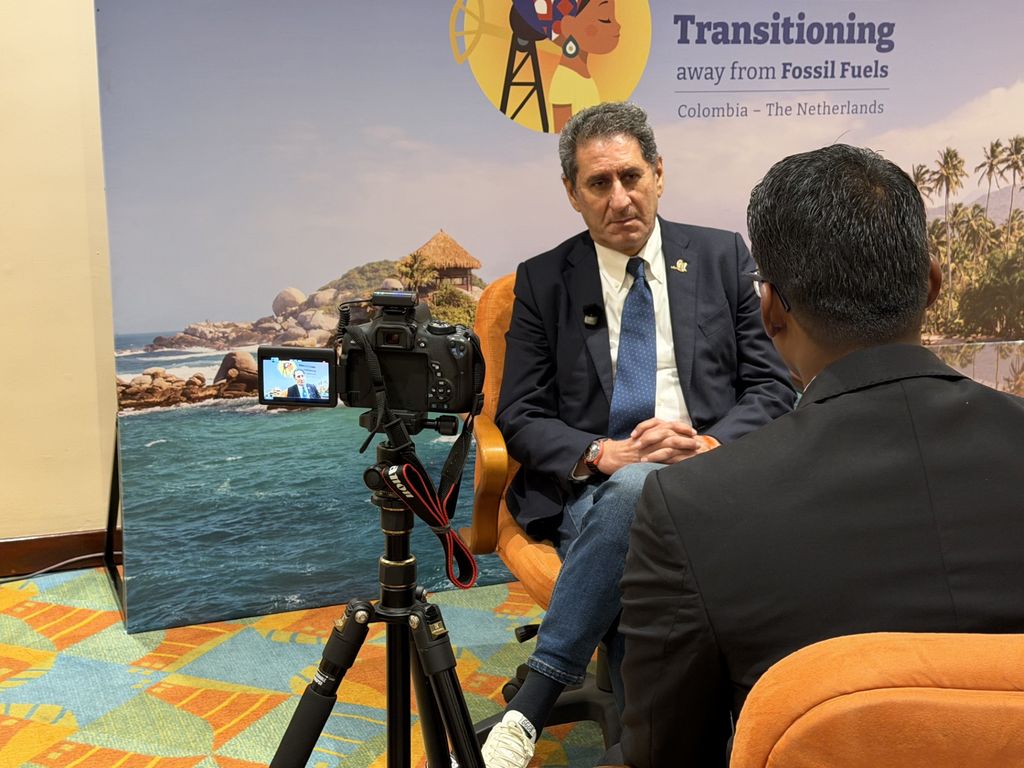
This was revealed by IRENA’s Director General, Francesco La Camera, in a sit-down interview with the Sunday Business Guardian at the First Conference on Transitioning Away from Fossil Fuels in Santa Marta, Colombia, last week.
Statistics in a 2026 report by IRENA show this region, and particularly Trinidad and Tobago (T&T), is far behind in the adoption of renewable sources of energy.
Between 2016 and 2023, T&T’s capacity stayed around 4–5 MW before a sharp jump in 2025 to 97 MW. Researcher and senior climate change and energy efficiency specialist, Professor Donnie Boodlal, said this sudden jump was mainly driven by the Brechin Castle Solar Project. It is the 92 MW facility in Couva developed through a joint venture between bp, Shell, and the National Gas Company (NGC).
“As of December 2025, they achieved a grid tie-in of the facility and that’s why in the year 2025 in the report the solar generation renewable energy capacity of T&T increased significantly,” Boodlal said.
Among Caribbean nations, the Dominican Republic leads the way in renewable energy with 3,274 MW, Puerto has achieved 1,591 MW while Jamaica has 281 MW.
La Camera said, “In October, we will launch an initiative for Latin America and the Caribbean. This initiative will allow us to have encounters with the governments, support them in their planning, supporting in the building of their energy plan, and then from the energy plan there can be projects that we can help countries to make mature to become bankable.”
He said this has proven to be useful for some centralised countries already.”
When asked what the main hindrance is in helping small islands states like those in the Caribbean achieve greater access to renewable energy, he added, “Sometimes it is the size of the islands that are not available for bankable projects. In other countries, sometimes they lack capacity. The fact that the infrastructure is not there for making electrons to be distributed to people. The infrastructure is crucial. The cost of the money is too high. The cost of the money is the illness for the symptom.”
Some Caribbean nations spend up to 13 per cent of GDP on oil imports. The Iran conflict sent the price of oil as high as US$126 a barrel in April. In an interview last month, executive director of the Caribbean Centre for Renewable Energy, Dr Mohammad Nagdee, said the crisis in the Middle East had an immediate impact on the pockets of Caribbean people.
However, the global picture of renewable energy is far more encouraging. Last year saw total renewable power capacity reach 5,149 gigawatts (GW) after the addition of 692 GW. That was a 15.5 per cent annual increase. In line with the previous year, solar energy led the increase, accounting for 511 GW or approximately 75 per cent of the total renewables’ capacity addition.
Wind energy followed suit, adding 159 GW. Together, solar and wind accounted for 96.8 per cent of all net renewable additions last year, reflecting the biggest cost decrease among all renewable technologies. Bioenergy took the third place with 2.3 per cent annual growth, adding 3.4 GW to total renewable energy expansion.
Asked to comment about the imbalance in access to renewable energy between the Global North and South countries, La Camera said, “We should not say it [the renewable energy imbalance] is what is happening, but it is what we have to avoid. We are working on a regional approach just to do our task in making it possible for the transition reaching the smallest village in Africa or south-east Asia.
“We have a regional initiative in Africa and south-east Asia, and we are opening one for Latin America and the Caribbean. What we have to understand is that we have to link the idea of the development to the building of the new infrastructure that will sustain the energy system that is coming.”
He warned oil and gas-based economies like T&T, Guyana, and Suriname that there is a higher cost to keep counting on fossil fuels as opposed to using the revenue earned to transition with the rest of the world.
When Boodlal was asked if he was concerned by this country’s slow transition to renewable energy, he stated, “Yes - but it needs context. T&T is structurally different from many countries in accelerating renewables. It is a gas-based economy with relatively cheap, domestic energy, which weakens the financial case for rapid renewable substitution. There has historically been policy hesitation rather than resource constraints.”
He went further in adding, “The slow pace does carry risks. There is a competitiveness risk. Energy-intensive industries may face carbon-border adjustments in export markets. There is an investment signal risk. Global capital is shifting toward low-carbon systems; lagging frameworks can deter investors. There is an energy security diversification. Over-reliance on gas leaves the system exposed to volatility in prices. If the current momentum is sustained and scaled, this country can still transition effectively - but the window to do so competitively is narrowing.”
It’s a point La Camera emphasised in the interview. When asked whether the Iran conflict will permanently change some countries’ reliance on oil and gas, the Italian said, “When people were describing this as the most severe energy crisis in recent times, I say it is not the most severe. It is the definitive crisis of a centralised energy system based on fossil fuels. It is evident the energy security should be pursued through a system that is not centralised, so not based on fossil fuels but based on renewables. This is crystal clear to everyone now.”
Among the key outcomes emerging out of the conference in Santa Marta last week include collaboration to build national and regional fossil fuel phase-out roadmaps (including links to NDC climate commitments), trade policies, and Ireland and Tuvalu were announced as co-hosts of the 2027 Second Conference on Transitioning Away from Fossil Fuels, with the conference taking place in Tuvalu.
La Camera said the discussions at the conference in Colombia were important.
“This conference has been crucial in my point of view. It has given a sign to the world. I think we will be in Copenhagen shortly to provide a concrete follow-up of this conference presenting our analytical work. That would be the first concrete result of the willingness that came from all the delegates participating in this conference.”
For T&T and the wider Caribbean, the challenge now is whether ambition can move faster than dependence on fossil fuels. While projects like Brechin Castle signal progress, experts warn the region risks falling behind as global investment increasingly shifts toward low-carbon economies. With oil prices vulnerable to geopolitical shocks and climate pressures intensifying, the message from Santa Marta was clear: the transition is no longer a distant environmental goal, but an economic and energy security imperative for the Caribbean’s future.