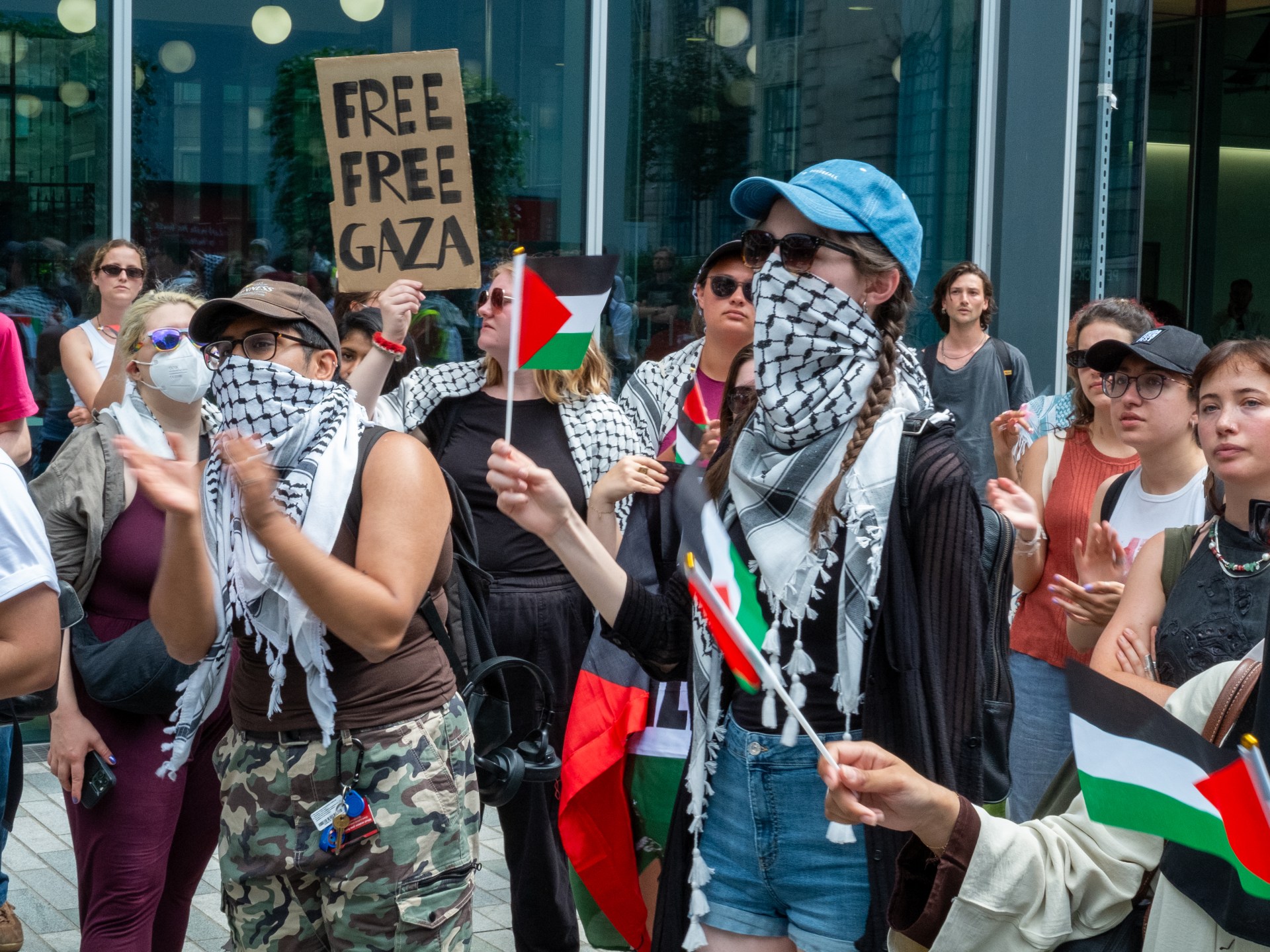

London, United Kingdom – Twelve British universities paid a private firm run by former military intelligence officials to “spy” on student protesters and academics, including those who have expressed solidarity with Palestine, it can be revealed.
A joint investigation by Al Jazeera English and Liberty Investigates has uncovered evidence that Horus Security Consultancy Limited trawled through student social media feeds and conducted secret counter-terror threat assessments on behalf of some of Britain’s most elite institutions.
- list 1 of 4The attack on the right to protest in the UK is not just about Palestine
- list 2 of 4Blood tech: UK’s use of Israeli spyware that helps underpin a genocide
- list 3 of 4The Gaza Tribunal: A question of complicity
- list 4 of 4‘Index of Repression:’ documents 964 anti-Palestinian cases in the UK
end of list
Horus, which describes itself as a “leading intelligence” firm, has been paid at least 440,000 pounds ($594,000) by universities since 2022.
Among those monitored were a Palestinian academic invited to give a guest lecture at Manchester Metropolitan University and a pro-Gaza PhD student at the London School of Economics, according to internal documents.
In October 2024, the University of Bristol provided the firm with a list of student protest groups it wished to receive alerts about, an internal university email suggests. It included pro-Palestinian and animal rights activists.
In total, 12 universities paid the firm to monitor campus protest activity. Others include the University of Oxford, Imperial College London, University College London (UCL), King’s College London (KCL), the University of Sheffield, the University of Leicester, the University of Nottingham and Cardiff Metropolitan University.
There is no suggestion that this activity is illegal.
These findings have come to light after Al Jazeera English and Liberty Investigates submitted freedom of information (FOI) requests to more than 150 universities.
Advertisement
All the institutions named in this article were approached for comment by Al Jazeera and Liberty Investigates.
The University of Oxford, UCL, KCL, the University of Leicester and the University of Nottingham did not respond to requests for comment.
The University of Sheffield said it used external services to “horizon scan” for issues which may affect the university, such as large-scale upcoming protests, and that it was “incorrect” to suggest this was intended to discourage activism. It added that it did not share student data with Horus or brief it to monitor individuals, and its priority is to maintain a safe environment while supporting lawful protest.
Imperial College London denied that the services it pays Horus for constitute the surveillance of students. It similarly said it is committed to free speech and that it uses Horus to “help identify potential security risks to its community, which might include protest activity within the vicinity of its campuses. All this information is drawn from the public domain”.
Horus was established in 2006 as a project within the University of Oxford’s security team by former Lieutenant-Colonel Jonathan Whiteley, who boasts a “23-year career running security, intelligence and counter-intelligence operations all over the world”, according to the company’s website.
In 2020, Colonel Tim Collins became a director of its parent company. He is currently listed on the website as one of four senior leaders of the company who “bring all of [their] extraordinary experience and expertise to Horus, on behalf of our clients”, and has given multiple speeches at conferences for university security teams on behalf of the firm.
In recent years, he has publicly blamed the rising number and size of pro-Gaza demonstrations in Western countries on a “Russian/Iranian orchestrated media campaign”. He has further called for non-British protesters “who misbehave” to be deported from the UK.
The firm was paid a total of 443,943 pounds ($587,399) between January 2022 and March 2025 to provide intelligence to universities in the UK on a range of areas.
The company offers a service called “Insight”, providing clients with open-source intelligence reports compiled using a tool it has developed to “harvest a vast range of sources on the internet”. According to its website, it has been integrating AI into its operations since 2022.
‘Profound legal concerns’: UN special rapporteur
Gina Romero, the UN special rapporteur for freedom of peaceful assembly and of association, said: “The use of AI to harvest and analyse student data under the guise of open source intelligence raises profound legal concerns.”
Advertisement
It allows for disproportionate amounts of data on students to be collected by companies that are free from public scrutiny, and can be used for purposes they cannot foresee, she explained.
Al Jazeera approached Horus by email and phone on March 31, April 1, 7 and 8, as well as reaching out to Whiteley by email on April 7 and Collins by email and LinkedIn on April 8.
Despite these repeated requests, Horus did not respond to Al Jazeera’s questions about the allegations listed in this article. On its website, Horus states that it adheres to “the strongest ethics in whatever we do, and are fully transparent and legally compliant in whatever territory we operate in.”
Seven of Horus’s university clients refused freedom of information requests from Al Jazeera and Liberty Investigates for copies of the briefings they have received from the firm. Four said they were confidential – despite ostensibly being based on information already in the public domain.
Six argued that making them freely available would undermine Horus’s business model. Section 43 of the UK FOI Act does provide an exemption allowing public bodies to refuse to disclose information considered commercially sensitive. This could be information that would prejudice a third party’s commercial interests, such as contractors like Horus.
But other documents and emails obtained via FOI from three universities – Bristol, LSE and Manchester Metropolitan – shine some light on the role the private intelligence company plays in Britain’s crackdown on campus activism.
Jo Grady, general secretary of the UK’s largest union for lecturers and university staff, the University and College Union (UCU), told Al Jazeera it was “shameful” that institutions had “wasted hundreds of thousands of pounds spying on their own students”.
‘Bespoke surveillance’
Lizzie Hobbs, a PhD student who took part in LSE’s month-long protest encampment in the summer of 2024, is among those whose social media posts were flagged to the university by Horus.
A wave of pro-Palestinian protest activity had begun on university campuses worldwide in late 2023, escalating during April 2024, as students demanded their institutions disclose and end any investments in companies considered complicit in Israel’s genocidal war on Gaza.
Liberty Investigates obtained a briefing sent to LSE’s security team on June 18, 2024, containing a post she wrote a day earlier on X, saying: “We may have been evicted, but we are more powerful and organised as a collective than we have ever been!”
Her post was one of thousands from students compiled into daily “encampment updates” and sold to universities for 900 pounds ($1,215) a month.
Hobbs only learned that her social media post had been flagged when Al Jazeera approached her for comment. She said: “We knew surveillance was happening by the university, but it is shocking to see how systematised it is”.
She added that it is “deeply scary” to see how much money universities are “willing to invest” for this purpose.
An email seen by Al Jazeera and Liberty shows that an LSE security officer forwarded the Horus briefing, which highlighted Hobbs’ X post, on to colleagues alongside the comment: “Apparently we were incredibly heavy-handed on the protesters!!”
Students had indeed accused their institution of heavy-handedness after it obtained a legal order to evict them from what they say was a non-violent building occupation calling for LSE to divest from Israel-linked companies. The university had described the protest as threatening and abusive.
Advertisement
LSE did not respond to our request for comment.
Another person subject to monitoring was Palestinian-American academic Rabab Ibrahim Abdulhadi. In 2023, she was invited to speak at a Manchester Metropolitan University (MMU) lecture series, to be held in June that year in memory of British student Tom Hurndall, who was killed by an Israeli sniper in Gaza in 2003.
Liberty Investigates obtained documents, including emails between Horus and university staff and a copy of the assessment Horus provided. Together, these show that on April 6, 2023, MMU asked Horus to conduct a secret counter-terror “threat assessment” on the 70-year-old Palestine studies scholar.
The UK’s 2015 Counter-Terrorism and Security Act requires universities to consider the risk of external speakers expressing “extremist” views, which could risk drawing people into terrorism. This requirement falls under the UK government’s Prevent counter-terror programme, and is the justification MMU provides for its actions. However, Amnesty International and several other rights groups have criticised the Prevent programme for disproportionately targeting Muslims and lacking transparency.
The San Francisco State academic was due to deliver a talk entitled “75 Years of Nakba, Sumoud and Solidarity: Honouring Tom Hurndall – Palestinian Martyr”. She said: “I was very happy to speak … it is really important to honour people who have given their lives expressing solidarity with Palestine”.
Abdulhadi said she was shocked when she heard about the threat assessment about her – also from Al Jazeera and Liberty Investigates: “You’re supposed to be innocent until proven guilty … but they actually made an assumption of guilt and started investigating me because of my scholarship”.
She added: “What am I supposed to study and teach about to avoid this unwarranted, unfair and unjust scrutiny and surveillance?”
Horus provided the university with a six-page report, in which it assessed her social media use as well as various allegations made against her by pro-Israel groups, on May 3, 2023. Abdulhadi has been able to obtain a copy of it using UK personal data laws.
It included reference to 2014 allegations of antisemitism against her, which were dismissed as meritless by her California university and the California state controller, as well as further allegations made in 2017, which were dismissed by a federal judge as lacking evidence.
An email between senior university officials, seen by Al Jazeera, shows that MMU ultimately allowed the lecture series event to go ahead on June 26 2023, in the Manton Building of MMU with “an appropriate security presence”. The university decided that there did not “seem to be any evidence to suggest [she] has been involved in groups that are proscribed in the UK”, and after Horus assessed there was a “moderate” risk of protest at the lecture which was “unlikely to be violent”.
Another email between senior MMU staff the following year stated the university had “commissioned Horus to do the due diligence on the speaker” for a different event, the details of which were redacted from the copy seen by Al Jazeera. The university declined to confirm if that was related to the following years’ memorial lecture, whose speaker was also Palestinian.
A spokesman for MMU told Al Jazeera: “To ensure the safety of our community and external speakers, we routinely undertake background checks and assessments ahead of events to identify any potential risks and inform any necessary security”.
Separately, the University of Manchester – a different university in the same city – confirmed to Al Jazeera that, since July 2023, it has commissioned Horus to conduct similar reports on two guest speakers coming to discuss “geopolitical issues”. The university refused to disclose the speakers’ identities or confirm whether they were Palestinian or held pro-Palestinian views.
Advertisement
Internal emails from University of Bristol staff to Horus reveal the institution has paid at least 8,700 pounds ($11,530) for a “bespoke” alert service covering “anything related to proposed student protest [and] encompassing all protest activity across the city” since May 2024.
The university provided the firm with a list of groups to monitor, which it redacted, citing personal data. It also disclosed an email staff subsequently sent to Horus, with the subject line “pro-Palestine protests”, asking for six animal rights groups to be included.
A University of Bristol spokesperson said the firm gathers “publicly available information on any protest activity by any group in the city that could potentially affect the safety of our university community”. They added: “It helps us to make informed decisions on where our security staff may be needed to provide support and if information needs to be conveyed to students and staff.”
A report by the European Legal Support Centre published in February this year found that academics and students were more likely to face repression for their pro-Palestine views than any other group in Britain.
Gina Romero, the UN special rapporteur for freedom of peaceful assembly and of association, said this “disturbing” surveillance by Horus has contributed to a “state of terror” she has witnessed among UK student activists.
She said: “Most students I have reached out to are experiencing psychological trauma, mental exhaustion, and burnout […] many of them are leaving activism altogether”.
A regular media commentator, Horus’s Colonel Collins was asked by Belfast newspaper News Letter in January 2024 why the Israel-Gaza conflict had sparked such widespread protest in comparison to other wars.
At the time, South Africa had just lodged its case at the International Court of Justice (ICJ), accusing Israel of committing genocide in Gaza, where the death toll had reached around 20,000 people, according to figures from the Gaza Health Ministry, which have since been accepted as “broadly accurate” by Israel. They currently stand at above 70,000.
But the former SAS soldier, himself from Northern Ireland, had a different take.
“What we’re seeing really is a Russian/Iranian orchestrated media campaign which is being willingly swallowed by the West,” he told News Letter.
Two months earlier, he had told the Express newspaper that pro-Palestine protesters who “misbehave” should “face the full consequences of the law … and those people who are not from this country should be deported until they can never come back”.
This article was produced as part of the Bertha Challenge Fellowship. Additional reporting by Zac Larkham and Joe Creffield.
Related News
Iran war: 10 frequently used words and their meanings
Trump says Israel and Lebanon’s leaders will speak on Thursday

World reacts to ‘brutal’ Israeli attacks on Lebanon amid US-Iran ceasefire