
U.S. President Donald Trump has announced an extension of the ceasefire in the Iran war, giving mediators additional time to arrange a new round of face-to-face talks between the U.S. and Iran.
Trump said he made the move, just hours before the current ceasefire was to expire, at Pakistan’s request as he waits for a “unified proposal” from Iran.
The announcement averted a resumption of fighting for the time being. But gaps between the sides remain wide, a planned trip to Pakistan by Vice President JD Vance to lead the American negotiating team remains on hold and a U.S. blockade of Iran remains in place.
Here’s what to know about where the ceasefire stands, the possible talks in Pakistan and other issues surrounding the war:
Ceasefire is extended, blame is exchanged
Two regional officials told The Associated Press on Tuesday that the United States and Iran had signalled they will hold a new round of talks. Pakistan-led mediators received confirmation that top negotiators, Vance and Iran’s parliament speaker Mohammad Bagher Qalibaf, were expected to lead their teams.
But late Tuesday, Iran’s Foreign Ministry spokesman said there was no “final decision” on whether to attend. The spokesman, Esmail Baghaei, told state TV that the lack of a decision was because of “contradictory messages” and “unacceptable actions” from the Americans, in particular the U.S. naval blockade of Iran.
Vance, meanwhile, called off a trip to Pakistan, as Pakistani leaders raced to try to salvage the talks. With a 0000 GMT deadline looming, Trump announced that the ceasefire would be extended indefinitely.
Trump said he had taken the step at Pakistan’s request and blamed what he described as Iran’s “seriously fractured” leadership for indecision. He said Pakistan had asked him to wait until Iran’s leaders “can come up with a unified proposal.” Still, he said the U.S. blockade would continue.
Even if Pakistan can arrange a meeting, serious challenges remain on the future of the Strait of Hormuz, Iran’s nuclear program and the blockade. Iran targeted ships in the strait over the weekend. The U.S. also attacked and boarded one Iranian vessel that tried to outrun the American naval blockade in the strait — signalling that the situation remains volatile.
A fragile ceasefire risks showing cracks
The U.S. and Israel launched the war on Feb. 28, opening a six-week war that has sent oil prices rising and shaken the global economy.
The current truce between Iran, Israel and the United States began April 8 after multiple deadlines posed by Trump that threatened Iran’s very “civilization” at one point. Last Friday, a ceasefire between Israel and the Iran-backed Hezbollah militant group in Lebanon also took effect. Both ceasefires have broadly held.
An earlier round of negotiations between Iran and the U.S. was held in Pakistan from April 11 into the early morning the following day. Vance took part in the highest-level talks between America and Iran since the 1979 Islamic Revolution, which ended without an agreement.
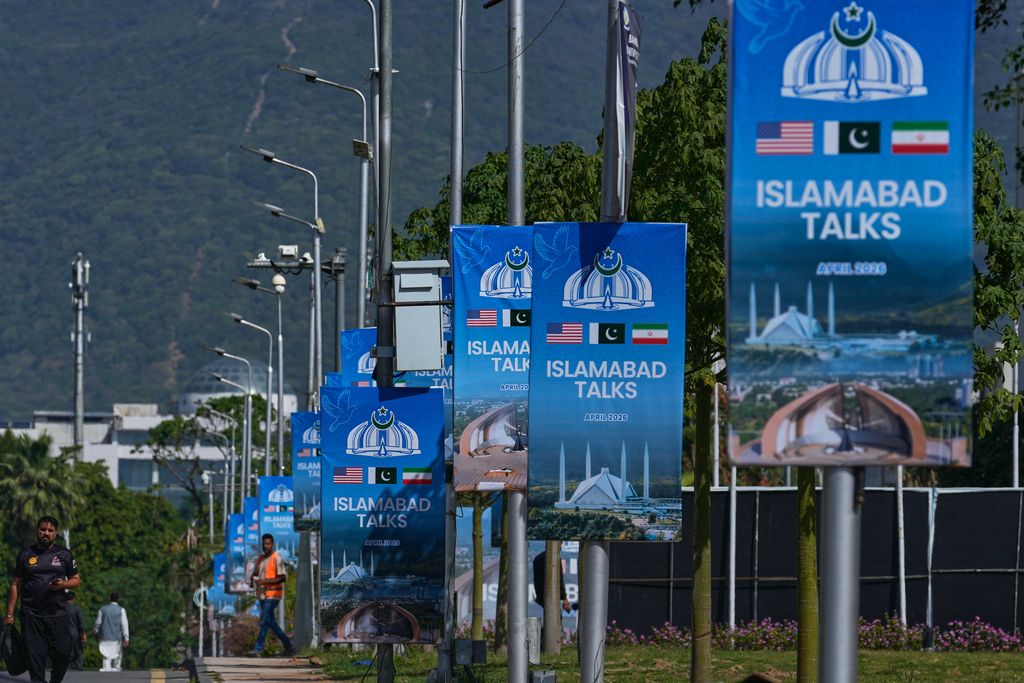
Since this weekend, authorities in Islamabad have made preparations similar to those that accompanied the first talks, suggesting another round loomed.
Strait of Hormuz remains effectively shut
The Strait of Hormuz, the narrow mouth of the Persian Gulf through which 20% of all natural gas and oil passes, remains effectively closed over Iranian attacks in the waterway. That included some attacks Saturday. There’s also a fear that Iran mined a portion of the strait used by transiting ships during peacetime.
Since the war, Iran reportedly has been charging as much as $2 million a vessel to allow them to pass. Opening the strait remains a key focus of negotiations and Tehran’s strongest leverage against Washington, particularly as countries around the world have begun rationing energy and warning of shortages of jet fuel.
The United States, meanwhile, has begun blocking ships from Iranian ports. The U.S. Navy attacked an Iranian container ship that tried to run through the U.S. blockade this weekend, with Marines rappelling onto it from helicopters. Iran has condemned the incident as “piracy” and a violation of international law.
Iran’s nuclear stockpile remains in country
All of Iran’s highly enriched uranium remains in the country, likely entombed at enrichment sites bombed by the U.S. during a 12-day war last June. Iran hasn’t enriched since then but maintains it has the right to do so for peaceful purposes and denies seeking nuclear weapons. Trump, along with Israel, has called for Iran to completely dismantle its nuclear program and give up its stockpile. Iran rejected that in its 10-point proposal for ending the war. —JERUSALEM (AP)
________
Story by JOSEF FEDERMAN | Associated Press
AP reporters Jon Gambrell in Dubai, United Arab Emirates, Aamer Madhani in Washington, Samy Magdy in Cairo and Munir Ahmed in Islamabad contributed reporting.
Related News

IATF seizes firearms, destroys cannabis trees
Suspect in Ghany Jr shooting returns to scene with police
Iran reopens Strait of Hormuz, but Trump says blockade on Iranian ships and ports will sta...