Venezuela’s top prosecutor orders the arrest of opposition leader’s ally, hours after his release
 09 February 2026
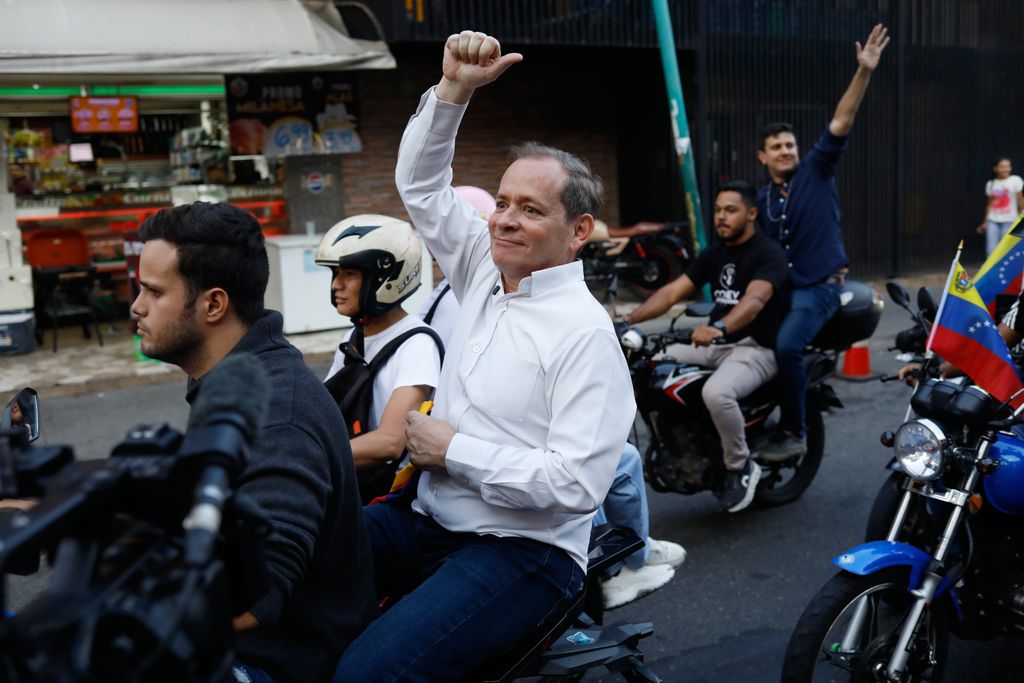

Venezuela’s top prosecutor said on Monday that his office had requested the arrest of one of the closest allies of opposition leader María Corina Machado, less than 12 hours after his release from a detention facility as part of a government move to free those facing politically motivated accusations.
The attorney general’s statement did not say whether Juan Pablo Guanipa was rearrested or give indication of his whereabouts.
The government had released him along with several other prominent opposition members on Sunday following lengthy politically motivated detentions.
Attorney General Tarek William Saab’s office posted on social media that it had “requested the competent court to revoke the precautionary measure granted to Juan Pablo Guanipa, due to his non-compliance with the conditions imposed by the aforementioned court.”
It did not elaborate on what conditions Guanipa, a former governor for the opposition, violated during the hours he was free, but said authorities were seeking house arrest.
Guanipa’s son, Ramón, told reporters Monday that a group of men in three vehicles intercepted his father and others traveling around 11:45 p.m. Sunday (February 8, 2026) in a neighbourhood in the capital, Caracas. They were armed with long guns and wore civilian clothes and bulletproof vests.
Ramón Guanipa said authorities have not yet notified him of his father’s whereabouts and their decision to place him on house arrest. He said his father did not violate the two conditions of his release — monthly check-ins with a court and no travel outside Venezuela — and showed reporters the court document listing them.
Prisoners released
The development marked the latest twist in the political turmoil in Venezuela in the wake of the U.S. military’s seizure on January 3, 2026, of then-President Nicolás Maduro and his wife, Cilia Flores, from a military base compound in Caracas in a stunning operation that landed them in New York to face federal drug trafficking charges.
The government of Venezuela’s acting President Delcy Rodríguez began releasing prisoners days after she was sworn in and has faced mounting pressure to free hundreds of people whose detentions months or years ago have been linked to their political activities. The releases also followed a visit to Venezuela of representatives of the U.N. High Commissioner for Human Rights.
Venezuelan-based prisoners’ rights group Foro Penal confirmed the release of at least 30 people on Sunday (February 8, 2026).
Some of those freed Sunday joined families waiting outside detention facilities for their loved ones. They chanted “We are not afraid! We are not afraid!” and marched a short distance.
“I am convinced that our country has completely changed,” Guanipa told reporters after his release. “I am convinced that it is now up to all of us to focus on building a free and democratic country.”
Guanipa had spent more than eight months in custody at a facility in Caracas.
“My father cannot be a criminal ... simply for making statements,” Ramón Guanipa said. “How much longer will speaking out be a crime in this country?”
Several members of Machado’s political organization were among the released Sunday, including attorney Perkins Rocha, and local organizer María Oropeza who, in 2024, had livestreamed her arrest by military intelligence officers as they broke into her home with a crowbar. Rocha was released to house arrest.
“They are terrified that Venezuelan society will mobilize and express its voice civically,” Machado, referring to Rodríguez’s government, told reporters Monday in Washington. “But let me tell you something, there’s no going back... What will Juan Pablo become now? What will Perkins become as a prisoner in his own home? A reference in this fight.”
Long detentions for political activities
Guanipa was detained in late May and accused by Interior Minister Diosdado Cabello of participating in an alleged “terrorist group” that was plotting to boycott that month’s legislative election. Guanipa’s brother Tomás rejected the accusation, and said the arrest was meant to crack down on dissent.
Rodríguez’s government announced on January 8, 2026, that it would free a significant number of those arrested — a central demand of the country’s opposition and human rights organizations with backing from the United States — but families and rights watchdogs have criticized authorities for the slow pace of the releases.
The ruling party-controlled National Assembly last week began debating an amnesty bill that could lead to the release of hundreds. The opposition and nongovernmental organizations have reacted with cautious optimism as well as with suggestions and demands for more information on the contents of the proposal.
National Assembly President Jorge Rodríguez, who is the acting president’s brother, on Friday posted a video on Instagram showing him outside a detention center in Caracas and saying that “everyone” would be released no later than next week, once the amnesty bill is approved.
Delcy Rodríguez, the acting president, and Volker Türk, the U.N. High Commissioner for Human Rights, spoke by phone in late January. His spokesperson, Ravina Shamdasani, in a statement said he sent a team to the country and “offered our support to help Venezuela work on a road map for dialogue and reconciliation” in which human rights should be centred. —CARACAS, Venezuela (AP)
_______
Story by REGINA GARCIA CANO | Associated Press
This story is part of an ongoing collaboration between The Associated Press and FRONTLINE (PBS) that includes an upcoming documentary.