
Senior Investigative Reporter
shaliza.has[email protected]
Urea, a key commodity for agriculture that was produced locally in T&T, is now in scarce supply.
The shortage in the local market has thrown rice farmers into crisis, threatening both their livelihoods and the country’s domestic staple production.
Since the October 23 closure of Canadian fertiliser giant Nutrien Ltd in Trinidad, 50-kilogramme bags of urea produced by the company have become scarce on the shelves of agricultural stores, prompting concerns over the future of the rice industry.
The situation has become so severe that some stores are charging black market prices for the fertiliser.
In September, farmers paid $205 for a 50-kilogramme (110-pound) bag of urea—equivalent to $1.86 per pound.
Last month, following Nutrien’s shutdown, some shops doubled the price to $400 per bag, or $3.64 per pound.
Last Wednesday, Guardian Media contacted 12 agricultural stores across the country to check urea availability. Only one Central-based store had stock, but in very limited quantities.
A two-pound bag was priced at $15, while four pounds cost $30—equating to $7.50 per pound. The other 11 stores reported empty shelves.
During operations, Nutrien produced 55,000 tonnes of urea monthly, most of which was exported to 30 countries. Urea, containing 46 per cent nitrogen, is primarily used as a plant fertiliser to boost yields and crop health, making it essential for rice production.
Last month, Nutrien announced a controlled shutdown of its Trinidad Nitrogen operations at Point Lisas Industrial Estate, despite being granted permission to continue using the port until the end of the year.
The decision was a response to port access restrictions imposed by the National Energy Corporation (NEC) and a lack of reliable, economical natural gas supply, which had reduced the profitability of the operations over time.
The company notified nearly 600 employees and contractors about temporary workforce adjustments, including short-term layoffs.
At the centre of the dispute is a $190 million (US$28 million) bill that NEC claims Nutrien owes.
Last Wednesday, former Energy Minister Stuart Young asked Prime Minister Kamla Persad-Bissessar in Parliament whether Nutrien would restart its plant this year, following her high-level meeting with the company’s executives.
In response, the Prime Minister confirmed discussions with Energy Minister Dr Roodal Moonilal and NGC chairman Gerald Ramdeen, stating:
“It was agreed that dialogue would continue with technocrats from NGC and Nutrien. So conversations are ongoing.”
Further discussions, she said, would determine the best way forward for both parties.
Rice farmers raise alarm
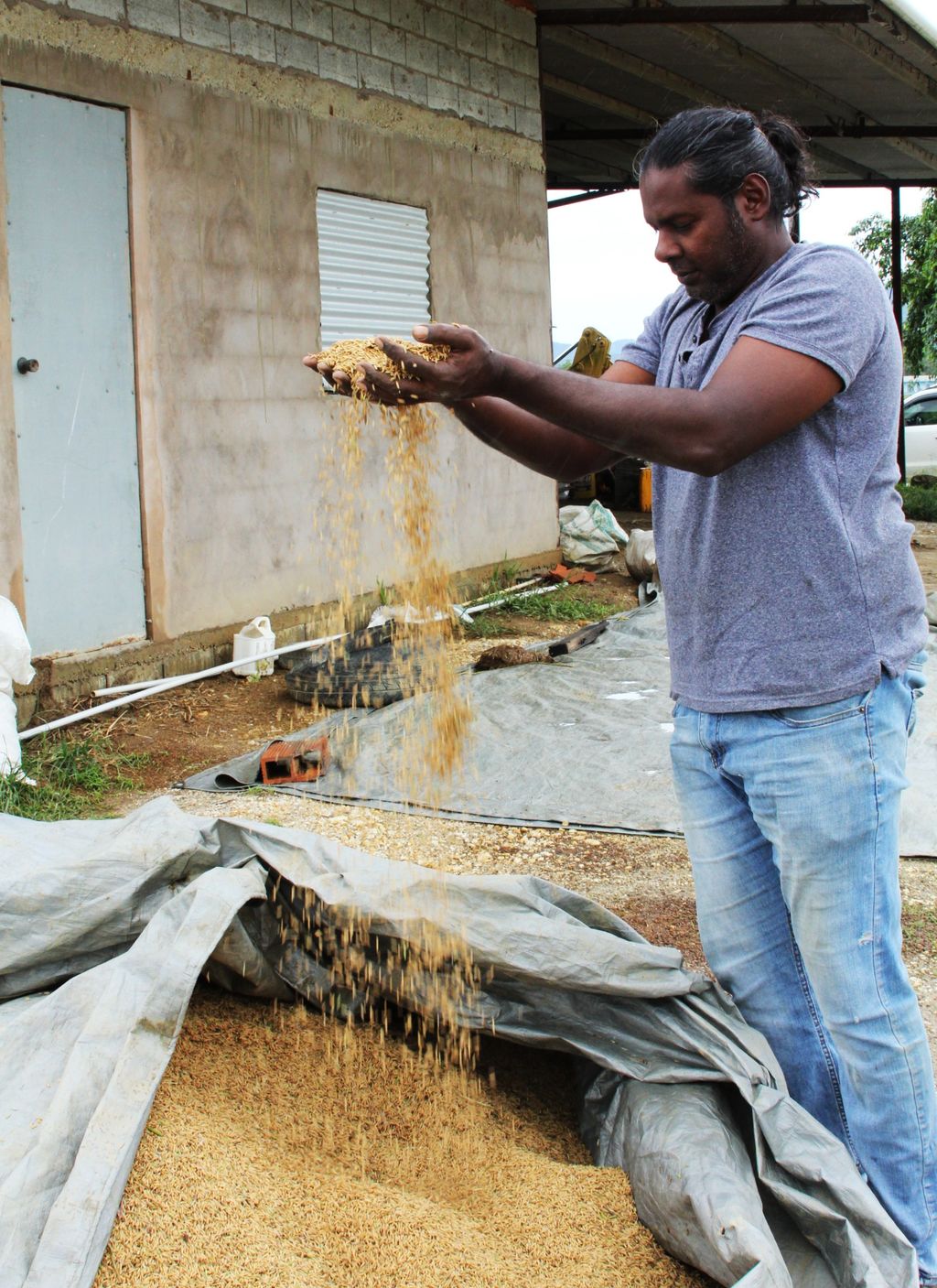
On Tuesday, a small group of rice farmers admitted that the urea shortage is seriously impacting their farms and livelihoods.
Sitting under a shed in Caroni with worried expressions, the farmers called on the Government to rectify the situation, noting that alternative fertilisers are too expensive.
Over the past three weeks, Eniath Hosein said they have been searching for Nutrien’s urea but found none.
“We can’t get access to it. The stores have no urea for sale. Urea is sold out in most stores. The shelves are empty,” Hosein said.
He added that stores with the fertiliser are charging exorbitant prices.
“I was told that the black market price for urea right now is above $400 for a 50 kg bag. It’s more than double what we were paying. So we have to pay exorbitant prices for whatever they have,” he said.
Hosein, who cultivates 200 acres of rice in Caroni, said farmers are resorting to other fertilisers with less nitrogen, such as CAN-27, which contains 27 per cent nitrogen.
Imported from Holland, a 40-kilogramme (88-pound) bag costs $265, or roughly $3 per pound.
“Nothing is as good as urea, which works best in waterlogged conditions. With these other fertilisers, you have to double the dosage and spend more money to get the desired results,” Hosein explained.
The increased cost has forced farmers to dig deeper into their pockets to maintain production.
“When farmers face rising costs, they will reduce the volume of fertilisers used on crops. This will affect yields and our livelihoods. This is a big problem for us right now.”
Hosein warned that the unavailability of urea could threaten the future of the rice industry.
“If farmers don’t have access to urea, they are not going to plant rice. Some may abandon rice cultivation entirely,” he said.
Struggling industry
In the early 1990s, Trinidad and Tobago had 6,000 rice farmers producing 21,200 metric tonnes of rice annually.
However, payment delays, climate change, rising fertiliser costs, high production expenses, low yields, insufficient dry-season water, and lack of political support led farmers to abandon their fields, shrinking the sector dramatically.
By 2018, production had dropped to just 585 metric tonnes, and the farming population dwindled to 40 rice farmers. These farmers manage 4,000 acres of land across Plum Mitan, Biche, Felicity, El Carmen, and Caroni, but currently only cultivate 1,000 acres.
Each acre can produce 3,800 pounds of rice, accounting for less than five per cent of local consumption. NFM purchases rice at a guaranteed price: $2.99/kg for grade one paddy, $2.86 for grade two, and $1.86 for grade three.
According to the World Integrated Trade Solution, T&T imported 31,430,200 kg of rice costing US$28.5 million in 2024, from Guyana, Brazil, India, Suriname, the USA, and Canada.
Long-standing farmer Fazal Akaloo said rice cultivation relies heavily on large quantities of urea.
“Rice cultivation is totally different. The Government should take more interest in the sector. The ups and downs in the rice industry are due to the lackadaisical approach of the authorities. Considering the investment farmers put into equipment, it’s not worth it.”
He said entering rice production costs around $1.5 million per farmer, and the increased cost of alternative fertilisers has been a heavy burden.
“How long can we sustain these increased costs? Frustration will set in, and farmers may quit. The rice industry has been hanging in the balance for too long.”
Akaloo called for T&T to become self-sufficient in rice production, noting that previous recommendations for a steering committee have yet to be acted upon:
“We have the capabilities to grow rice in T&T, but we lack political will. The powers that be are only talking. We want to see action.”
Joe Pires, managing director of Caribbean Chemical and Agencies Ltd, confirmed the scarcity of urea.
“There is not much on the market. Most of our customers have none,” Pires said.
He added that a ten per cent duty was imposed on urea when Nutrien manufactured it locally, while other fertilisers remained duty-free.
“With Nutrien no longer producing urea, the Government should remove the duties on imported urea. We plan to approach the minister to reduce the duty until Nutrien resumes production.”
Pires cautioned that importing urea would raise prices further:
“Imported urea would cost $295–$299 per 50-kilogramme bag, about 25 per cent more for farmers.”
Some farmers have turned to sulphate of ammonia (SoA), which contains 21 per cent nitrogen. An 88-pound bag retails at $170, or $2.02 per pound.
“SoA is half the nitrogen strength of urea, yet more expensive,” Pires said.
He stressed, however, that the shortage of urea does not mean agriculture will shut down.
Guardian Media reached out to Agriculture Minister Ravi Ratiram on Thursday via WhatsApp to ask about the urea scarcity and possible duty reductions, but he did not respond.