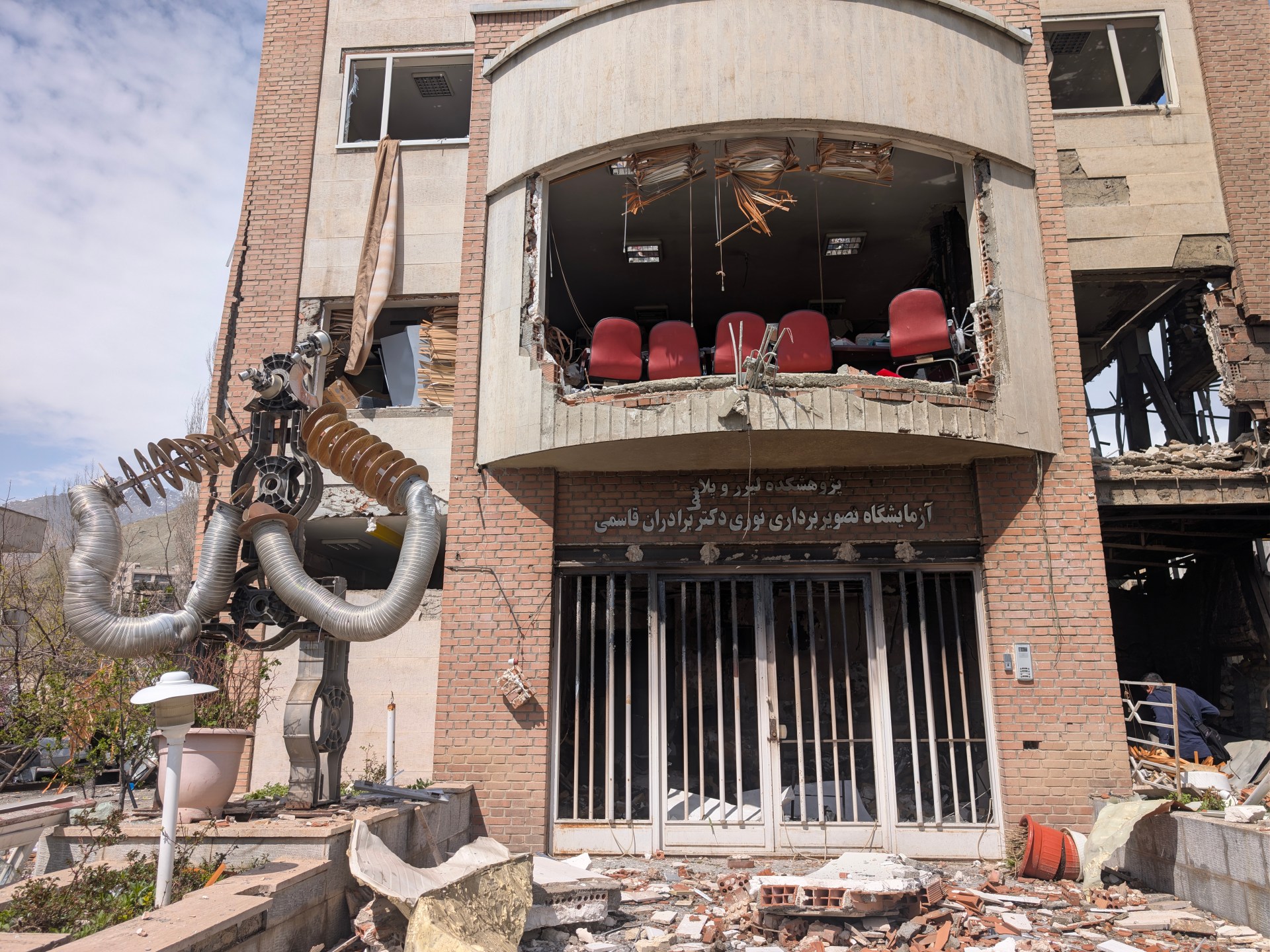

Tehran, Iran – Inside the sprawling Shahid Beheshti University in northern Tehran, a research centre lies in ruins after warplanes bombed it.
The attack on Friday on the Laser and Plasma Research Institute of the elite higher education facility is part of a growing pattern of civilian sites targeted by the United States and Israel in their war on Iran.
- list 1 of 3Vehicles burn in Israel after being hit with Iranian projectile debris
- list 2 of 3Witness records Israeli strike on building in Lebanon’s Tyre
- list 3 of 3Iran says US, Israel belong in Stone Age after Tehran university strike
end of list
There were no casualties at the university because it was mostly empty after all classes across the country were moved online by the government until further notice. Dormitories nearby were lightly damaged.
The US and Israel did not officially divulge the rationale behind the attack, but Mohammad Mehdi Tehranchi, a senior theoretical physicist and nuclear scientist who was assassinated during the opening salvo of Israel’s 12-day war in June, was the director of a magneto-photonics lab there.
“This hostile act not only targets the security of academics and the country’s scientific environment, but is also a clear attack on reason, research, and freedom of thought,” the university said in a statement, calling on international peers to raise awareness about similar strikes.

Hossein Simaei Saraf, minister of science, research and technology, told reporters at the research centre on Saturday that parts of at least 30 universities have so far been impacted by US and Israeli strikes since the start of the war on February 28.
Advertisement
He said Iranian scientists have been targets for decades and pointed out that several more Shahid Beheshti University professors were assassinated by Israel during the 12-day war.
“Attacking universities and research centres means returning to the Stone Age,” the minister said in reference to a threat by US President Donald Trump to bomb Iran “back to the Stone Ages” by systematically hitting its infrastructure, including power plants.
Another major university attacked during the ongoing war was Tehran’s Science and Technology University, which saw one of its research centres reduced to rubble and other departments damaged a week ago. The facility worked on developing domestically made satellites.
The US and Israel also attacked the Pasteur Institute in downtown Tehran, which was founded more than 100 years ago in collaboration with the internationally renowned Institut Pasteur in Paris but now operates independently.
The institute works on infectious diseases, producing vaccines and biological products and providing advanced diagnostics.
The World Health Organization (WHO), which works with two of the institute’s departments as collaborating centres, confirmed that the institute “sustained significant damage and was rendered unable to continue delivering health services” but said no one was killed.
More than 20 attacks have targeted healthcare facilities in Iran since the start of March, WHO Director General Tedros Adhanom Ghebreyesus said on Friday, also pointing to the Delaram Sina Psychiatric Hospital, which sustained significant damage in a strike on Sunday.
A major pharmaceutical company was hit near Tehran this week. Iran’s government said the attack aimed to affect medicine supply lines while Israel claimed the company was linked to the production of chemical weapons.
US and Israeli attacks have also impacted schools, houses and businesses across the country, killing more than 2,000 people, according to Iranian authorities. Fighter jets flew at low altitudes over Tehran on Friday night, launching strikes that lit up the mountainous areas north of the capital.
As a defiant Iran continues to block the Strait of Hormuz despite Trump’s repeated demands to reopen the waterway, the US and Israel are increasingly focusing their air attacks on economic targets that could have widespread ramifications for Iranian civilians.
Heavy bombardment on Saturday targeted the economic zone in the oil-rich city of Mahshahr, one of Iran’s most important industrial hubs and a key source of export revenue.
Advertisement
Multiple refineries were significantly damaged, and a local official said at least five people were wounded.
This comes a day after Israeli Prime Minister Benjamin Netanyahu boasted that his military has “destroyed 70 percent of Iran’s steel production capacity” after putting two top manufacturers, including the largest in the Middle East, out of commission with multiple rounds of devastating strikes.

On the same day, two rounds of large air raids significantly damaged the B1 bridge near Tehran. At least eight people were killed and more than 90 wounded in the attack, which came while a large number of civilian families were spending Sizdah Bedar, or Nature Day, together in the area.
The recently completed 136-metre-high (446ft-high) suspension bridge would have considerably cut traffic between Tehran and nearby Karaj and traffic moving towards provinces north of the capital, areas that are popular travel destinations. It was built by Iranian engineers over several years.
A US official told the Axios news website that the bridge was attacked because it was used by the Iranian armed forces to try to secretly move missiles and missile parts from Tehran to launch sites in western Iran and provide logistical support for the military in Tehran.
The bridge was on the verge of being inaugurated and had not yet opened to traffic.
Trump immediately celebrated its targeting by releasing a video of parts of the bridge collapsing and warned that there would be “much more to follow”.
On Saturday, he reminded Iran that there were 48 hours left on his deadline to reopen the Strait of Hormuz or he would bomb Iran’s top electricity generation plants simultaneously and put them out of commission. He has also threatened to bomb water desalination plants. Those facilities and power plants are civilian targets that cannot be targeted under international law.
The commanders of the Islamic Revolutionary Guard Corps (IRGC) who are managing the war and running the country backed by the government have emphasised that they will not surrender and will only escalate attacks across the region in retaliation.
Washington has also bombed the area of the Bushehr Nuclear Power Plant four times during the war with the latest strike on Saturday killing a guard and damaging a nearby structure without hitting the reactor. Several other civilian nuclear sites were also attacked and destroyed over the past week.
More than 100 US legal experts this week condemned strikes impacting civilians in Iran as raising “serious concerns about violations of international human rights law and international humanitarian law” and also expressed concern about “the risk of atrocities across the region”.
Related News
The war in Iran: Key takeaways from Al Jazeera’s interview with Marco Rubio
Children’s hospital in Tehran keeps hopes and smiles alive during war
‘Dangerous escalation’: World reacts to Israel passing death penalty law