U.S. Midterms key takeaways: Voters punish Trump, and the GOP suffers historic losses
 04 November 2026
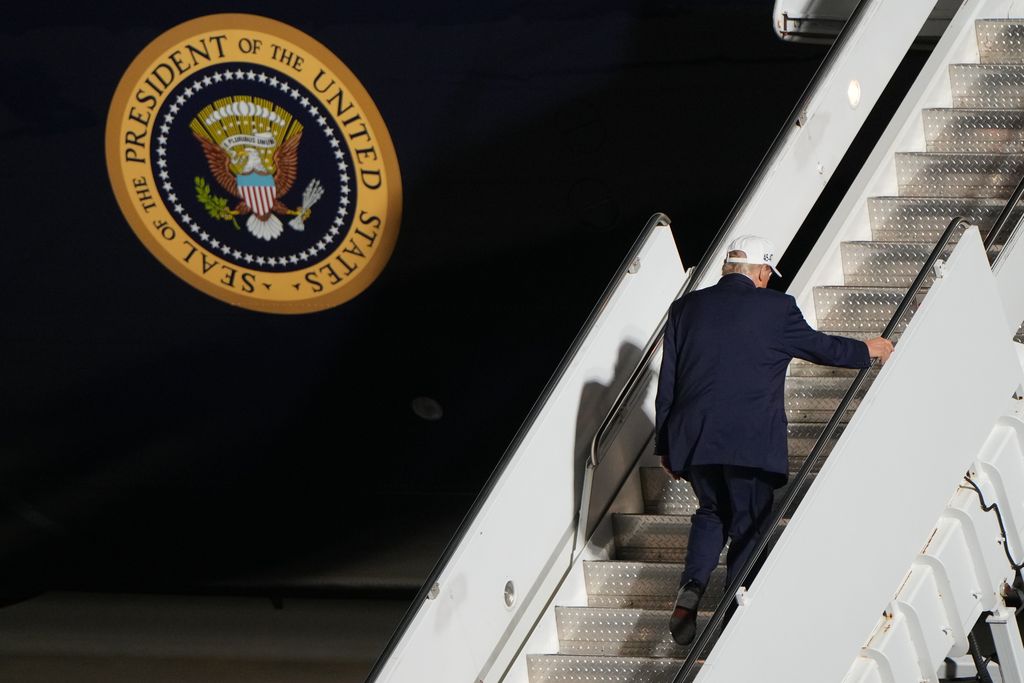

President Donald Trump repeatedly encouraged voters to pretend he was on the midterm ballot. They did. And it’s hard to imagine a worse outcome for the Republican president and his party.
Voters absolutely punished Trump’s allies almost everywhere. Democrats won in swing states like Georgia, Michigan, New Hampshire and North Carolina and in Republican strongholds of Iowa, Kansas, Texas and even South Carolina. Trump’s controversial mid-decade redistricting plan appeared to backfire. And Republican losses allowed Democrats to make history in Georgia, where Democrat Keisha Lance Bottoms became the first Black woman elected governor in U.S. history, while in Texas, Democrat Gina Hinojosa will become its first Latina governor.
Voters nationwide were in the mood for change, according to The AP Voter Poll, which found that roughly three-quarters of voters feel “angry” or “dissatisfied” with the direction of the country.
Among those who had Trump in mind when they cast their vote, about twice as many wanted to express opposition to the Republican president as those who wanted to support him. Most also blamed the Trump administration for high costs: about 6 in 10 say higher than usual prices are “more because of Trump’s policies.”
Trump’s coalition was also fraying: Young voters dramatically shifted away from the GOP after warming to Trump in 2024, while the GOP also lost ground among Black men and Hispanics.
With undeniable momentum, Democrats won control of the House and Senate, which will curb Trump’s power after he’s faced few limits from a compliant Republican-controlled Congress.
Beyond control of Washington, the extent of these GOP losses could shake the very foundation of the Republican Party — and perhaps the Democratic Party, too — as the political world pivots almost immediately into a new presidential election season and Trump becomes without question a lame duck.
Here are some takeaways from Tuesday’s midterms:
The end of the Trump era may be beginning
Tuesday’s electoral beating appeared to be a direct repudiation of Trump, who demanded loyalty across his party and saddled Republicans with his dismal approval ratings, an unpopular war with Iran and surging costs.
Indeed, Trump’s political strength is hitting a new low roughly two years before his final term ends.
The AP Voter Poll confirms that voters are deeply unhappy with Trump, with roughly 6 in 10 saying they disapprove of his job performance. About 70% of voters want Congress to provide more checks and balances on the presidency. And roughly 6 in 10 voters said Trump places a higher priority on his personal interests than the country’s interests.
Trump was betting that his base of white working-class voters — and an increased share of young people and voters of color — which fueled his presidential victory in 2024 could save his Republican allies if they show up in great numbers.
He was wrong.
The AP Voter Poll indicates a substantial shift in young people and Hispanics moving away from Republicans compared with Trump’s victory just two years ago.
Voters under 30 were about evenly split between Trump and Vice President Kamala Harris in 2024. But in this election, about 7 in 10 voters in that same age group nationally say they supported the Democratic House candidate in their area.
Meanwhile, Republicans appeared to lose ground with Black voters, particularly Black men. Only about 1 in 10 Black male voters nationally backed the Republican candidate in their local U.S. House race, down from the roughly one-quarter who supported Trump in the last presidential election, according to AP VoteCast. About 9 in 10 Black voters supported the Democratic House candidate, up from the roughly 8 in 10 who cast their ballot for Harris.
It was a similar story for Hispanic voters. About one-third of Hispanics say they backed the Republican in their local U.S. House race, while roughly 4 in 10 voted for Trump two years ago. About 6 in 10 Hispanic voters nationally say they voted for the Democratic candidate in their local House race. That’s as about 7 in 10 Hispanic voters say Trump’s policies have worsened economic conditions in the U.S.
Such shifts will echo into the 2028 presidential contest, which unofficially begins Wednesday.
Democrats won everywhere and will soon control Congress
Since World War II, the House and Senate have flipped from one party to the other in the same midterm just three times: 1946, 1994 and 2006.
Democrats did it again in 2026.
They won virtually everywhere in a truly historic sweep. Democrats won Senate and governor’s races in Georgia, Ohio, Iowa and Texas — the latter three states Trump carried by 11, 13 and 14 percentage points, respectively.
In North Carolina, Democratic former Gov. Roy Cooper won the Senate race. Sen. Jon Ossoff easily won reelection in Georgia, while Lance Bottoms won the Georgia governorship. New Hampshire Democrat Chris Pappas won his Senate race, making him the first openly gay man in the Senate. Maine Sen. Susan Collins lost, leaving Republicans without any members of Congress in New England. In Ohio, former Ohio Sen. Sherrod Brown flipped a GOP-held Senate seat, while former state health official Amy Acton beat close Trump ally Vivek Ramaswamy for governor.
The Democratic romp continued in Michigan, where Democrat Abdul El-Sayed won despite an ugly intraparty feud in recent days and will soon become the first Muslim senator. In Kansas, voters picked Democrat Adam Hamilton, a first-time candidate who leads the largest United Methodist church in the country, over incumbent Republican Sen. Roger Marshall — the first time a Democrat has won a Senate seat in Kansas in nearly a century. And in Texas, long an object of desire for Democrats, 37-year-old state lawmaker James Talarico was elected to the Senate, while Hinojosa defeated three-term Gov. Greg Abbott.
The most painful blow for Trump may have come in South Carolina, where his handpicked candidate to replace the late Sen. Lindsey Graham, his sister Darline Graham, was defeated by Democrat Annie Andrews, a pediatrician making her first run for the Senate. Andrews ran unsuccessfully for Congress in 2022.
Candidate quality matters — and Trump picked flawed candidates
Trump loves to tout his record in picking winners in primary elections. He will not love talking about how those Republican primary winners, many of them deeply flawed, failed in the general election.
Trump-backed Texas Republican Ken Paxton wasn’t able to shake his years of scandals. About two-thirds of Texas voters said Paxton did not have the right personal character to serve as a U.S. senator, according to The AP Voter Poll.
In South Carolina, Trump was a staunch supporter of Graham, who infamously flubbed a foreign policy question on the debate stage. Voters took note. About two-thirds of South Carolina voters said Graham did not have the right experience, The AP Voter Poll found. About 7 in 10 of the voters who doubted Graham’s experience voted for Andrews.
Georgia’s Trump-backed Senate candidate Mike Collins tried to convince voters that Ossoff was too liberal for the Deep South. Voters decided the Republican congressman was, in fact, the extremist in the race after he was linked to multiple white supremacists. About half of Georgia Senate voters thought Mike Collins’ views were “too extreme,” compared to about one-third who said the same about Ossoff.
In North Carolina, Trump’s handpicked Republican candidate Michael Whatley lost to Cooper. During the 2024 presidential campaign, Trump elevated Whatley from his state party chairmanship to the Republican National Committee chairmanship, hailing him as “one of the most capable executives in our country.”
Days before the election in Kansas, Marshall was still explaining his decision as a physician to sue patients for outstanding bills. A slim majority of Kansas voters said Marshall did not have the right personal character to serve in the U.S. Senate, The AP Voter Poll found.
These Republicans ultimately couldn’t outrun their own issues — even as they spent hundreds of millions of dollars trying to define their Democratic opponents as the extremists.
The Democratic brand still needs work
Trump’s losses do not necessarily mean the Democrats won.
The AP Voter Poll shows that about half of voters have a “very” or “somewhat” unfavorable opinion of the Democratic Party, while about 6 in 10 view the GOP negatively.
That leaves the Democratic Party’s major factions — the progressive left flank and the liberal-to-moderate establishment — parsing Tuesday’s outcomes to claim any advantage in Democrats’ tug-of-war over party identity.
The party’s moderate wing had a good night as high-profile leaders like Pennsylvania Gov. Josh Shapiro and Maryland Gov. Wes Moore won reelection. Both are considered 2028 presidential prospects.
But the progressive movement also had a good night as its highest-profile candidate, Abdul El-Sayed, defeated Mike Rogers and won in Michigan. El-Sayed is not a member of the Democratic Socialists of America, but he shares some of the movement’s goals.
El-Sayed’s win gives progressives a legitimate argument that a far-left leader can win, even in a perennial battleground. Moderate leaders, of course, have argued the opposite.
Trump’s gerrymandering backfires
Trump set off a tempest in Texas when he pushed the most populous Republican-run state to redraw congressional boundaries. California Gov. Gavin Newsom answered by persuading his state’s voters to respond in kind. Democratic and Republican states followed. Along the way, the U.S. Supreme Court gutted part of the Voting Rights Act, allowing several Southern states to redraw districts that had been majority- or near-majority-Black.
But the Trump-backed gerrymandering push wasn’t going as planned for Republicans, whose redrawn maps spread conservative supporters across more districts.
In Florida, Democratic Rep. Jared Moskowitz won the state’s 25th District; Democrat Pia Dandiya won the 22nd District and Rep. Kathy Castor won reelection in the 14th District. Republicans had redrawn all three districts this spring with the intent of ensuring GOP victories this fall.
In Texas, Democrats won three redrawn, heavily Latino districts that touch the U.S.-Mexico border. Two Democratic incumbents, Reps. Henry Cuellar and Vicente Gonzalez, withstood GOP challenges. In another, Democratic challenger Bobby Pulido ousted Republican Rep. Monica de la Cruz. —WASHINGTON (AP)
_______
Story by STEVE PEOPLES, BILL BARROW and LINLEY SANDERS | Associated Press