
Senior Political Reporter
Trinidad and Tobago has disassociated itself from calls urging an end to the US blockade of Cuba and to uphold the region’s Zone of Peace policy, which were made in the Bogota Declaration at the recent 10th Summit of heads of state and Governments of the Community of Latin American and Caribbean States (CELAC).
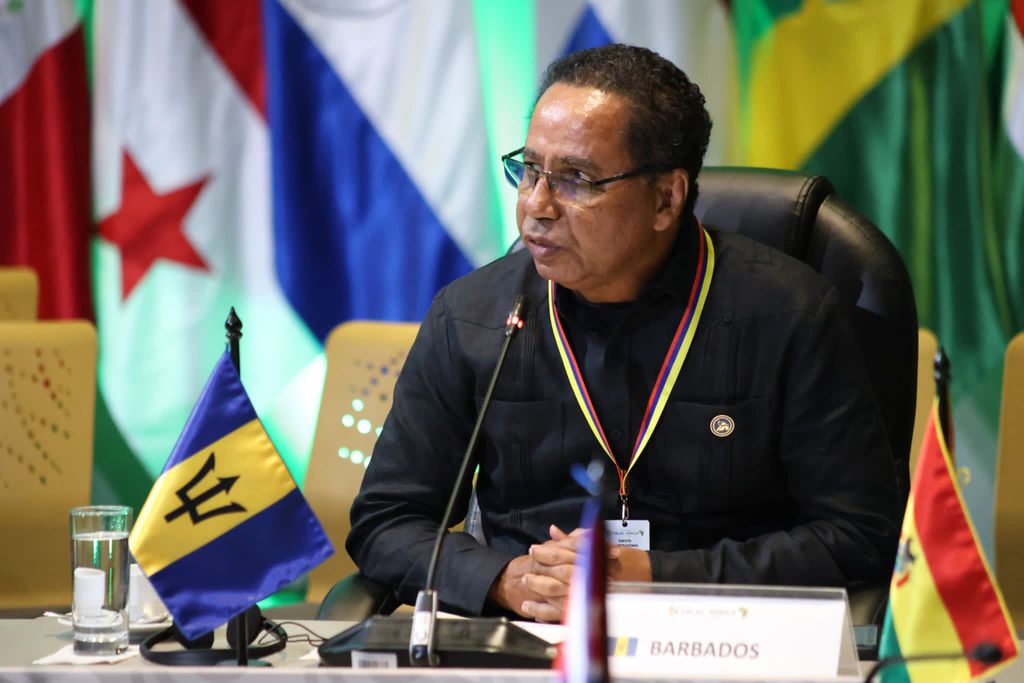
At the summit, Barbados High Commissioner to T&T, David Comissiong, also called for CELAC to hold fast to its collective denunciation of the United States’ “illicit unilateral blockade of CELAC member Cuba as a gross violation” of the region’s internationally recognised designation as a Zone of Peace—and that CELA must also denounce extra-judicial killings of regional citizens.
The summit concluded in Colombia last Friday.
T&T was represented by its Charge d’Affaires in Panama, officials said.
The Bogota Declaration, involving 35 principles on current issues, was issued at the climax of the summit.
According to the document, T&T disassociated itself from certain items, including the first paragraph. This stated: “We highlight the full validity of the Proclamation of Latin America and the Caribbean as a Zone of Peace and the unrestricted commitment of CELAC member states to ensure respect for this Proclamation by all states, as adopted at its Second Summit of Heads of State and Government, held in Havana in January 2014, which recognises the region as a zone of peace and free of nuclear weapons in accordance with he Treaty for the Prohibition of Nuclear Weapons in Latin America and the Caribbean (Treaty of Tlatelolco) and its Additional Protocols. This is based on the promotion, and respect of the purposes and principles of the Charter of the United Nations and international law.”
T&T, along with Argentina, Chile, Costa Rica, Ecuador, El Salvador, Honduras, Panama, Peru and Paraguay, also disassociated themselves from paragraph seven of the declaration.
This called for countries that supported the UN General Assembly Resolution (October 29, 2025) to reiterate the need to end the economic, commercial and financial embargo imposed against Cuba, as well as their opposition to laws and regulations with extraterritorial effects. It also said the designation of Cuba as a state sponsor of terrorism, and its continued inclusion on the list, has created obstacles to international financial transactions with Cuba.
T&T also disassociated from an aspect on Paragraph 19, which called for agreement on the importance of strengthening cooperation in migration management, including return processes, “... and recall our commitment to deepen co-operation and dialogue on migration and mobility in a comprehensive, balanced, integrated manner, based on shared responsibility and on commitment to safe regular and orderly migration in accordance with national competencies and with full respect for international law and human rights.”
T&T disassociated itself from a reference to “we reiterate the importance of regional frameworks for dialogue on migration.”
Barbados’ Comissiong, addressing CELAC’s Foreign Ministers meeting, said since its 2010 establishment, CELAC has signalled the enduring value of a unified Latin American and Caribbean voice and remains the only forum in which all developing hemispheric countries are fully represented, underscoring its unique legitimacy and convening power.
“It reflects the historic vision of the great nineteenth-century liberator Simon Bolivar, who recognised that the strength of our region lies in its unity, and the 21st-century inspiration of the late great Fidel Castro and Hugo Chavez,” he said.
Comissiong added that experience has shown the region that CELAC’s effectiveness is closely linked to sustained political engagement among member states and continuity in its work.
“... We must strengthen our follow-up mechanisms to ensure implementation of agreed outcomes,” he said.
Citing the Zone of Peace and Cuba, Comissiong said, “We must also be determined to ensure that CELAC functions in a concrete way as an instrument of development in our region. As we all know, there can be no development without peace! And so, we must all make a profound commitment to uphold and defend CELAC’s historic 2014 ‘Declaration of Havana’, which proclaimed our region as a Zone of Peace.
“That means our denunciation and rejection of the extra-judicial killings of our citizens by an intruding great power! We must also hold fast to our collective denunciation of the United States’ illicit unilateral blockade of our CELAC member state of Cuba as a gross violation of our region’s internationally recognised designation as a Zone of Peace.
“Indeed, let’s all ensure that we uphold our duty as members of this great fraternal regional organisation to give our member state of Cuba all of the concrete solidarity and support that it needs as it faces the current threat to its sovereignty and to the well-being of its people.”
Urging CELAC to assert itself - now more than ever - as a unified voice in global governance for effective representation of Latin America and Caribbean priorities, Comissiong added, “The challenges before us do not call for isolated responses, but for coordinated action grounded in shared responsibility.”
Related News
Transport minister holds talks in Barbados on air connectivity

Court of Appeal judges say privacy law may need updating

Two arrested; gun and drugs seized in Mayaro operation