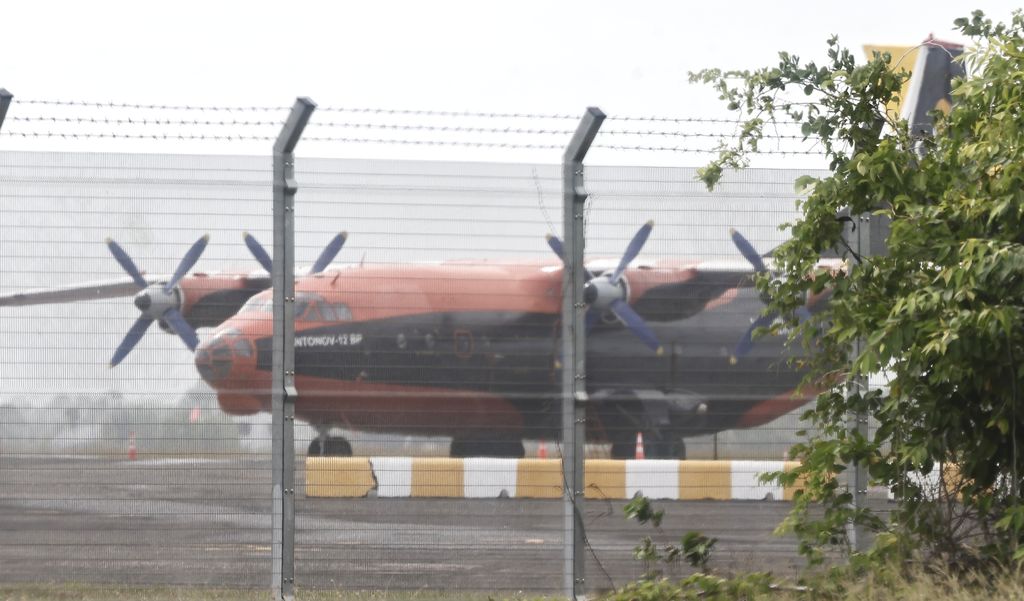

The crew of a Ukrainian aircraft, which landed at the Piarco International Airport on Thursday night with several tonnes of industrial explosives on board, was allowed to leave Trinidad last night, after facing hours of interrogation by local and international security authorities.
In a release last evening, the Airports Authority of Trinidad and Tobago (AATT) said, “Following extensive enquiries and assessments conducted by the relevant authorities, it was determined that no liability should be attributed to the pilot or crew. Consequently, authorisation was granted and the aircraft and crew were cleared to depart Trinidad and Tobago.”
Prior to this, however, the AATT said the aircraft and eight-member crew were detained by Immigration Division officers, after it was discovered that the explosives on board had not been declared in accordance with established international aviation and security protocols.
The aircraft, which was registered as flight no CVK-7078, had landed for a technical refuelling stop and was en route to Cape Verde, with Libya as its final destination. However, when the information discrepancy was discovered, the local officials detained the crew.
The AATT said the investigation into the matter subsequently involved officials from the Customs and Excise Division, Airports Authority Police Force, TTPS Special Branch, AIRCOP, United States Border Investigations and other national security stakeholders.
Speaking earlier on the matter during yesterday’s sitting of Parliament, Homeland Security Minister Roger Alexander had also sought to reassure citizens that there was no threat to national security.
“We have the situation under control,” he said.
In a press release during the day as well, the TTPS said routine checks of the aircraft’s cargo had “identified irregularities requiring immediate precautionary action.”
Senior police officials later told Guardian Media that local immigration authorities were not informed the plane had been headed to T&T in the first place, and after learning that hazmat cargo was contained therein, they were concerned after being told just what it was.
Data from the flight tracking website Flightradar24 revealed the aircraft started its journey in Houston, Texas and made a stop in Nassau, Bahamas, before landing in Trinidad on Thursday around 6.30 pm.
The TTPS confirmed, “The aircraft was secured, the crew accounted for, and all relevant national security units activated in accordance with established protocols. At no time was there any threat to the travelling public, airport operations, or the wider national community.”
A senior officer said the crew, including two pilots, provided “reasonable answers” when questioned as to what the explosives were intended for – which included use in mining, quarrying and even underwater operations.
However, he said given recent developments involving threats to senior Government officials, they could not ignore anything that could prove to be detrimental to the nation and citizens.
Guardian Media learned the Antonov An-12B aircraft is owned and operated by Cavok Air – which, according to an online search, lists it as a Ukrainian cargo airline based in Kyiv.
When Guardian Media visited the old South Terminal yesterday, the orange and black plane remained under the watchful eyes of the TTPS and the T&T Defence Force (TTDF), who maintained a continuous presence on the tarmac.
Former T&T Civil Aviation Authority (TTCAA) director general Ramesh Lutchmedial yesterday said while it was not unusual for a civilian aircraft to transport munitions of war, they had to ensure compliance with all applicable laws.
“For a civilian aircraft, all so-called hazardous materials must be packaged and carried in accordance with those standards,” he said.
Uncertain if the aircraft and its crew were operating on behalf of the government of Ukraine or as a private charter, he agreed both scenarios allowed for T&T law enforcement agencies to, “inspect the cargo to ensure that the packaging and segregation of all the hazardous material is in accordance with the standards of international civil organisations.”
He said local authorities had the right to ground the aircraft if the crew was not in compliance with international protocols.
Indicating that there must be an air service agreement in place which would allow the aircraft to come to T&T, Lutchmedial said it had to be determined if the airline had approval from the TTCAA to operate a commercial flight locally and if the aircraft had satisfied all inspection checks in line with international safety standards.
“They have in the past grounded aircraft where there was non-compliance with international safety standards,” he claimed.
He added that the Customs and Excise Division had the authority to ensure that all cargo was duly listed on the aircraft manifest and was permissible to be in T&T territory.
In the case of non-compliance, he said appropriate action can be taken, such as seizure of the cargo, the aircraft and detention of crew members.
Under the International Air Services Transit Agreement (IASTA), an airline of a country which is the state party to the agreement has the right to land in another state party territory for fuel or maintenance. Ukraine and T&T are state parties to the IASTA.