
Senior Reporter
kay-marie.fletch[email protected]
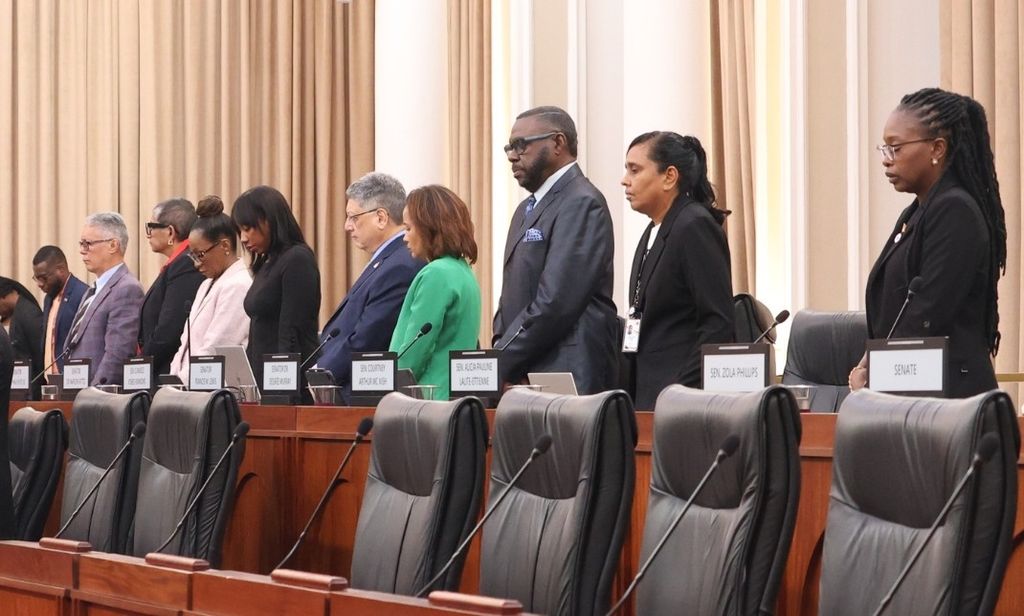
The Government is now looking to independent senators to support the proposed Zones of Special Operations (ZOSOs) bill after it was rejected by all Opposition Members of Parliament (MPs) present for the vote in the Lower House on Friday.
The bill will be debated in the Upper House tomorrow (Tuesday). It requires a three-fifths majority to be passed.
During a media briefing held at United National Congress headquarters in Chaguanas yesterday, Defence Minister Wayne Sturge said, “The bill will be debated in the Senate on Tuesday, in earnest, and will pass with the support of four of the nine presidential senators. At least one member of the House on Friday made it clear that the Opposition PNM will lobby the president’s senators to not lend the required support.”
Meanwhile, Sturge rubbished claims that the Government’s new crime-fighting tactic is another State of Emergency (SoE).
According to him, ZOSOs does not have the same sweeping powers as an SoE.
He explained that police would not be able to lock down everyone in a hot spot, nor arrest whoever they want.
“There are provisions in the bill which allow for areas within the zone to be the subject of a cordon for a maximum of 24 hours and for a curfew to be imposed within the cordon for a maximum of 72 hours,” he said.
The Minister added that operations would only target people and premises who are subject to reasonable suspicion.
He said, “Contrary to the patent nonsense being published by some PM-affiliated social media bloggers, not all persons within the zone or the cordon would be subject to arbitrary arrest, detention or search of their persons or property. Where cordons and curfews are imposed, operations will be surgical and timely and would target only those persons and premises who are the subject of what we call in law reasonable suspicion, which is a safeguard.”
He also strongly rejected claims that the bill would be used to target specific racial groups.
Additionally, Sturge said when it comes to the issue of arrests without warrants, it is based on reasonable suspicion, and people must be brought before the court promptly.
He added, “The power of arrest without warrant already exists both in statute and at common law. The provisions dealing with arrest and detention have four safeguards in this Bill. Firstly, the arrest is based on reasonable suspicion. It is not arbitrary. And reasonable suspicion would mainly be driven by intelligence. The provisions dealing with arrest and detention have four safeguards, as I said. Reasonable suspicion is one. Second one is that the bill provides that a person arrested and detained must be brought before a court promptly.”
However, also speaking to Guardian Media via telephone yesterday, former National Security Minister Marvin Gonzales stood by his view that the Government always intended to use an SoE to tackle crime because it has no other plans.
“The Government intends for that law (ZOSOs) to come into effect upon the expiration of the State of Emergency as one of their crime fighting tools, all right, and that is evidence to me, or for me, as justification for this theory that the Government lied to the people of Trinidad and Tobago by coming up with a story to declare a State of Emergency in Trinidad and Tobago ... because they had no other plan to do so.”
The present SoE, which was declared in July 2025, will expire on January 31.