
Senior Reporter
Defence Minister Wayne Sturge has thrown his support behind the deployment of US Navy SEAL personnel to Trinidad and Tobago, dismissing concerns that the move could undermine the country’s sovereignty.
Responding to questions from Guardian Media yesterday, Sturge agreed that the SEALs’ deployment can assist T&T in combating crime through specialised training.
Asked for details about the current number of Navy SEALs in the country and how many more are expected to assist with training, Sturge questioned if such disclosures were in the best interest of the public.
Prime Minister Kamla Persad-Bissessar recently revealed that members of the US Navy SEALs are already in the country handling logistics ahead of a larger deployment. She said the teams will work alongside local security forces to provide training and support in border protection, drug interdiction and internal security.
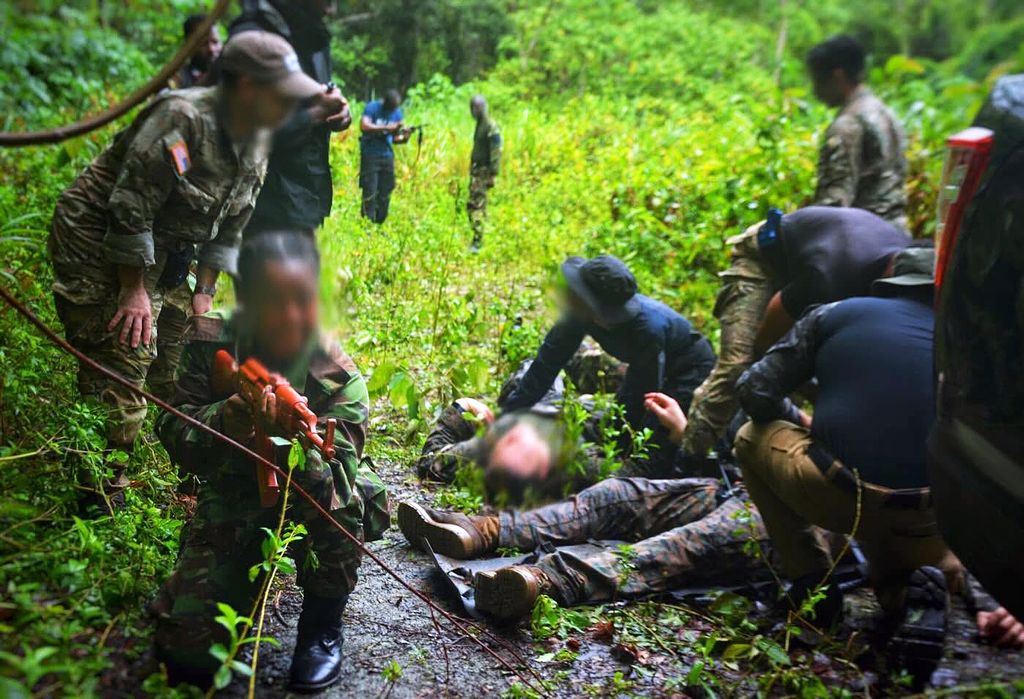
Her announcement came as the US Embassy and SOCSOUTH revealed that US Army Civil Affairs Soldiers assigned to the 98th Civil Affairs Battalion (Special Operations) joined Defence Force members for tactical combat casualty care and jungle technical exchange from June 15 to 18 at Teteron Barracks.
Asked yesterday whether he was concerned about the implications of foreign military personnel operating in the country, Sturge firmly rejected suggestions that T&T’s sovereignty was under threat.
“I have no concerns regarding sovereignty as their presence ensures that our sovereignty is assured and not undermined by the well-financed narco-terror empires whose actions in the last few years caused us no end of worry,” the Defence Minister said.
“Their presence strengthens our partnership in achieving a shared goal and can only be beneficial to our efforts to disrupt the activities of the narco-terror networks.”
However, former national security minister and Opposition Chief Whip Marvin Gonzales has sharply criticised Persad-Bissessar over the reported presence of US Navy SEALs in T&T, accusing her of acting without transparency and accountability on a matter of national sovereignty.
Yesterday, Gonzales described the Prime Minister’s announcement as “reckless” and questioned the legal basis under which the elite American military unit was invited into the country.
He argued that Navy SEALs are military personnel rather than law enforcement officers and said the Government must explain what agreements or international arrangements govern their presence.
“The Prime Minister must explain under which law or international protocols Navy SEALs were invited onto our shores,” Gonzales said.
The Opposition MP also raised concerns about sovereignty, accusing Persad-Bissessar of failing to adequately inform the public about the nature and scope of the deployment.
Gonzales further questioned the Government’s rationale for seeking foreign military assistance while simultaneously claiming that crime is under control, insisting that citizens deserve full disclosure on any security arrangements involving foreign forces operating within the country.
While some security experts have welcomed the move, others have questioned the rationale for deployment.
Criminologist Darius Figuera argued that Navy SEALs are traditionally used for high-level strategic operations rather than conventional law enforcement training.
He questioned whether there were broader objectives behind the deployment.
“The SEAL team, you’re in the crème de la crème of the US military structure,” he said. “To have them in the country training is one thing.”
Figuera suggested the public should seek clarity on whether specific threats have been identified that warrant the SEALs’ presence in T&T.
“So I ask the question to the Prime Minister: who are the designated threats that the SEAL team is here to take out?” he said.
Figuera pointed to previous US-supported operations targeting transnational criminal organisations and questioned whether similar objectives could be influencing the deployment.
“They are the most efficient tip of a military establishment,” he said. “So you’re going to take the most efficient tip of your spear and send them to Trinidad and Tobago to train people how to interdict drugs?”
Former commissioner of police and national security minister, Gary Griffith, however, sought to reassure the public that the SEALs will not be conducting operations locally.
“There is a misinterpretation by members of the public to believe that the SEALs are coming here to be involved in joint operations. That is not true,” Griffith said.
He explained that foreign military personnel would not have powers of arrest or operational authority within T&T and therefore could not participate in crime-fighting exercises alongside local law enforcement agencies.
According to Griffith, the most likely role of the SEALs would be to provide advanced tactical training to specialised units within the country’s protective services.
“They can arrive here to be involved in training of our elite units such as the Special Naval Unit of the Coast Guard, the Special Forces in the Army, and probably tactical elite units in the Police Service,” he said.
Such training, Griffith noted, could focus on counter-terrorism operations, hostage rescue scenarios, extraction missions and other specialised security functions.
Regional security and intelligence expert Dr Garvin Heerah contended that international cooperation is increasingly necessary to address evolving security threats.
Heerah said modern criminal activity in the country extends far beyond traditional domestic policing challenges.
“The country is increasingly confronted by sophisticated transnational criminal networks involved in narcotics trafficking, firearms smuggling, human trafficking, money laundering, cyber-enabled crime, gang operations and organised criminal enterprises that operate across multiple jurisdictions simultaneously,” he stated.
Heerah argued that criminal organisations exploit maritime routes, porous borders, and technological vulnerabilities, making regional and international collaboration essential.
“The involvement of US Navy SEAL personnel should therefore not automatically be interpreted as a foreign force coming to police Trinidad and Tobago,” he said.
Rather, he suggested such partnerships are typically focused on specialised training, intelligence sharing, operational planning and capacity building.