
Somalia’s minister of defence, Ahmed Moalim Fiqi, has accused Israel of planning to forcibly displace Palestinians to the breakaway region of Somaliland, denouncing the alleged plan as a “serious violation” of international law.
In an interview with Al Jazeera on Saturday, Fiqi called on Israeli Prime Minister Benjamin Netanyahu to withdraw his diplomatic recognition of the “separatist region”, calling the move announced late last year a “direct attack” on Somalia’s sovereignty.
- list 1 of 4What does Israel’s recognition of Somaliland mean for the region?
- list 2 of 4Somaliland recognition: Israel’s foothold in the Horn of Africa
- list 3 of 4Top Somaliland official defends Israel ties amid Arab backlash
- list 4 of 4Saudi-led coalition says STC’s al-Zubaidi fled to UAE via Somaliland
end of list
“Israel has long had goals and plans to divide countries – maybe before 20 years – and it wants to divide the map of the Middle East and control its countries… this is why they found this separatist group in northwestern Somalia,” Fiqi told Al Jazeera.
“We have confirmed information that Israel has a plan to transfer Palestinians and to send them to [Somaliland],” he added, without elaborating.
Fiqi’s comments came amid a global outcry over Netanyahu’s decision in December to recognise Somaliland, a breakaway part of Somalia comprising the northwestern portion of what was once the British Protectorate.
The move made Israel the first country in the world to recognise Somaliland as an independent state and came months after The Associated Press news agency reported that Israeli officials had contacted parties in Somalia, Somaliland and Sudan to discuss using their territory for forcibly displacing Palestinians amid its genocidal war on Gaza.
Somalia denounced the Israeli move, with President Hassan Sheikh Mohamud telling Al Jazeera that Somaliland had accepted three conditions from Israel: The resettlement of Palestinians, the establishment of a military base on the coast of the Gulf of Aden, and joining the Abraham Accords to normalise ties with Israel.
Advertisement
Officials in Somaliland have denied agreeing to resettle Palestinians from Gaza, and say there have been no discussions on an Israeli military base in the area.
But Fiqi on Saturday reiterated that Israel “wants to create a military base to destabilise the region” on the Bab al-Mandeb Strait, which connects the Gulf of Aden to the Red Sea.
“I see it as an occupation to destabilise the area,” Fiqi added.
He also stressed that Israel has no legal right to grant legitimacy to a region within a sovereign state.
Somaliland first declared independence from Somalia in 1991, but it has failed to gain recognition from any United Nations member state since.
Israel’s world-first announcement triggered protests in Somalia and swift criticisms from dozens of countries and organisations, including Turkiye, Saudi Arabia and the African Union.
Fiqi told Al Jazeera that Israel’s move falls into a decades-long goal to control the Middle East and accused Israel of exploiting separatist movements in the region. Roughly half of the areas formerly known as Somaliland have declared their affiliation with Somalia over the past two years, he added.
The minister praised the countries that had condemned Israel and pledged that Somalia would lean on all diplomatic and legal means to reject Israel’s “violation”.
He also commended United States President Donald Trump’s administration for not recognising Somaliland.
Although the US was the only member of the 15-member United Nations Security Council that did not condemn Israel for the recognition on December 30, it said its position on Somaliland had not changed.
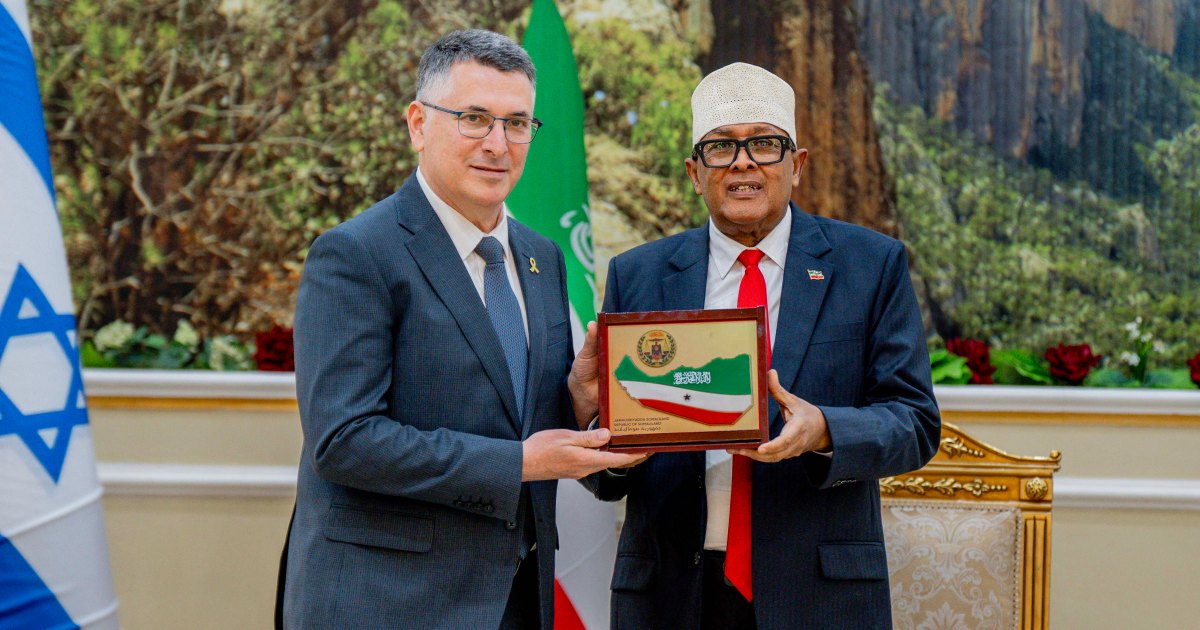
For its part, Somaliland’s governing party has defended its newfound relations with Israel after Israeli Minister of Foreign Affairs Gideon Saar travelled to Hargeisa, the region’s largest city and self-declared capital, earlier this week.
Hersi Ali Haji Hassan, chairman of the governing Waddani party, told Al Jazeera days later that Somaliland was “not in a position to choose” who provided it with legitimacy after decades of being spurned by the international community.
“We are in a state of necessity for official international recognition,” Hassan said. “There is no choice before us but to welcome any country that recognises our existential right.”
Hassan did not deny the prospect of a potential military base.
“We have started diplomatic relations… This topic [a military base] has not been touched upon now,” he said.
When pressed on whether Somaliland would accept such a request in the future, Hassan said only to “ask the question when the time comes”, calling the line of inquiry “untimely”.
Advertisement
Israeli think tanks say Somaliland’s location, at the gateway to the Red Sea and across from Yemen, make it a strategic site for operations against the Yemeni Houthi rebel group, which imposed a naval blockade on Israeli-linked shipping before the US-brokered ceasefire in Gaza.
The Institute for National Security Studies, in a November report, said Somaliland’s territory could “serve as a forward base” for intelligence monitoring of the Houthis and serve “a platform for direct operations” against them.
The Houthis said that any Israeli presence would be a target, a statement Somaliland’s former intelligence chief, Mostafa Hasan, said amounted to a declaration of war.
Related News
Sudan sources say South Sudanese among captured RSF members as war rages
Somaliland recognition: Israel’s foothold in the Horn of Africa
A Filipino tribe fights to stay as a ‘Smart City’ rises on a former US base