
Senior Reporter
elizabeth.gonza[email protected]
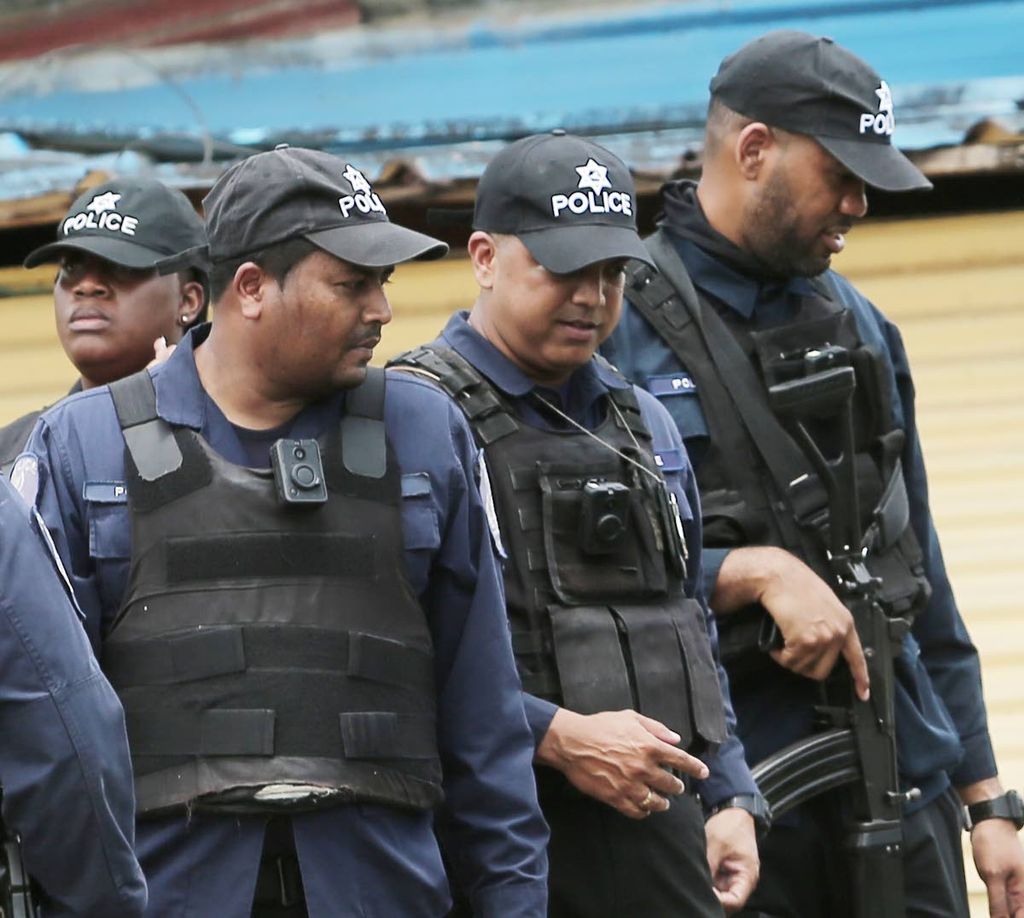
Less than five per cent of an estimated 6,500 police officers in the TTPS use body cams while on duty, said Deputy Commissioner of Police Junior Benjamin.
In a sit-down interview with Guardian Media last week, Benjamin revealed that the service has about 190 active body-worn cameras.
In a subsequent interview, Police Commissioner Allister Guevarro put that figure at 180 that were “actually usable.”
During an interview on Friday, he said these had been distributed to front-line officers.
He said 1,000 body cameras, which were purchased prior to him becoming commissioner, had been “repurposed” and were now being used to train police recruits at the Police Training Academy, St James.
Benjamin, though, could not provide a full inventory to Guardian Media but said the availability of body cams was small.
“I can tell you that what we have is a very small amount, and it certainly is not sufficient for the police service at all.
“The service, our position is that we do support the whole idea of body-worn cameras. It aids in at least three areas, as far as we are concerned, in terms of helping and giving evidential value to things. It also aids in transparency, which we think is number one for the police officers, and also in public confidence. When the public sees you have that body-worn camera, it also increases the public’s confidence with the police officer. Therefore, we are in full support of body-worn cameras. And as part of the tool of trade for police officers, we want to ensure that we can outfit, if possible, all police officers with body-worn cameras,” he said.
The use of body-worn cameras has once again become a part of public discourse following the police-involved shooting of 31-year-old Joshua Samaroo and his common-law wife in St Augustine on January 20.
Even the Police Complaints Authority reminded officers about the need to use the cameras.
As it stands, Benjamin said the programme’s policy would need revision when new cameras are procured because the framework was built around older devices.
He said the TTPS has not returned to tender because the next procurement must be budgeted, and said the next attempt is being lined up for fiscal 2026–2027.
Last September, Alexander told the House that the 3,000 body-worn camera contract, awarded in August 2024, was cancelled to save funds. The contract was worth $24.9 million.
At that time, Commissioner of Police Allister Guevarro said he believed the cameras could be bought for much less and claimed the quoted costs were inflated.
Meanwhile, Opposition MP Keith Scotland, who was a minister in the Ministry of National Security in the former government, said he still supports disciplinary action against officers who refuse to comply with body-camera requirements.
As chairman of the Joint Select Committee on National Security, Scotland in February 2024 had called on former police commissioner Erla Harewood-Christopher to institute disciplinary action against them—make an example, and people will fall into line.
In an interview last Thursday, Scotland said, “I stand by that (statement)… Even more so now, I stand by that. It is even more critical now.
“And it serves as a first line of protection against police officers from allegations, which may be untrue. The body cams will not lie.”
He argued that departmental orders are sufficient to mandate use and that consequences already exist under common law and the disciplinary regime.
“It’s a lawful instruction, and the disobedience of a lawful instruction will have consequences under the common law and its disciplinary consequences.”
Police Social and Welfare Association president ASP Ishmael Pitt said the association is not opposed to body cameras but is concerned about limitations. He rejected the claim that officers are simply refusing to comply.
“It is not a case of officers just not using the body cameras. Officers do use the body cameras on a daily basis. It is not that officers are just disregarding what is the policy of the organisation. I can tell you that body cameras are being provided to what we would call frontline officers.”
DCP Benjamin said the TTPS policy position is that cameras are supposed to be on when officers are outside on duty, but earlier devices created operational compromises.
“Based on our policy, it’s supposed to be, once you’re outside on duty, you’re supposed to have it on. We had a situation where we had two sets. One of these—the battery was a problem, so the battery was dying very quickly, so we tried to switch it on only when you’re having the interaction or the engagement. The second set, the battery was not a problem. However, the challenge was really to get the clips, you know, that were suitable.”
When questioned, he could not recall internal investigations or disciplinary action tied to body-cam failures.
He argued that enforcement becomes harder to sustain when the programme is not properly resourced.
“The aim was to really get it into the culture of the police. And as I said, even before that time, these situations right now have really stunted our ability to continue to pursue it because we need to have a proper functional system so that it becomes part of everybody’s DNA.”