
US Secretary of State Marco Rubio has said the United States has done “nothing punitive” against the Cuban government, saying the current humanitarian situation on the island preceded recent actions by the administration of US President Donald Trump in the Caribbean.
Speaking to Al Jazeera in an exclusive interview on Monday, which largely focused on Iran, Rubio maintained that the government in Havana was to blame for Cuba’s current woes.
- list 1 of 3Cuba’s lights begin to return, but its crisis is far from over
- list 2 of 3Trump wants to overthrow the Cuban president
- list 3 of 3Trump says ‘Cuba is next’ target of US military
end of list
“We’ve tried to explain it to anyone who will listen. Their system doesn’t work, their system of economics,” Rubio said. “It’s completely dysfunctional. It’s just not a real system, and you can’t change it unless you change the government.”
Rubio pointed to US pressure on Venezuela to stop shipping oil to Cuba following the military abduction of Venezuelan leader Nicolas Maduro in January.
“We’ve done nothing punitive against the Cuban regime. They claim we have, but we haven’t. The only thing that’s changed for the Cuban regime is they’re not getting free Venezuelan oil anymore,” Rubio said. “They’re not getting subsidies anymore. That’s the only thing that’s changed.”
The top US diplomat did not reference Trump’s executive order in late January, threatening sanctions against any country that provides oil to Cuba. Washington has also maintained a decades-long trade embargo on the island.
On Sunday, Trump appeared to loosen the US position on fuel shipments, even as he again appeared to float military action against Cuba.
“If a country wants to send some oil into Cuba right now, I have no problem, whether it’s Russia … and if other countries want to do it,” Trump said, responding to a Russian oil tanker approaching the island.
Advertisement
Hailing the military operation against Venezuela, he added: “And Cuba’s next, by the way, but pretend I didn’t say that, please.”
Rubio, meanwhile, pushed back on claims by Cuban officials that blackouts on the island have accelerated amid the pressure campaign.
“These blackouts that are occurring that I see people reporting have nothing to do with us,” Rubio told Al Jazeera. “They were having blackouts last year. They’re having blackouts because they have equipment from the 1950s in their grid that they’ve never maintained and never upgraded because they’re incompetent.”
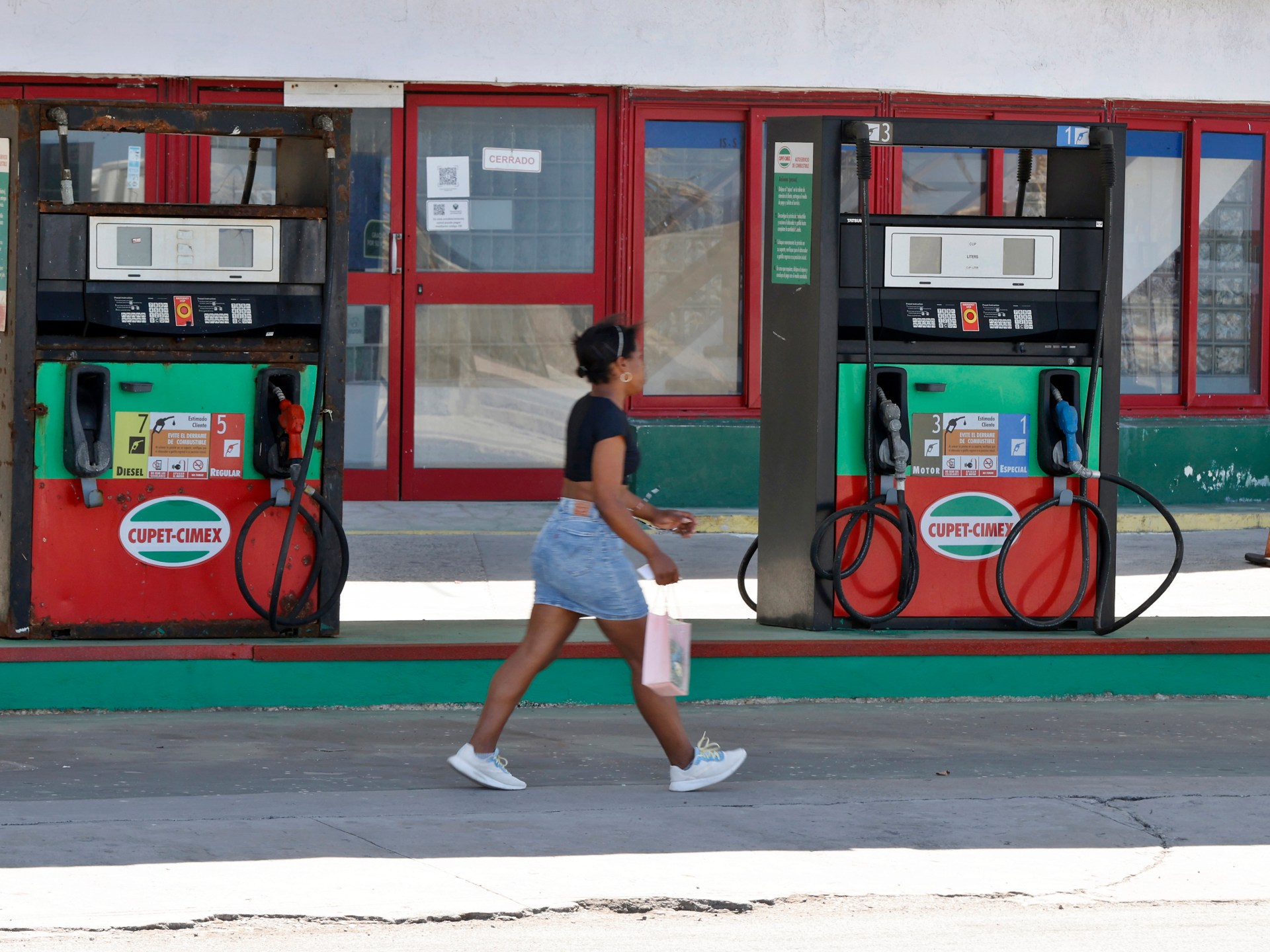
The United Nations Office for the Coordination of Humanitarian Affairs (OCHA) has said the island nation has experienced three nationwide grid collapses in March, “leaving over 10 million people without electricity after three consecutive months without diesel, fuel oil, gasoline, jet fuel or liquefied petroleum gas”.
Last week, the UN released a $94.1m plan to keep critical services running for the country’s most vulnerable residents.
“If the current situation continues and the country’s fuel reserves are exhausted, we do fear a rapid deterioration, with the potential loss of life,” Francisco Pichon, the UN coordinator in Cuba, told reporters.
Rubio, the son of Cuban immigrants, has long opposed Cuba’s communist government, which is currently led by President Miguel Diaz-Canel.
Rubio’s political career has long been defined by calls for regime change, with some observers arguing the US secretary of state was likely a main architect of the Trump administration’s military campaign against Venezuela, which has for years aligned closely with Havana.
Earlier this month, Trump suggested he could “free” or “take” Cuba, even as he said talks with the government were progressing.
“I think I could do anything I want with it,” he said at the time.
Diaz-Canel responded that “any external aggressor will clash with an impregnable resistance”.
Speaking to Al Jazeera on Monday, Rubio also said the situation in Venezuela was “moving along very well” since the abduction of Maduro.
Maduro’s government has largely remained intact under the leadership of interim President Delcy Rodriguez, who has overseen several reforms sought by the Trump administration, including releasing political prisoners and opening the country’s oil industry to foreign companies.
He said US efforts in Venezuela would soon move from “stabilisation” to “recovery”.
“And finally, we want to see a full transition, because in order for Venezuela to fulfil its economic potential, it has to have a stable, democratic government, that people are willing to invest in that economy because they know that they’re protected by laws and courts and legitimacy,” Rubio said.
Advertisement
“So we are well on our way to achieving this,” he said.
Related News
Venezuela’s Maduro set to appear in US court months after abduction
‘Unpleasant surprises’: Will key French cities elect far-right mayors?
Missiles overhead, silence below: Israel’s home front holds firm