
RADHICA DE SILVA
Senior Multimedia Reporter
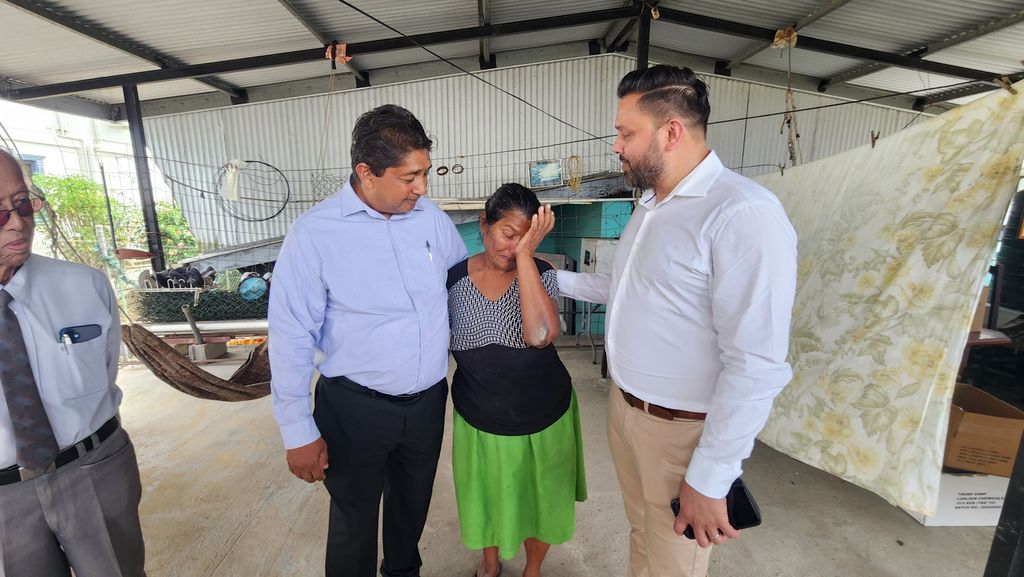
Tears of joy flowed from Jhumantie Mohammed after a Water and Sewerage Authority (WASA) team arrived at her home on Friday, conducting tests and starting excavation of a condemned WASA line which she believes is responsible for the undermining of her Debe home.
Wiping her eyes, Mohammed said she worked hard all her life selling produce in the market, beating rice and doing domestic work to build her home, which she says now has a constant flow of chlorinated water running beneath it.
“I am 72 years old and I worked all my life. I can’t sleep at night, I have to sleep on the couch. It hard for me,” Mohammed said, explaining that she has been begging for the issue to be addressed for nearly a decade. She fears the continuous water flow has weakened her foundation, causing steel and reinforced concrete to rot and her house to shift out of shape.
Hugging Mohammed as she wept, WASA chief executive officer Dain Maharaj promised to find the source of the leak.
Maharaj explained that preliminary sampling was done on site and laboratory testing would take several hours to determine chlorine content and match it against World Health Organization standards for treated water. He noted that once chlorine is detected, it would confirm the source as WASA infrastructure, as there are no raw water lines in the area.
“What we are doing different this time ,” Maharaj said, noting that teams from water loss, operations and the laboratory were all deployed early. “We are actually going upstream where we have an old condemned line, where we are going to excavate shortly, to see if there’s any possibility… and really try to find exactly where this water is coming from.”
He acknowledged Mohammed’s frustration, as previous investigations over the past ten years had attributed the water to cesspit or spring sources, despite her own independent tests indicating chlorinated water. Maharaj assured that WASA would now push further by excavating potential sources and reviewing records, while relying on fresh sampling rather than older data.
Addressing wider concerns about aging infrastructure in the community, Maharaj said WASA is assessing pipe breaks per kilometre and using international benchmarks to determine when entire lines must be replaced rather than repeatedly patched.
Area councillor for La Fortune Debe North, Krishna Persadsingh, welcomed the swift response and credited the intervention of Minister of Public Utilities Barry Padarath.
“Yesterday, he gave the instruction to WASA to come out and do the investigation,” Persadsingh said. “Mr Dain Maharaj reached out almost immediately to me and the resident, and he assembled a team this morning to come out here and lend some assistance.”
Persadsingh said Mohammed had been complaining for about ten years and while some assessments were done, Maharaj has now committed to finding the root cause and ensuring the matter is resolved through collaboration with WASA, the regional corporation or private support if needed.
“Relief is in sight,” he said. “This situation will be resolved now.”
Related News

Energy Chamber to review its internal governance amid STOW controversy

Family of man killed by police wants CoP to step aside from probe
Families to pursue Paria litigation despite ex-gratia payments