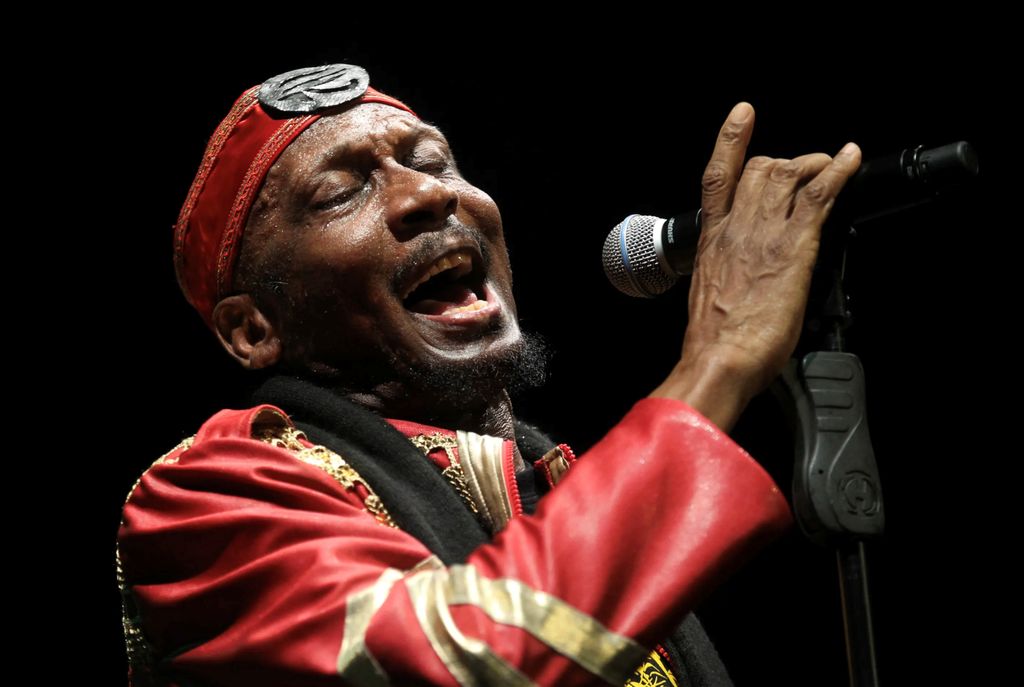

Jimmy Cliff, the charismatic reggae pioneer and actor who preached joy, defiance and resilience in such classics as “Many Rivers to Cross,” “You Can Get it If You Really Want” and “Vietnam” and starred in the landmark movie “The Harder They Come,” has died at 81.
His family posted a message Monday on his social media sites that he died from a “seizure followed by pneumonia.” Additional information was not immediately available.
“”To all his fans around the world, please know that your support was his strength throughout his whole career,” the announcement reads in part. “He really appreciated each and every fan for their love.”
Cliff was a native Jamaican with a spirited tenor and a gift for catchphrases and topical lyrics who joined Kingston’s emerging music scene in his teens and helped lead a movement in the 1960s that included such future stars as Bob Marley, Toots Hibbert and Peter Tosh. By the early 1970s, he had accepted director Perry Henzell’s offer to star in a film about an aspiring reggae musician, Ivanhoe “Ivan” Martin, who turns to crime when his career stalls. Henzell named the movie “The Harder They Come” after suggesting the title as a possible song for Cliff.
“Ivanhoe was a real-life character for Jamaicans,” Cliff told Variety in 2022, upon the film’s 50th anniversary. “When I was a little boy, I used to hear about him as being a bad man. A real bad man. No one in Jamaica, at that time, had guns. But he had guns and shot a policeman, so he was someone to be feared. However, being a hero was the manner in which Perry wanted to make his name — an anti-hero in the way that Hollywood turns its bad guys into heroes.”
“The Harder They Come,” delayed for some two years because of sporadic funding, was the first major commercial release to come out of Jamaica. It sold few tickets in its initial run, despite praise from Roger Ebert and other critics. But it now stands as a cultural touchstone, with a soundtrack widely cited as among the greatest ever and as a turning point in reggae’s worldwide rise.
For a brief time, Cliff rivalled Marley as the genre’s most prominent artist. On an album that included Toots and the Maytals, the Slickers and Desmond Dekker, Cliff was the featured artist on four out of 11 songs, all well placed in the reggae canon.
“Sitting in Limbo” was a moody, but hopeful take on a life in restless motion. “You Can Get it If You Really Want” and the title song were calls for action and vows of final payments: “The harder they come, the harder they fall, one and all.” Cliff otherwise lets out a weary cry on “Many Rivers to Cross,” a gospel-style testament that he wrote after confronting racism in England in the 1960s.
“It was a very frustrating time. I came to England with very big hopes, and I saw my hopes fading,” he told Rolling Stone in 2012.
The music lives on
Cliff’s career peaked with “The Harder They Come,” but, after a break in the late 1970s, he worked steadily for decades, whether session work with the Rolling Stones or collaborations with Wyclef Jean, Sting and Annie Lennox among others. Meanwhile, his early music lived on. The Sandinistas in Nicaragua used “You Can Get it If You Really Want” as a campaign theme and Bruce Springsteen helped expand Cliff’s U.S. audience with his live cover of the reggae star’s “Trapped,” featured on the million-selling charity album from 1985, “We Are the World.” Others performing his songs included John Lennon, Cher and UB40.
Cliff was nominated for seven Grammys and won twice for best reggae album: in 1986 for “Cliff Hanger” and in 2012 for the well-named “Rebirth,” widely regarded as his best work in years. His other albums included the Grammy-nominated “The Power and the Glory,” “Humanitarian” and the 2022 release “Refugees.” He also performed on Steve Van Zandt’s protest anthem, “Sun City,” and acted in the Robin Williams comedy “Club Paradise,” for which he contributed a handful of songs to the soundtrack and sang with Elvis Costello on the rocker “Seven Day Weekend.”
In 2010, Cliff was inducted into the Rock and Roll Hall of Fame.
He was born James Chambers in suburban Saint James and, like Ivan Martin in “The Harder They Come,” moved to Kingston in his youth to become a musician. In the early 1960s, Jamaica was gaining its independence from Britain and the early sounds of reggae — first called ska and rocksteady — were catching on. Calling himself Jimmy Cliff, he had a handful of local hits, including “King of Kings” and “Miss Jamaica,” and, after overcoming the kinds of barriers that upended Martin, was called on to help represent his country at the 1964 World’s Fair in New York City.
“(Reggae) is a pure music. It was born of the poorer class of people,” he told Spin in 2022. “It came from the need for recognition, identity and respect.”
Approaching stardom
His popularity grew over the second half of the 1960s, and he signed with Island Records, the world’s leading reggae label. Island founder Chris Blackwell tried in vain to market him to rock audiences, but Cliff still managed to reach new listeners. He had a hit with a cover of Cat Stevens’ “Wild World,” and reached the top 10 in the UK with the uplifting “Wonderful World, Beautiful People.” Cliff’s widely heard protest chant, “Vietnam,” was inspired in part by a friend who had served in the war and returned damaged beyond recognition.
His success as a recording artist and concert performer led Henzell to seek a meeting with him and flatter him into accepting the part: “You know, I think you’re a better actor than singer,” Cliff remembered him saying. Aware that “The Harder They Come” could be a breakthrough for Jamaican cinema, he openly wished for stardom, although Cliff remained surprised by how well known he became.
“Back in those days there were few of us African descendants who came through the cracks to get any kind of recognition,′ he told The Guardian in 2021. “It was easier in music than movies. But when you start to see your face and name on the side of the buses in London that was like: ‘Wow, what’s going on?’”
NEW YORK (AP) —