Senior Reporter
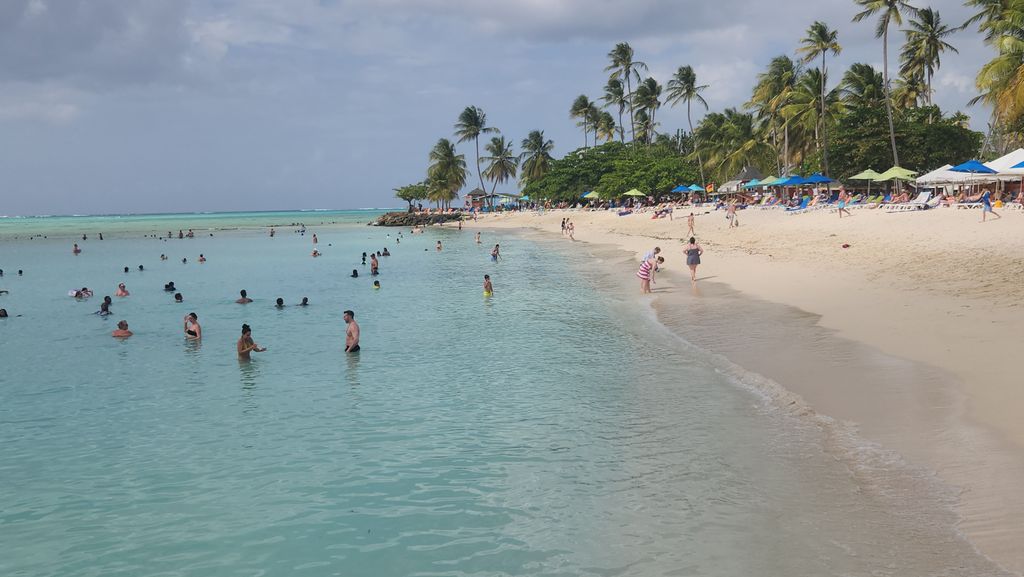
The last time there was a serious maritime accident involving minors at Pigeon Point Heritage Park, the Tobago House of Assembly (THA) was required to pay significant compensation for failing to warn visitors of the dangers posed by boats and watercraft.
On June 12, 2007, Yanik Vincent Quesnel and his then girlfriend, Ana Carolina Barry-Laso—both 17 at the time—were seriously injured after being struck by a pirogue’s propeller while swimming at the popular tourist attraction.
Quesnel, a resident of Cascade, was left paralysed and wheelchair-bound.
Barry-Laso, a Spanish national whom he had met in Costa Rica, where they were both studying, was left partially paralysed. She later regained mobility but was left with a permanent limp.
Through their attorneys, Senior Counsel Douglas Mendes and Kerwyn Garcia, the pair filed a negligence lawsuit—not against the boat operator—but against the THA, the park, and the Office of the Attorney General.
In October 2010, then-High Court judge Judith Jones upheld the claim, finding the THA and the park liable for failing to take adequate steps to ensure the visitors’ safety and prevent the accident. She dismissed the aspect of the claim seeking to hold the State liable.
Justice Jones did not immediately assess damages, as the compensation sought was largely based on the millions of dollars spent by the families on medical treatment.
The THA and the park filed an appeal, but it was withdrawn before determination. The matter was eventually settled during the tenure of former attorney general Anand Ramlogan, SC.
In her ruling, Justice Jones examined which legal entity bore responsibility for the facility after it was purchased in 2005 from businessman Dr Anthony Sabga, founder of the ANSA McAL conglomerate, which also owns this newspaper.
She found that while the land was held by the State, and the waters bordering the facility typically fell under its control, responsibility for both had been vested in the THA and the park under legislation establishing the Assembly.
“Insofar as the liability of the THA is concerned, its liability arises as a result of its occupation of the park, as well as its control over the adjacent waters,” she stated.
Justice Jones rejected claims that Quesnel and Barry-Laso were responsible for the accident by voluntarily swimming in a channel that runs parallel to the beach and is frequently used by boats and other watercraft.
She noted that it was Barry-Laso’s first visit to Trinidad and Tobago and to the facility, while it was only Quesnel’s second visit, his previous one having been when he was between ten and 11 years old.
“I find as a fact that the use of the channel by boats in the adjacent waters presented an unusual danger to sea bathers—one not within the reasonable expectation of visitors to Tobago, and in particular the claimants,” she said.
“Nor does the fact that the claimants may have seen boats, whether moored or moving, suggest that they accepted the risk of injury,” she added.
Ruling that the THA and the park had breached their duty of care, Justice Jones found that liability could have been avoided had adequate warning signs been erected.
“It is clear from the evidence that not only did they have control over the park, but also exercised sufficient control over the beach area—given the presence of concessionaires, lifeguards, bathroom facilities and beach chairs—to allow for the erection of warning signs,” she said.
She also found that the swimming area could have been demarcated from the boat channel, as had been done by the facility’s previous owner prior to the sale.
“In my opinion, the presence of ropes and buoys would not only hinder the use of the channel by boats, but would also provide a warning to operators and demarcate a safe area for bathing,” she said.
“There is no issue as to the reasonableness of the cost of implementing these measures. In my view, the cost is negligible,” she added, noting that such measures were implemented by the THA after the accident.
Justice Jones further found that the failure to warn or restrict boat traffic in the adjacent waters caused or materially contributed to the injuries.
“It would seem to me that had there been signs warning of the risk posed by boats in that area, the claimants would have heeded them,” she said, adding that there was no evidence the specific area held any particular attraction for the pair.
Guardian Media was unable to contact the individuals for comment on the recent death of seven-year-old Angelica Jogie, who was struck by a jet ski while swimming with relatives at the facility on Wednesday.
According to publicly available information, Quesnel is now a neuroscientist, trader and crypto data analyst, while Barry-Laso is an attorney based in the United Kingdom.