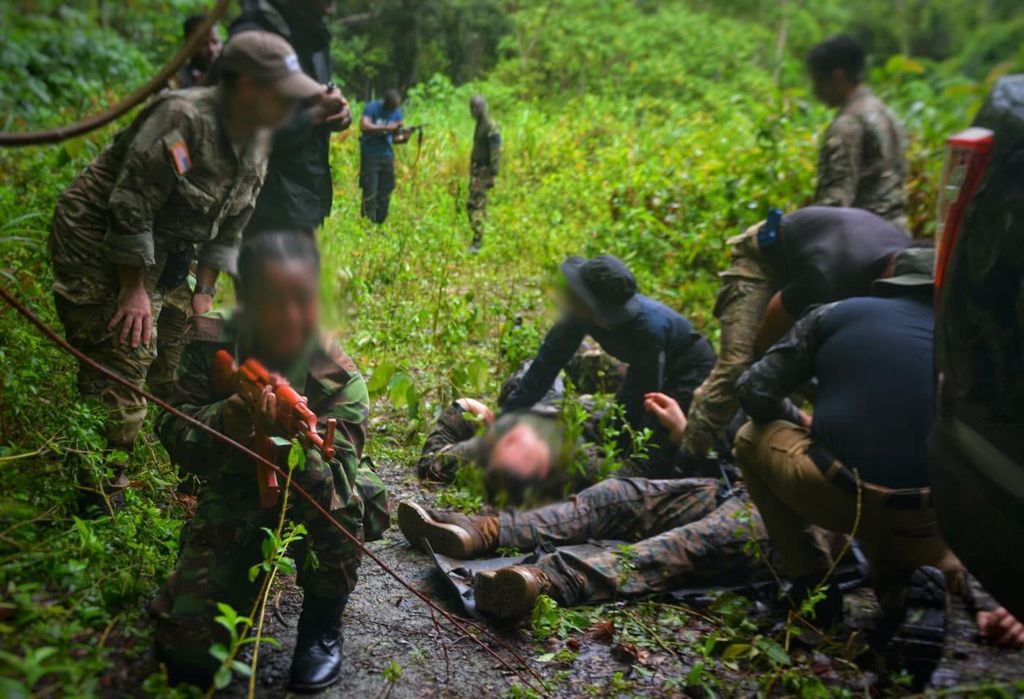
Powerful earthquakes rock Venezuela, killing at least 32 people. Death toll is expected to rise
 25 June 2026

A pair of powerful earthquakes rocked Venezuela, tearing down buildings, closing the country’s main airport and sending panicked residents of the capital pouring into the streets. At least 32 have died, the acting president said Thursday, warning that the toll was expected to rise.
Footage on state TV showed three children, covered in dust but alive, pulled from the rubble in La Guaira state, which Acting President Delcy Rodríguez described as a “disaster zone” and the area hardest hit by Wednesday evening’s 7.2 and 7.5 magnitude earthquakes.
Powerful back-to-back earthquakes struck Venezuela on Wednesday evening, collapsing buildings and sending panicked residents into the streets as communities across the South American country sustained damage.
The quakes, among the strongest to strike Venezuela in more than a century, could be felt throughout the region, with buildings evacuated in places as far away as Brazil’s Amazon, about 1,700 kilometers (1,050 miles) from Venezuela’s capital, Caracas.
While Venezuela sits near multiple fault lines, its position straddling the South American and Caribbean plates makes strong earthquakes much less common than in other parts of Latin America.
Rodríguez declared a state of emergency in an address to the nation late Wednesday, saying the quakes caused damage in several states. She asked health care professionals to report to hospitals to assist the injured.
The casualty figures she released early Thursday — including at least 700 injured — excluded La Guaira, which sits north of Caracas on the coast, and so the numbers are expected to rise.
“Dozens of buildings have collapsed there ... and we are currently carrying out intensive rescue operations to save lives,” Rodríguez said.
Residents fled their homes in panic
Television broadcasts Thursday showed rescue workers using power tools to work their way into piles of rubble. Many people searching for the missing appeared to be regular people, rather than professionals. Collapsed buildings, toppled electric poles and debris blocked streets.
During the quakes, people ran from swaying buildings in Caracas, many visibly shocked when they turned back to see destroyed walls that left furniture visible from the street. Columns of dust rose in two typically busy neighborhoods in the capital.
“It started off gently and then gradually grew, and in the end, we all had to leave our houses, go outside and gather together,” Caracas resident Hector Ricci said.
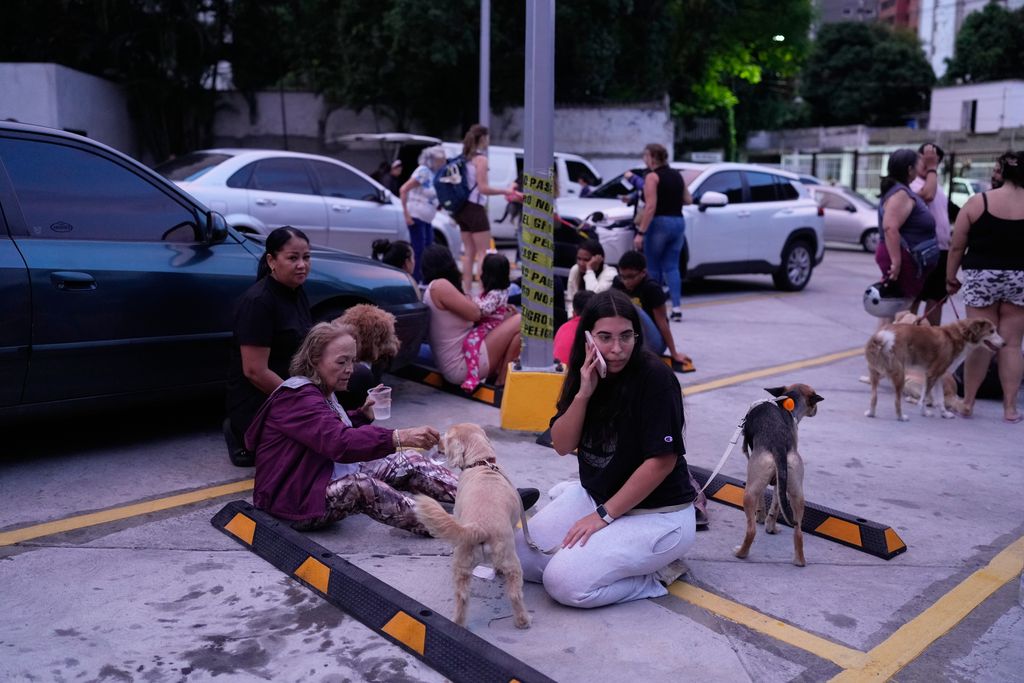
Interior Minister Diosdado Cabello urged people to remain outside as aftershocks could further damage structures, and many people stayed on the streets for hours, some sitting on the ground hugging pets as dust gathered around them. Others spent the night in parked cars, subway stations and other public places.
Parts of the capital lost power and cellphone coverage, and the earthquakes damaged and closed Simón Bolívar International Airport, the country’s main airport, Rodríguez said.
In Caracas, subway services were suspended and natural gas shut off, she said. Classes will also be canceled for several days, and the Ministry of Education said some school buildings would be used as shelters and donation centers.
Roberto Gamas, another Caracas resident, said the building he was in “shook from side to side. Unreal. The force was incredibly strong.”
The lack of cellphone signal in parts of Venezuela deepened the distress of many families, particularly those among the more than 7.7 million people who have left the country during its protracted crisis and who struggled to reach relatives inside the country.
Venezuela opposition leader María Corina Machado, herself in exile, sent wishes on X for “strength, serenity, and solidarity.”
Venezuela was hit twice by large quakes
The U.S. Geological Survey said the first earthquake, with a magnitude of 7.2, hit west of Moron on the Caribbean coast, about 170 kilometers (105 miles) west of Caracas. It had a depth of 22 kilometers (about 14 miles).
The USGS reported a 7.5 magnitude earthquake just a minute later, with a depth of 10 kilometers (about 6 miles) and an epicenter 16 kilometers (10 miles) southwest of Moron.
Several governments offered assistance
Offers of help poured in from countries around the world.
U.S. Secretary of State Rubio said in a post on X early Thursday that the United States is “immediately deploying search and rescue teams, medical resources, and humanitarian assistance to Venezuela.”
Rodríguez — who became acting president after an American military operation captured her predecessor, Nicolás Maduro, and brought him to the U.S. to stand trial — thanked U.S. President Donald Trump. She said in an X post later that she spoke with Rubio by phone without sharing details. She also expressed thanks to the leaders of various nations who have sent messages of support and offers of help.
Ecuador ordered the delivery of humanitarian aid, and Rodríguez said Qatar, Mexico and El Salvador had already sent rescue personnel.
“We send you all our solidarity and our prayers. Stay strong, Venezuela,” El Salvador President Nayib Bukele, once diametrically opposed to Venezuela’s government, wrote in a post on X.
Earthquakes impact the region
Buildings in Manaus, Belem and Macapa in Brazil’s Amazon were evacuated, according to reports on TV Globo. The quakes also were felt in Colombia’s Caribbean and northeast regions.
The U.S. Pacific Tsunami Warning Center issued several tsunami alerts that were quickly lifted.
While uncommon in Venezuela, earthquakes are frequent along the Pacific coast, including in Mexico and Chile, which both sit along the seismically active tectonic belt known as the Ring of Fire, an area that the USGS says is responsible for 90% of earthquakes. —CARACAS, Venezuela (AP)
______________
Story by REGINA GARCIA CANO and JUAN PABLO ARRAEZ | Associated Press
Garcia Cano reported from Bogota, Colombia. Associated Press writers Clara Preve in Buenos Aires, Astrid Suarez in Bogota, Colombia, Mauricio Savarese in Sao Paulo and Anna-Catherine Brigida, Megan Janetsky and India Grant in Mexico City, Cristina Fuentes in Madrid and Maria Teresa Hernandez in Beijing contributed to this report.
Related News

Cops net three in Sangre Grande home invasions
Concerns raised over sole-select method in $3.4B HDC housing contracts
PAHO wants higher taxes to curb harmful consumption of alcohol and sugary drinks