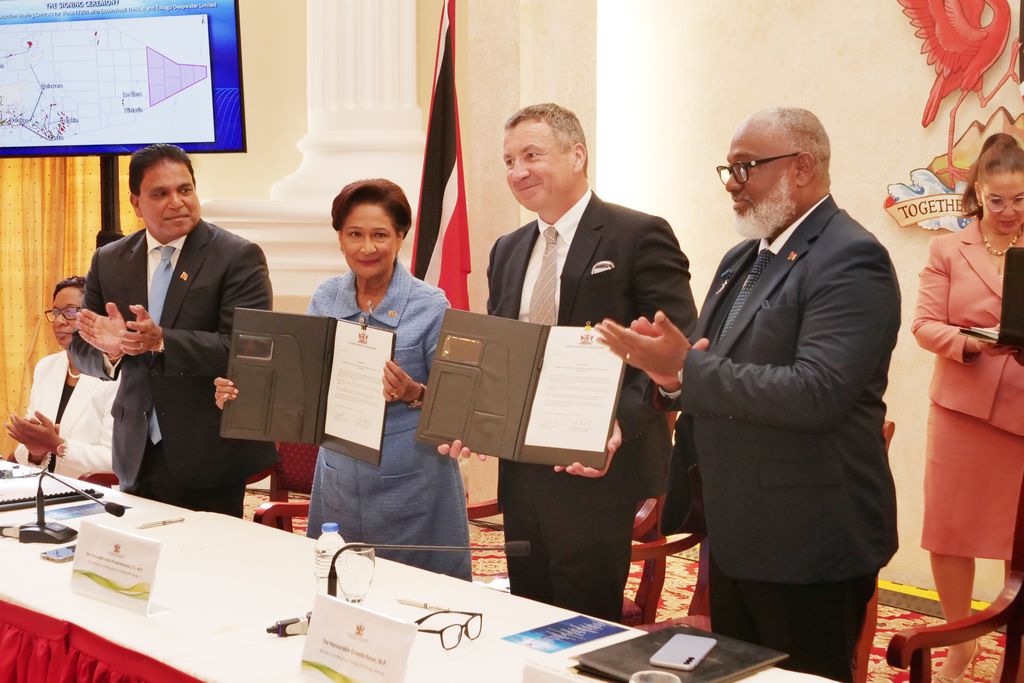

Prime Minister Kamla Persad-Bissessar has made it clear that Trinidad and Tobago’s position on the Dragon gas field remains unchanged, despite the removal of Venezuela President Nicolás Maduro and renewed speculation about whether the stalled project may now have a lifeline.
Responding to a question from Guardian Media on whether the removal of Maduro had positively altered the prospects for Dragon gas, Persad-Bissessar yesterday stressed that the resource belongs to Venezuela and that any decision on its development rests solely with a legitimately elected Venezuelan government.
“Dragon gas is the property of the Venezuelan people. Whenever they choose a leader through free and fair democratic elections, that leader will make a decision on Dragon gas,” the Prime Minister said.
She added that Trinidad and Tobago had never sought to appropriate Venezuelan resources and would instead focus on maximising its own assets.
“T&T does not covet Venezuelan property; we never have and we never will. We will work with what we possess and endeavour to build on it,” Persad-Bissessar said.
Her comments come amid ongoing uncertainty over governance in Venezuela following Maduro’s ouster, conflicting signals regarding the authority of a transitional administration, and questions about the United States’ position on sanctions and energy negotiations.
Maduro is currently facing an indictment in the US in relation to drug charges brought against him by the US, following his removal from Venezuela during a targeted US action on Saturday.
Also contacted for comment on the situation yesterday, former energy minister and energy expert Carolyn Seepersad-Bachan cautioned against drawing conclusions on T&T’s energy future at this stage, citing unresolved questions about who holds authority in Venezuela and who would be empowered to negotiate any cross-border gas arrangements.
“We don’t know who the regime is. Which regime is going to be running Venezuela at this point, even the transitional regime?” Seepersad-Bachan said, noting that it remains unclear whether elections will be held and what form a new administration might take.
She said the uncertainty complicates negotiations, particularly given indications from the United States that sanctions and embargoes on Venezuela remain in place.
“So, who are you negotiating with? We don’t know. That’s my concern. Until that settles, then you would know what your position would be,” she said.
Seepersad-Bachan recalled that under the previous Venezuelan administration, agreed terms and conditions for the extraction of Dragon gas had been established, supported by licences that allowed negotiations and preparatory work. However, those arrangements were later disrupted when Venezuela indicated it was no longer operating under the existing framework.
“The terms and conditions for the extraction of that gas were already there,” she said, adding that it remains unclear whether a future administration would reinstate previous licences or introduce a new legal and regulatory regime.
She also pointed to the continuing role of the US Office of Foreign Assets Control (OFAC), noting that any progress on Dragon gas would still require appropriate licences if sanctions remain in force.
“You still have to go back for the OFAC licence,” Seepersad-Bachan said, describing the existing six-month licence as one that permits negotiations rather than production.
She explained that even if the licence remains valid, negotiations can only proceed meaningfully once there is clarity on the composition and authority of the Venezuelan government, whether transitional or permanent.
Seepersad-Bachan added that uncertainty extends beyond Dragon gas to other cross-border fields, including Loran-Manatee and Cocuina-Manakin, where efforts to resolve unitisation and licensing issues have also been constrained by sanctions and diplomatic conditions.
While T&T has been able to move forward with extracting its own entitlement from Loran-Manatee following de-unitisation, Seepersad-Bachan said the estimated 2.7 trillion cubic feet of gas was insufficient to sustain both the Point Lisas Industrial Estate and the Atlantic LNG facility over the long term.
“That was not adequate,” she said, explaining that Dragon gas had been viewed as a potential supplement to support domestic industry and LNG production.
Despite speculation that political change in Venezuela could unlock stalled projects, Seepersad-Bachan said the current situation suggests otherwise, with US sanctions still in place and no definitive shift in policy.
“I thought if it is that they wanted Maduro removed and they got what they wanted, things would change, but that has not,” she said.
“The situation remains the same.”