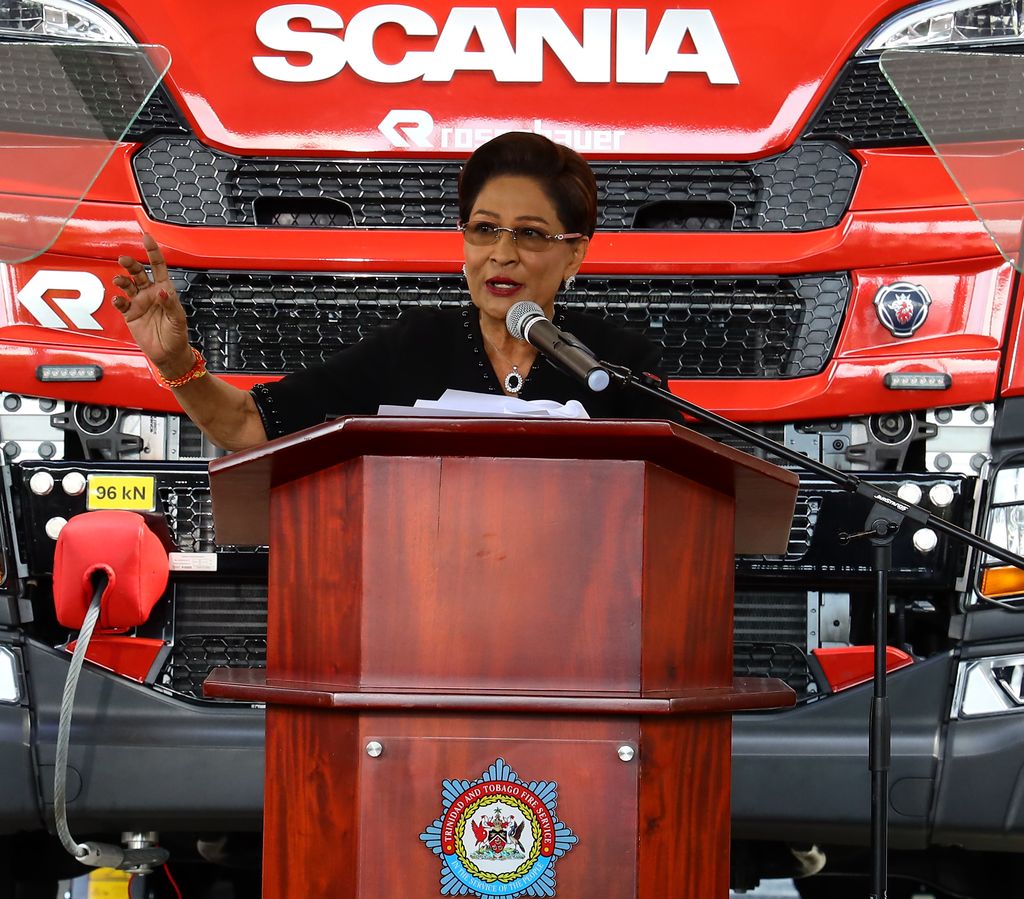

Prime Minister Kamla Persad-Bissessar says a diplomatic delegation will soon travel to Venezuela to ensure Trinidad and Tobago secures its “just share” of cross-border oil and gas resources, signalling a renewed push to advance long-stalled energy projects.
Speaking at a $69 million fire tender handover ceremony in Penal yesterday, Persad-Bissessar said the initiative forms part of a broader strategy to strengthen the country’s economic security alongside improvements in national safety infrastructure.
“Shortly, a diplomatic delegation will depart Trinidad and Tobago to go to Venezuela to ensure we get our just share of the oil and gas, which we partly own through the NGC,” she said.
She did not elaborate further and declined to take questions from the media.
Her comments come amid longstanding negotiations between the two countries over joint energy reserves, particularly the Dragon gas field and the Loran-Manatee field.
The Dragon gas field, located in Venezuelan waters but in close proximity to T&T’s energy infrastructure, has been identified as a critical supply source for the country’s liquefied natural gas (LNG) industry. However, development has been repeatedly delayed due to geopolitical tensions and sanctions imposed on Venezuela by the United States.
Similarly, the Loran-Manatee field, which straddles the maritime boundary between the two countries, has long been the subject of complex bilateral arrangements. While T&T has proceeded with development of the Manatee portion, negotiations have continued over how best to treat the Venezuelan Loran reserves.
Relations between Port-of-Spain and Caracas have fluctuated over the years, with disputes over access, revenue-sharing and operational control. These tensions intensified under the administration of now deposed Venezuelan president Nicolás Maduro, particularly as the United States had imposed sanctions targeting his government, complicating cross-border energy cooperation. Many of those sanctions have since been lifted by the Donald Trump administration after Delcy Rodriguez was installed as the interim Venezuelan leader.
However, Persad-Bissessar, in making the announcement, said her Government is working with the US government and other governments to ensure that Trinidad and Tobago benefits fairly from shared resources.
“We are looking not only at safety and security in the physical sense, but also economic security for our people,” she said.
When asked whether she would personally accompany the delegation, Persad-Bissessar said the details remain “a work in progress.”
Energy expert and former minister Carolyn Seepersad-Bachan yesterday welcomed the move, noting that there has been considerable anticipation surrounding the outcome of ongoing discussions involving cross-border gas development.
She pointed to the importance of expanding existing United States Office of Foreign Assets Control (OFAC) licences—currently issued to major energy companies such as Shell and BP—to a country-specific framework that would include T&T’s state entities like the National Gas Company (NGC).
According to Seepersad-Bachan, such an approach would provide greater legal certainty and allow NGC to participate fully in negotiations without risking breaches of US sanctions. She said a 2010 unitisation agreement had initially facilitated joint development of the cross-border reservoir by Chevron on the Venezuelan Loran side and Shell on the Trinidad-based Manatee side. However, sanctions later rendered that arrangement impractical, leading to the de-unitisation of the field.
Seepersad-Bachan said T&T has since advanced plans to independently develop the Manatee reserves—estimated at 2.7 trillion cubic feet of gas—with first production expected around 2027.
She explained that, from a petroleum engineering standpoint, unitisation is generally preferred, as it maximises recovery, prevents competitive drilling and reduces duplication of infrastructure.
Guardian Media attempted to contact Energy Minister Roodal Moonilal and NGC chairman Gerald Ramdeen for comment, but was unsuccessful, as calls went unanswered.
Related News

Police seek help to find missing Sangre Grande man
Just under 300 political parties, coalitions to participate in upcoming Haiti election

One dead, teen among three wounded after Belmont attack