
Senior Reporter
dareece.po[email protected]
A heated confrontation broke out in the Lower House yesterday, after the Government moved to abruptly end debate on a private member’s motion, triggering a dramatic Opposition walkout and accusations that the administration was stifling dissent in Parliament.
The motion, first brought by Laventille West MP Kareem Marcelle on January 26, sought to have the House take note of the socio-economic impact of rising unemployment in communities following mass terminations and the non-renewal of contracts.
It also called on Government to urgently respond to what it described as a developing socio-economic crisis by providing adequate and meaningful social relief measures.
The debate featured contributions from several MPs over two sittings, including Barry Padarath (UNC), Dr Nyan Gadsby-Dolly (PNM), Clyde Elder (UNC), Dominic Romain (PNM) and Vandana Mohit (UNC).
When debate resumed yesterday, Mohit continued her contribution before Symon de Nobriga (PNM) and Energy Minister Dr Roodal Moonilal took the floor.
However, Moonilal then moved to bring the debate to an immediate close.
“Given the friviolous, vexatious, ill-advised wording and intent of this motion, I believe it should be defeated forthwith. And, Mr Speaker, in those circumstances, in accordance with standing order 52-1, I beg to move that the question be now put.”
Standing Order 52(1) states: “After a question has been proposed, any Member may at any time during the course of debate rise in his place and move ‘That the question be now put’ and unless it appears to the Chair that that motion is an abuse of the rules of the House or an infringement of the rights of the minority, the question ‘That the question be now put’ shall be immediately put.”
However, Standing Order 15 provides that a minister may move that the House adjourn after the conclusion of questions to ministers. On private members’ day, except with the agreement of the Opposition whips, the House is not supposed to be adjourned earlier than 6 pm.
The debate was wound up around 4.30 pm.
Port-of-Spain South MP Keith Scotland rose to object, arguing that granting the request would violate his right to speak on a day specifically allocated for private members’ business.
“It is my respectful submission that to accede to this request abuses my rights to speak on a private members’ motions day, which today (yesterday) has been specifically allocated for.”
However, before Scotland could complete his submission, House Speaker Jagdeo Singh interrupted and began outlining the relevant standing orders governing the closure of debates.
Singh explained that Standing Order 46(2) allows a minister to move to close debate on a motion critical of the Government, but noted this provision applies only to ministers. He said Standing Order 52 is a rule of general application and allows any member to move that “the question be now put.”
The Speaker said the chair could only refuse such a request in two narrowly defined circumstances: if the motion constitutes an abuse of the rules of the House, or if it infringes on the rights of the minority.
“The discretion which is to be exercised is not an open-textured one. It is only in two very narrowly circumscribed circumstances that it can be refused. That’s the problem. The way the standing orders are constructed is that once you don’t meet either an abuse or a suppression of the minority, the question has to be put,” Singh said.
“In my respectful view, the evidence does not arise to an abuse of the rules and neither is it an infringement on the rights of the minority.”
Opposition members immediately protested as the Speaker continued his ruling.
“Everyone has a right to speak but historical evidence is... no, no, I am ruling. I don’t wish to hear anyone,” Singh said as opposition MPs voiced objections.
Scotland insisted he had been prevented from completing his submission.
“You stopped me in the middle of making my submission,” he shouted, his voice audible in the chamber despite his microphone being turned off.
“I heard you. Have a seat, have a seat,” the Speaker responded.
But Scotland continued to protest, telling the Speaker: “Hear me before you rule.”
Singh admonished him, saying both of them could not be on their feet at the same time and instructing him repeatedly to take his seat.
Opposition members were heard shouting, “It is a disgrace, it is an abuse of process.”
As the confrontation escalated, the Speaker called for a marshal.
When Singh eventually put the question to the House, the Opposition benches were empty after PNM members walked out.
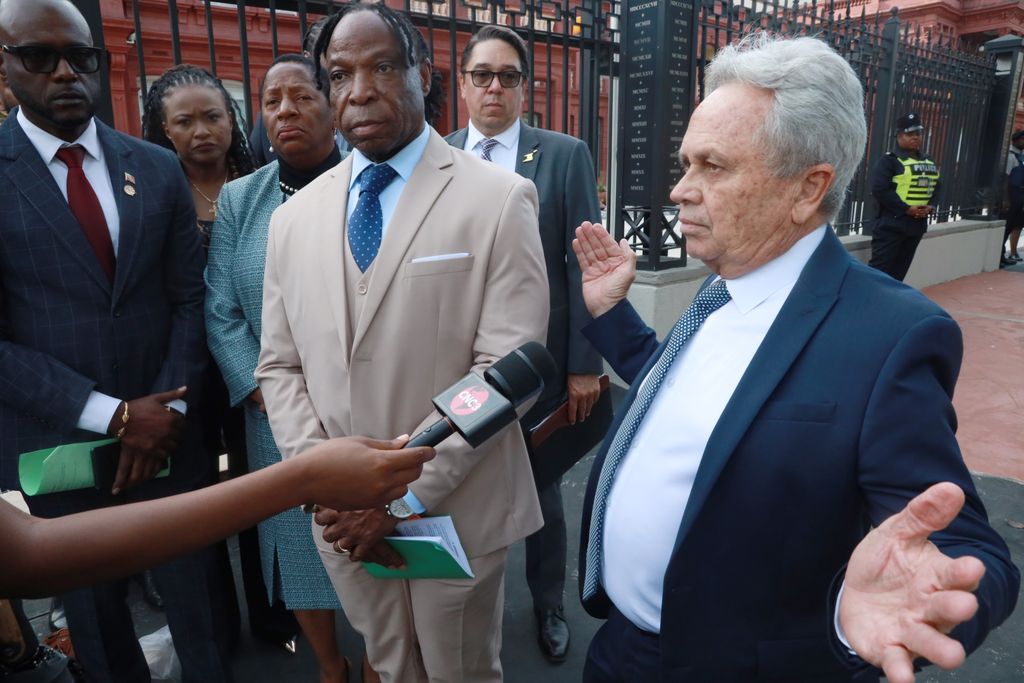
Outside Parliament, Opposition MPs condemned the ruling. They described the decision as outrageous, dangerous and a violation of the rights of the minority in the House and promised to protest.
“There is nothing in the SoE regulations that prevent us, the people of Trinidad and Tobago, from hitting the streets and letting our voices be heard against this wicked, brutal dictatorship that we have as a Government in Port-of-Spain. Enough is enough and it is time to push back against them,” Opposition Chief Whip Marvin Gonzales said.
“Because when you can shut down an opposition utilising your majority, invoking the standing orders in a clear abuse of process in the way that we are seeing today (yesterday), it is time to say enough is enough and push back against all of them within the confines of the law.”
Scotland described the incident as a dangerous moment for parliamentary democracy.
“If you really internalise what has happened, they have literally shut down democracy in Trinidad and Tobago as we know it,” he said, accusing Government of being uncomfortable with facts surrounding its “dismal” performance over the past ten months.
“This is one of the darkest days in our history, you know, parliamentary history ... How could this not be an infringement of the right of the minority when we have come today for that specific purpose?” he questioned.
Diego Martin North/East MP Colm Imbert also criticised the decision, saying the Opposition had been prevented from responding to what he described as misinformation raised during the debate.
He specifically took issue with Energy Minister Dr Roodal Moonilal’s attempt to compare the termination of workers from CEPEP, URP and the reafforestation programme with the layoffs that occurred at Caroni and Petrotrin.
“In one case, people got billions of dollars in severance and so on. In another case, people got zero,” Imbert said.
He noted that the motion highlighted how Government’s actions disproportionately affected single mothers, female-headed households, youth, the elderly and persons with disabilities, increasing food insecurity, school absenteeism, mental health strain and the risk of exploitation and social exclusion.
“In my 34 years as a public servant, as the longest-serving parliamentarian at this time, and one of the longest-serving ever, I have never experienced this,” he said.
“As far as I am concerned, this is a total abuse of process, and it is a total infringement of our rights, because the way the standing orders are worded, it is the infringement of the rights of the minority. We are the minority.”