
Lead Editor-Politics
akash.sama[email protected]
The law to give sweeping authority to the Prime Minister and National Security Council (NSC) to designate communities as security zones and deploy expanded police and military powers has been defeated in the Senate.
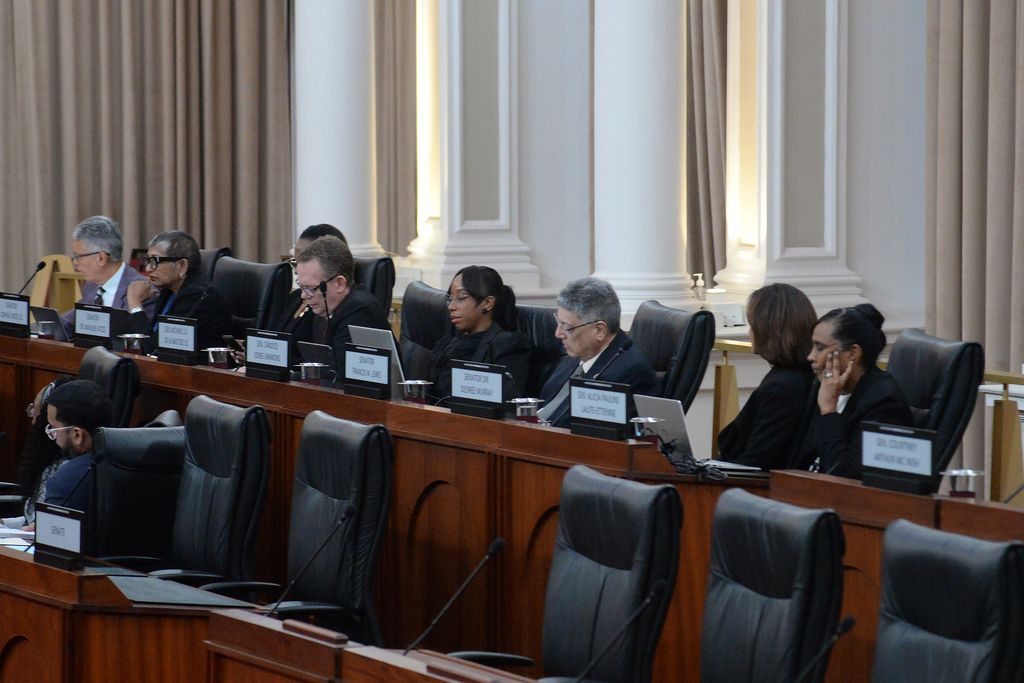
The Law Reform (Zones of Special Operations) Special Security and Community Development 2026 Bill, which required a three-fifths majority for passage, did not receive support from a single Independent Senator last night. The Government needed at least four Independent Senators to support the legislation for its passage.
However, when it came to a vote after four sittings of the Upper House, the 15 Government Senators voted in favour, 14 voted against, inclusive of eight of the nine independent senators and six Opposition senators, and there was one abstention - Independent Senator Courtney Mc Nish.
This means when the State of Emergency expires on January 31, the Government will not be able to implement its ZOSO initiative, which it said was paramount to continuing the gains made against the criminal elements during the SoE.
Before the bill went to a vote yesterday in the Upper House, Attorney General John Jeremie gave the Independent and Opposition benches notice that the Government would not be making any amendments to the 28 clauses in the bill.
During the Committee Stage of the bill where amendments are usually considered, Jeremie explained that there was no time to fully ventilate the almost 50 amendments proposed by both Independent and Opposition benches.
“We are maybe 72 hours away from the end of the State of Emergency, and we wish to have something in place by then,” Jeremie said.
Independent Senator Anthony Vieira expressed disappointment with the Government’s position.
“When I listened to you and Minister (Wayne) Sturge initially, I was under the impression that Government might have been open to taking amendments,” Vieira said.
However, Jeremie took the position that the amendments proposed by the Independent Senators were “substantial” and should not be dismissed quickly. However, again, he said that time did not permit any prolonged discourse.
“We will not be close to that before the 31st, and something will have to be put in place on the 31st. That is what our intelligence agencies tell us. I apologise for that, because that is not the way we normally do business. But then this debate has gone on for a considerable period of time,” the AG said.
One of the major amendments proposed was to insert a “sunset clause” into the bill, which is essentially an expiration date. Independent Senators argued that it would allow the Government and Parliament the opportunity to review the law and its effectiveness.
However, the Attorney General, in winding up the debate, rejected that suggestion.
“Why no sunset clause? We say the bill does not require a sunset clause because clause 28 already provides for a review by way of a parliamentary committee. Further, the bill is not a short-term measure to address criminality and escalating levels of violence in a society.”
Jeremie added, “There’s another reason why there’s no sunset clause on it and this has to do with the soft part of the legislation, the Social Transformation Committee. Once that starts, I’m told by my colleagues in Jamaica that that is actually a very powerful tool in terms of getting the communities to buy in to the fact that life can be better without the gangs. They are able to access services, they are able to come out of their houses, they are able to do things that they would not normally do.”
But while Jeremie did not accept any amendments, he invited the Independent Senators to have a discussion with him at a later date.
“We do, however, commit to a continuous process of engagement with the independents in particular, and we’d like to discuss with them a structure in which that could take place.”
Independent Senator Dr Desiree Murray still brought forward her amendment for the mandatory use of body cameras in ZOSOs. The bill said the body cameras should be used but only if the device is available.
However, the AG said there is already a standing order for the mandatory use of body cameras. He said this was one matter that he will consider, as he believes officers in ZOSOs are utilising body cameras.
The AG was asked by Opposition Senator Dr Amery Browne if this means he would delay the passage of the bill until this is addressed. However, Jeremie said he did not know the state of the T&T Police Service and its body cameras. He only reiterated that body cameras should be worn by police officers.
Focus will now be on Prime Minister Kamla Persad-Bissessar, who earlier this month sparked significant national debate following her sharp criticisms of the Independent Senators during the deliberation of the bill.
The Prime Minister launched a blistering attack on critics of the legislation, including members of the Independent bench, describing them as “weak men and women” and “pseudo-independent groups” whom she accused of effectively “defending violent criminals.”
She went further, branding some senators as “shameless,” “bootlickers” and “brown-nosers,” and suggesting they were advancing the political interests of the Opposition People’s National Movement (PNM) rather than acting in the public interest.
In response, Independent Senators, including Anthony Vieira and Michael de la Bastide, rejected the accusations, defending their role as one grounded in independent oversight. They said their responsibility in Parliament is to ask “uncomfortable questions,” scrutinise legislation and hold the Executive to account, not to serve as a “rubber stamp” for the Government.
About the bill
The proposed Law Reform (Zones of Special Operations) Bill, 2026, would have given the Prime Minister, in consultation with the Police Commissioner and Chief of Defence Staff, the authority to designate specific high-crime areas as “Zones of Special Operations” (ZOSOs) where criminal activity is deemed serious and escalating.
Once a zone is declared, the legislation would have granted expanded powers to a joint police and military command. These included the ability to deploy combined security forces into the area, establish security cordons for up to 24 hours, impose curfews lasting as long as 72 hours, and conduct searches without a warrant under certain conditions. Officers could also detain individuals suspected of involvement in criminal activity, subject to limited court oversight.
A ZOSO could have remained in effect for up to 180 days.
Beyond enforcement measures, the bill also sought to establish a Social Committee tasked with assessing non-security needs within designated zones, including infrastructure, housing, health and education, and recommending social intervention programmes aimed at long-term community development.