
United States forces have departed their remaining bases in Iraq as the Global Coalition to Defeat ISIL (ISIS) expires, opening a new chapter in Iraqi security.
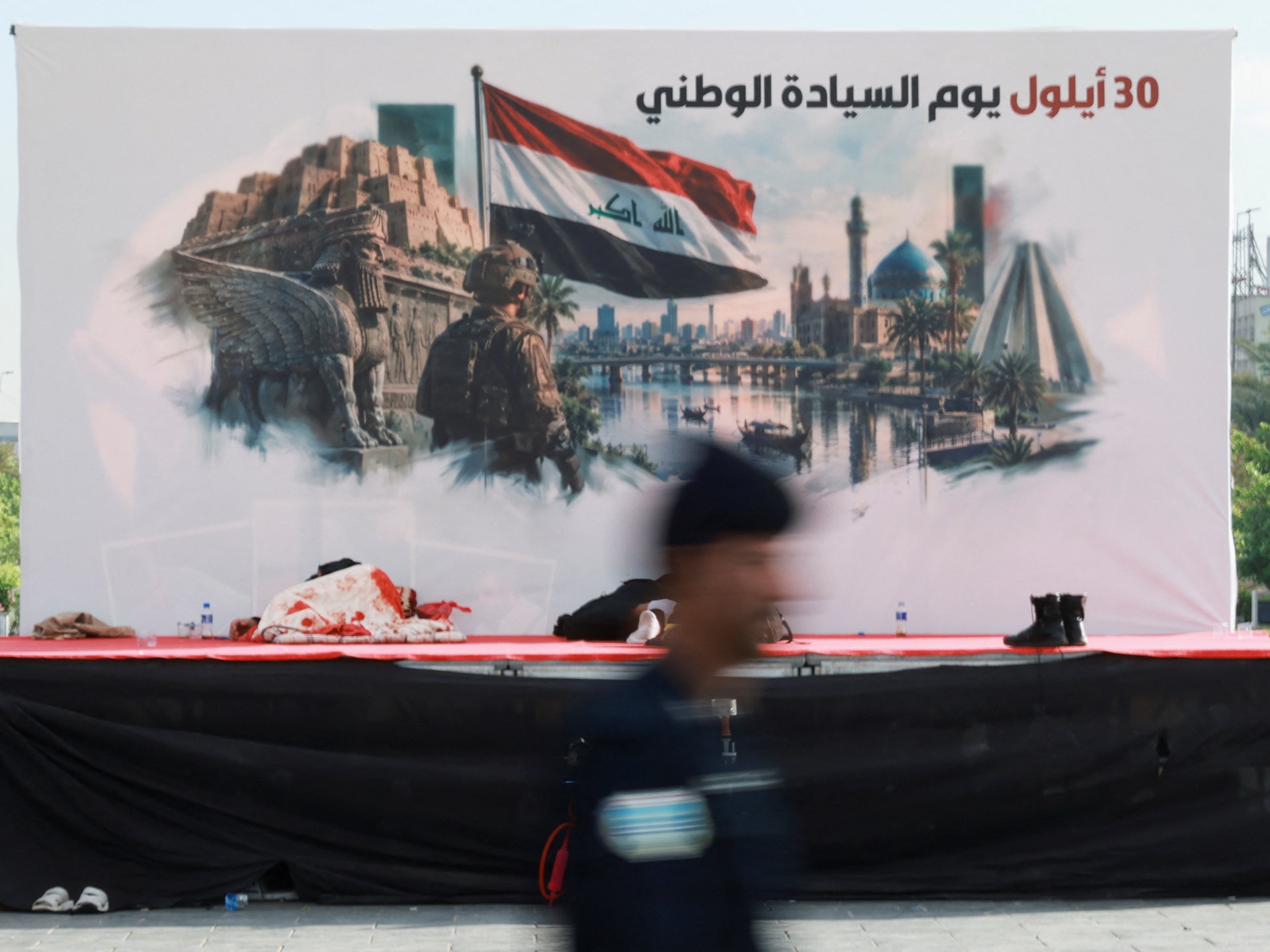
Baghdad is marking the occasion with four “Sovereignty Days”, a national holiday from September 30 to October 3 that underscores the deep symbolism of the US exit.
- list 1 of 3US troops fully withdraw from Baghdad base after two decades
- list 2 of 3Iraq begins high-stakes security balancing act as US troops withdraw
- list 3 of 3Will Turkiye end its military presence in northern Iraq?
end of list
However, the withdrawal raises questions about what comes next.
What really ended on September 30?
Wednesday’s deadline brought an end to a two-year phased withdrawal process of US troops from Iraq.
A joint Iraq-US statement issued in September 2024 announced that the Global Coalition to Defeat ISIL would wind down in two stages.
The first would be the end of combat operations inside Iraq by the end of September 2025 at the latest.
The second stage would continue until September 2026, to support operations against ISIL in Syria, according to a mechanism determined by the US-Iraq Higher Military Commission.
In January, Iraq announced that coalition advisers had completed their withdrawal from federal areas, but logistical support for operations in Syria would continue via a base in Erbil, the main city in Iraq’s semi-autonomous Kurdish region.
The US withdrawal on Wednesday ends Washington’s 12-year operation supporting Iraqi forces in the fight against and defeat of ISIL, which began in 2014.
US forces have been concentrated in northern Iraq, comprising some 2,500 military personnel in recent years, as well as in Syria.
After the 2003 invasion of Iraq, there were 170,000 US troops in the country at the height of the US occupation in 2007.
Advertisement
These US forces were withdrawn from Iraq under President Barack Obama in 2011. A later contingent was invited back to Iraq in 2014 following the rise of ISIL, mostly providing air support and training to Iraqi forces.
![Members of the Iraqi security forces drive in a convoy through Baghdad to celebrate the withdrawal of US-led coalition forces from Iraq September 30, 2026 [Ahmed Saad/Reuters]](https://www.aljazeera.com/wp-content/uploads/2026/09/2026-09-30T082654Z_1534756323_RC2KTNAPDJ1H_RTRMADP_3_IRAQ-USA-COALITION-1790757678.jpg?w=770&resize=770%2C514&quality=80)
What are US forces taking with them?
It’s not just US soldiers leaving Iraq. Military equipment, including crucial air defence systems, is also being withdrawn.
US air defences in Erbil have played a role in intercepting Iranian ballistic missiles and drones during the current war.
Kurdish military commander Sirwan Barzani told the Reuters news agency that Iraq could also lose three other capabilities: US intelligence, logistical support and drones.
The concern is most acute in Iraq’s semi-autonomous Kurdish region, which is administered by the Kurdistan Regional Government (KRG).
The KRG’s Ministry of Peshmerga Affairs – which oversees Kurdish armed forces and was instrumental in the fight against ISIL – said the region had come under more than 1,000 drone and ballistic missile attacks since the US-Israeli war on Iran began on February 28.
“Leaving the Kurdistan region without providing any defence system is a cause for concern,” KRG Prime Minister Masrour Barzani said on Sunday.
Barzani’s office was targeted in a drone attack last month, which officials claim was launched from Iranian territory.

What can Iraq do on its own?
Baghdad says that many security tasks had already been passed to Iraqi forces ahead of the deadline.
On Monday, Iraqi Air Force commander Lieutenant General Khalid al-Tamimi told state news that no coalition force had carried out any duties inside Iraq since the start of 2026.
Iraqi drones have replaced coalition aircraft for reconnaissance, he said, and the air force conducts daily aerial surveys of the country.
He touted Iraq’s independent operation and maintenance of its fleet of F-16 fighters, saying they had conducted missions for 10 days without outside help.

Air defence support, however, remains the most sensitive issue.
In mid-September, Iraqi military spokesperson Sabah al-Numan announced the nation was close to procuring air defence systems from South Korea, Turkiye and the United States.
Advertisement
They would be deployed under carefully studied military plans “to ensure full protection of Iraqi airspace, including the Kurdistan region”, he told the AP.
Hassan Barari, professor of international relations at the University of Jordan, told Al Jazeera that it is “unlikely” that the Iraqi state is currently capable of protecting its airspace from missiles and drones, The prospect of future Iranian strikes on Erbil was one example, he added.
Does the withdrawal give ISIL an opening?
ISIL is a shadow of the force it was a decade ago, when it held nearly a third of Iraq.
After sustained pressure from Iraqi forces, the group is currently “at its weakest” with just a few hundred fighters, the latest report by the UN secretary-general said.
Chief Pentagon spokesman Sean Parnell hailed “the success of a 12-year campaign” against the armed group and “a transition from a wartime coalition mission to an Iraqi-led security effort”.
Iraqi forces would lead efforts to keep Iraq secure and ISIL “suppressed”, he added.
ISIL cells have not disappeared from Iraq entirely. Iraqi security and army officials told Reuters on Wednesday that the group had planned attacks to coincide with the withdrawal of the US, showing it can still exploit security gaps.
ISIL “is seeking to send a message that the group is still powerful and capable of launching bloody attacks”, Colonel Khalid al-Bayati, a senior Iraqi security official, told the agency.

Some of Iraq’s non-state armed groups, in particular militias linked to Iran, see the US exit as a victory.
Abu Mojtaba al-Yasiri, a commander in the Islamic Resistance in Iraq, an umbrella group of Iran-aligned militias, told Reuters the withdrawal was “a historic victory for the Iraqi Islamic resistance groups and honorable Iraqis, and a crushing defeat for the American project”.
However, the withdrawal does not necessarily mean these groups will lay down their arms.
Baghdad had initially declared that the September 30 coalition withdrawal would also be a deadline for all armed groups in Iraq to surrender their weapons. Many armed groups rejected the deadline, which Baghdad has now pushed back to June 2027.

What role remains for Washington?
The departure from the bases does not mean the US is stepping back from Iraq’s security affairs.
The 2024 joint US-Iraqi statement that kicked off the withdrawal process envisaged a transition to bilateral security relations.
At a security cooperation dialogue in July 2024, the two countries agreed on a new phase including liaison officers, training and security cooperation programmes.
They also discussed the strengthening of Iraqi forces through military assistance, arms sales and financing. They stressed the importance of maintaining US equipment used by Iraqi forces and bolstering military education and training.
Advertisement
After Iraq took control over US headquarters at Baghdad airport on Monday, Lieutenant General Saad Maan told local media that the handover does not mean an end to security cooperation with international partners, but building a relationship built on mutual respect and preserving the independence of Iraqi decision-making.
In that sense, September 30 marks the beginning of a new phase in the Baghdad-Washington security relationship rather than an end to it.
The question is no longer how many US boots are on the ground in Iraq, but how Iraqi institutions can shoulder the country’s security burdens, and where the US-Iraq relationship goes next.
Related News
Egyptian parliament delays vote on military support for Saudi Arabia
10 injured after car crashes into rugby supporters in Australia
Yemeni government forces claim 1,860 Houthis ‘neutralised’