Guevarro under fire for saying mosquitoes kept officers from drug arrests
 13 December 2025
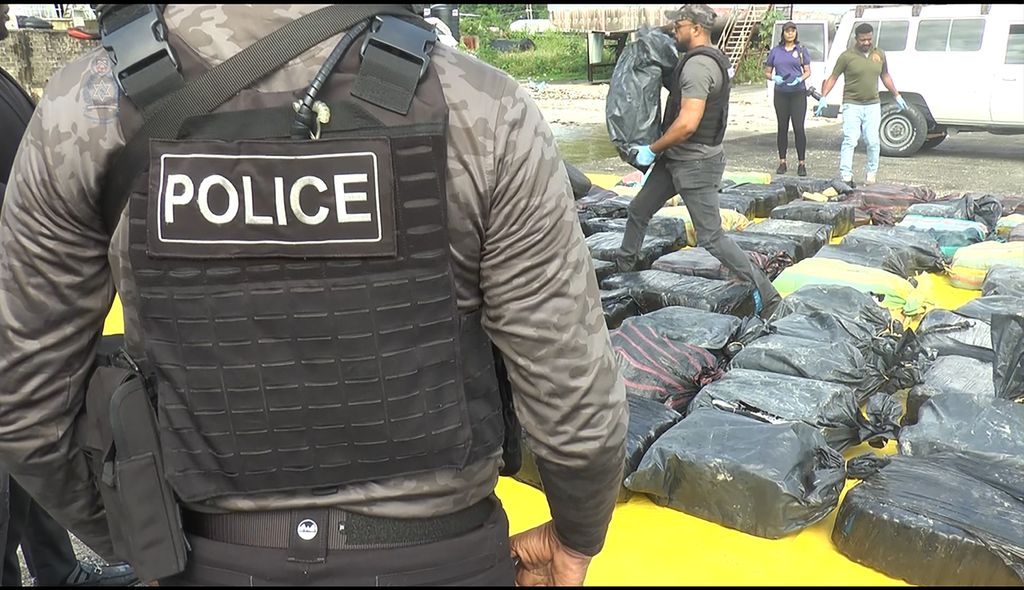

Former T&T Defence Force Lieutenant Commander Norman Dindial is blasting Police Commissioner Allister Guevarro for failing to make any arrests in two multi-million-dollar drug busts over a span of 24 hours.
Dindial’s comment came after Guevarro claimed the TTPS made no arrests in drug hauls at Caroni Swamp and in Point Fortin because he did not want to subject his officers to the possibility of getting dengue from mosquito bites while doing surveillance on the stashes.
During his speech at the opening of the City Police sub-station in Port-of-Spain, yesterday, Guevarro confirmed the US-installed radar was used to detect a second marijuana stash in Point Fortin. This time, he said some 625 kilogrammes were seized. This followed the seizure of 1,560 kilogrammes of “creepy marijuana” with an estimated street value of $171,205,320 in the Caroni Swamp on Wednesday night.
Before he could be asked why no arrests were made, however, Guevarro said it would have been pointless to leave his officers waiting on the owners of the drugs.
Commenting on why no arrests were made in both seizures, Guevarro said: “We had to go with a boat (for Caroni Swamp raid), and hearing this boat coming from miles away, you know the police coming. You ain’t going and come back for the weed. So, what the police will do? We take it up and we move with it because we’re not going to leave it there for it to end up on the streets.”
He added: “Likewise, same thing last night (Thursday). When you enter South Central Road, the first thing you see, men on their phones. So, why would I leave my officers to do surveillance in the bush for two and three nights to get mosquito bite and dengue when the simplest thing would be to just take the marijuana and remove it and later destroy it because it is not in the hands of those persons who would take it to monetise it and then victimise you, the public.”
However, Dindial yesterday said the excuse given made no sense, as the drugs could have been tagged and tracked, or the Regiment could have been used if the TTPS felt the surveillance task was overwhelming. “That makes no sense. That shows you that you have no operational capabilities and you don’t know about how operations work. It’s telling me that you’re afraid your men can get dengue,” he said.
“You have the army. That is rubbish, you telling me that you could not have placed a tracking device on the drugs itself and track the drugs when the drug is moving?”
He also disputed the TTPS account that the radar was used to track down the Caroni Swamp stash.
“The radar cannot see through the Northern Range. The radar cannot see anything at all that’s in Caroni Swamp. So, they are blatantly lying because they are using, or they’re trying to use a propaganda mechanism to justify putting that radar where it is right now. The radar cannot, simply put, see into the Caroni Swamp.”
Guevarro, when asked why the boat with the 1,560 kilogrammes of marijuana had no engine, said it was not a boat that brought the drugs to Trinidad and Tobago. Rather, he said, the drugs were merely stashed on the boat it was found in. He denied that the video of the find was part of a re-enactment, saying the police service was not Hollywood. Prime Minister Kamla Persad-Bissessar also confirmed that the drugs were found with the assistance of the US-installed radar in Tobago. During her speech at an award ceremony for outstanding students in the Caribbean Examination Council’s (CXC) at the Government Plaza, Port-of-Spain, on Thursday night, Persad-Bissessar deviated from her script to thank the US for the radar.
“Today, I met with some officials from the US Embassy this evening (Thursday) before I came. That’s not in my script, but I can share it. Using the radar that we installed in Tobago, we were able today to drug bust $171 million worth of illegal drugs.”
Meanwhile, former police commissioner and minister of national security Gary Griffith yesterday said the value of the “sensitive equipment” is now being undermined by the growing tendency of some to oversell, overexplain, or publicly justify its installation.
He first chastised Homeland Security Minister Roger Alexander for saying the radar can be used in the kidnapping of couple Derrick and Claribel Tardieu.
“Just as it seemed the situation could not deteriorate further; the Commissioner of Police issued a media release “thanking” the radar for assisting in targeting criminal elements. The statement read more like a marketing testimonial than a communication from the nation’s chief law enforcement officer. I cannot recall any precedent where law enforcement thanks a piece of equipment.”
He said this was not “ a trivial misstep,” adding that law enforcement should retain the appearance and reality of institutional independence.
“The credibility of the TTPS is not strengthened when it appears aligned with political messaging. Sensitive national-security assets must be protected from unnecessary exposure, not paraded for public justification. If we continue down this road, the radar will lose its strategic advantage long before it delivers its full operational value. That would be a disservice to the public, to national security, and to the very institutions tasked with protecting this nation.”
Alexander, who was also at the opening of the police post, said he did not want to divulge who gets the data from the radar, as that is a matter of national security. He added that perhaps in time he could reveal that.
Asked if there were any other radar systems installed in Trinidad that could have been used, Alexander said: “What we can tell you is this, technology is the way to go, and we are going in that direction to ensure that our law enforcement officers are technology-ready.”