Flavio Bolsonaro enters Brazil’s 2026 presidential race with father’s nod
 05 December 2025
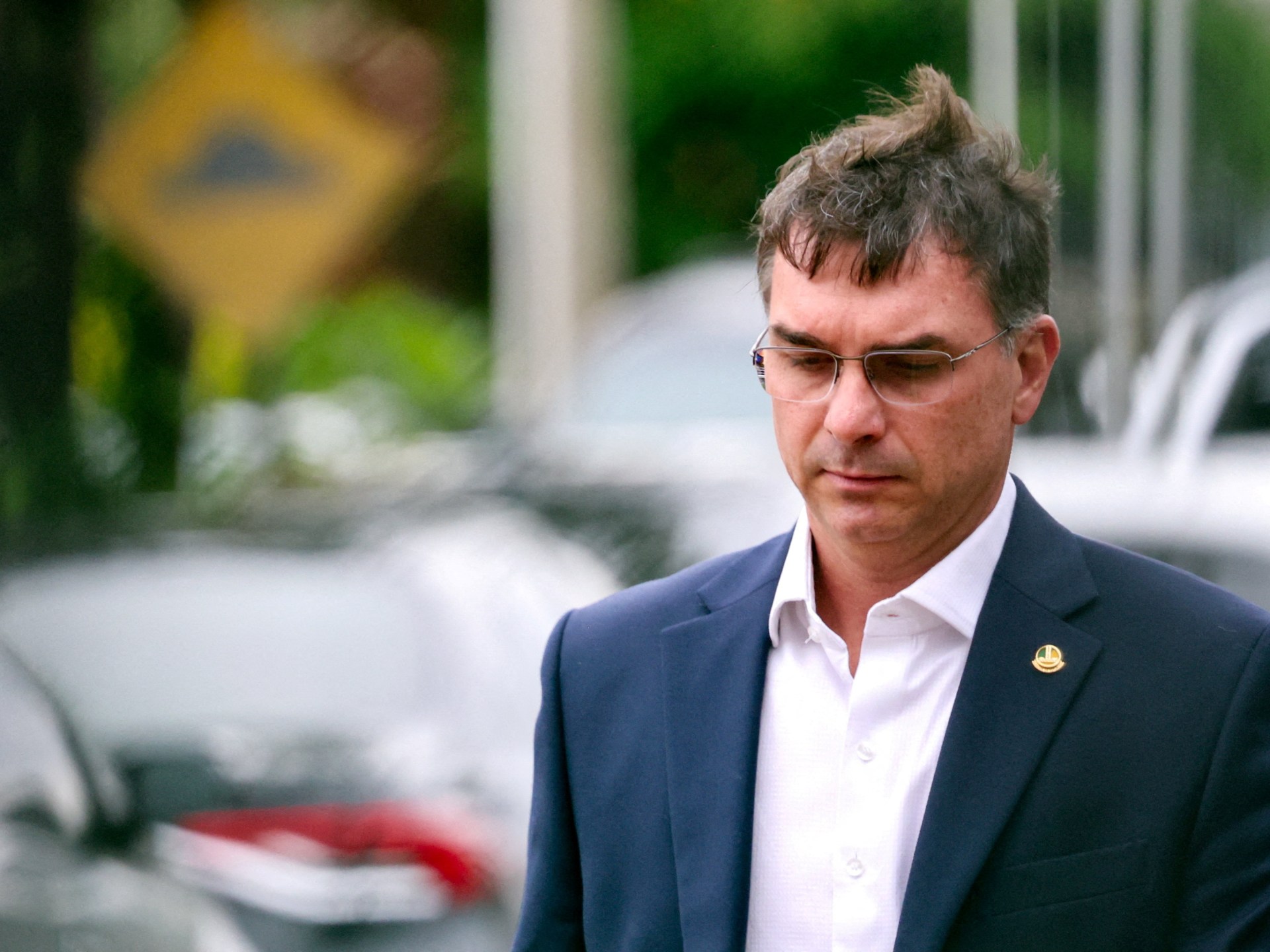

Brazilian Senator Flavio Bolsonaro, the eldest son of imprisoned former President Jair Bolsonaro, has announced he has received his father’s endorsement to run for the presidency in 2026.
In a social media post on Friday, Flavio shared a picture of himself kissing the top of his father’s head, along with a statement.
- list 1 of 3Brazil’s Supreme Court panel votes to keep Bolsonaro in police custody
- list 2 of 3Bolsonaro says hallucinatory effects of meds made him tamper with ankle tag
- list 3 of 3Trump and Lula hold phone call to discuss US tariffs on Brazil, sanctions
end of list
It explained that his father — whom he called the “greatest political and moral leader” in Brazil — had given him the “mission of carrying on our national project”.
“I cannot and I will not accept seeing our country go through a time of instability, insecurity and discouragement,” Flavio wrote.
“I will not stand idly by while I see the hopes of families fading and our democracy dying.”
Brazil is scheduled to hold elections on October 4, 2026, and with his father’s nod, Flavio is now the heir apparent to represent the far-right Liberal Party (PL) at the ballot box.
Jair Bolsonaro is considered the honourary leader of the PL, though he is barred from holding office through 2030.
The party’s official president, Valdemar Costa Neto, confirmed that Jair’s endorsement of his son conferred upon Flavio the party’s nomination.
“As president of the PL, I inform you that Senator Flavio Bolsonaro is the name selected by Jair Bolsonaro to represent the party in the presidential race,” Costa Neta wrote in an official statement.
“Flavio told me that our captain confirmed his pre-candidacy. So if Bolsonaro spoke, it’s settled!”
The announcement sets up a rematch of sorts between the Bolsonaro family and Brazil’s current left-wing president, Luiz Inacio Lula da Silva.
Advertisement
Imprisoned over a coup attempt
The elder Bolsonaro and Lula previously faced each other in the 2022 presidential race. It was a closely fought match: Neither candidate won a majority of the vote in the first round, which forced the contest into a runoff.
But on October 30, Lula emerged victorious in the second round, squeaking out a slim victory with 50.9 percent of the vote. It was the closest outcome to a presidential race since Brazil’s return to democracy in the 1980s.
Nevertheless, Jair Bolsonaro, the incumbent, refused to publicly acknowledge his defeat. Instead, he and his allies filed a legal challenge against the vote, arguing there was evidence of “serious failures” and “malfunctions” in the voting machines.
It was a theory Jair Bolsonaro had publicly advanced even before the first vote was cast, when he was on the campaign trail. Critics have pointed out that there is no evidence to support the claims.
The legal challenge was ultimately tossed for being “in total bad faith”.
But Jair Bolsonaro’s supporters continued to rally against his defeat. In the months that followed, they attacked federal police headquarters in the capital Brasilia, and after Lula’s inauguration, on January 8, 2023, they stormed government buildings in the city’s Three Powers Plaza.
Some of the protesters sought to provoke a military response that would overthrow Lula’s nascent government.
The riot at the Three Powers Plaza ultimately spurred federal investigations, raids and arrests.
Following his electoral defeat, Jair Bolsonaro also found himself mired in probes and legal complaints, which ranged from fraud allegations related to his COVID-19 records to accusations of embezzlement.
In June 2023, Brazil’s Superior Electoral Tribunal (TSE) voted to bar Jair Bolsonaro from public office until 2030, calling his use of public resources to spread election falsehoods an “abuse of power”.
And just last month, Jair Bolsonaro was taken into custody to serve a 27-year prison sentence, after he was convicted in September of plotting to stage a coup.
Jair Bolsonaro has denied any wrongdoing and described his prosecution as a politically motivated hit job, designed to dent his continued popularity.
Politics, a family affair
His sons, meanwhile, have transformed into public advocates for their father, petitioning for his release.
Earlier this year, Eduardo Bolsonaro, a member of Brazil’s Chamber of Deputies, travelled to the US to lobby President Donald Trump for help with his father’s case.
In mid-November, a panel on Brazil’s Supreme Court voted to put Eduardo on trial to weigh whether his actions amounted to obstruction of justice.
Advertisement
Jair Bolsonaro’s family and allies have also pushed Congress to pass an amnesty bill that would allow the ex-president to walk free.
In the lead-up to Friday’s endorsement, there was speculation that former First Lady Michelle Bolsonaro might be an option to represent the PL in next year’s election. Sao Paolo’s governor, Tarcisio Gomes de Freitas, was also floated as a possibility.
But the selection of Flavio Bolsonaro, 44, is seen as an appeal to the ex-president’s far-right base.
That choice could end up alienating centrists in Brazil’s conservative arenas. Flavio has served in the Senate since 2019 and previously was state deputy for Rio de Janeiro.
Currently, the biggest contender in the upcoming race is Lula himself.
In late October, the left-wing president announced he would seek a fourth term. Now 80 years old, he has reassured his supporters that he felt as energetic as ever.
Brazilian law allows for only two consecutive terms at a time, but more are possible if they are not back to back. Lula first served as president from 2003 to 2011, before mounting his latest successful bid in 2022.
Polls currently show Lula in the lead for next year’s race, though the vote is more than nine months away.
A survey conducted in late November by the National Confederation of Transport and the research firm MDA Institute attempted to measure the odds of various match-ups Lula could face.
Lula came out on top each time. When pitted against the imprisoned Jair Bolsonaro, he earned nearly 39 percent support to the right-wing leader’s 27 percent. When compared to Michelle Bolsonaro, Lula had even higher support: 42 percent to her 23 percent. Flavio Bolsonaro was not among the options surveyed.
Lula would be 85 years old if he were to win and complete a fourth term.
Related News
Trump-backed candidate leads Honduras presidential vote, early trends show
Turkiye orders arrest of top-tier footballers, officials in gambling probe
Corbyn’s new party faces crisis as cofounder skips first day of conference