
DAREECE POLO
Senior Reporter
dareece.po[email protected]
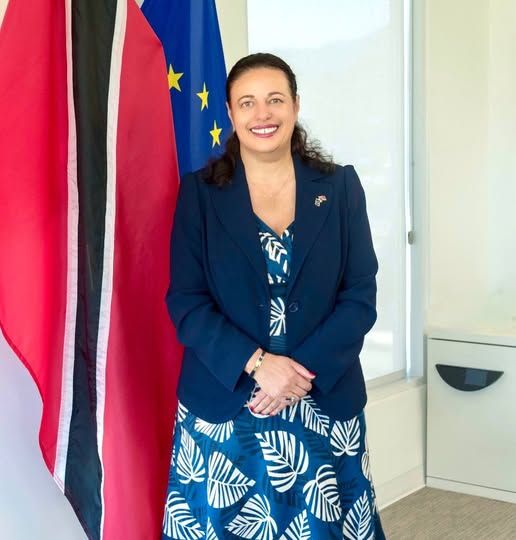
The European Union’s ambassador to Trinidad and Tobago, Cécile Tassin, believes the model of confidential dialogue can help the Caribbean Community (Caricom) resolve internal disagreements, as tensions persist within the regional bloc over the reappointment of Secretary General Dr Carla Barnett.
Tassin, a veteran diplomat with more than three decades of experience, assumed her first ambassadorial posting last October.
Her tenure begins at a time when relations between T&T and other Caricom member states have come under strain.
In an exclusive interview with Guardian Media yesterday, she pointed to the European Union’s own model of decision-making, where disputes are typically addressed at the technical level before reaching political leaders. She suggested that this kind of preparation allows for smoother outcomes at the highest levels of governance.
“Usually, when the meeting between heads of state happens in Europe, everything has been prepared in advance. First, we have all the ambassadors, what we call the permanent representatives of the member states. And actually, even before the ambassadors, you have all the experts who come from Europe, then the ambassadors, then you have the ministers.”
“So normally when it reaches the heads of state, of course, they can still take decisions, but normally all the disagreements have been really dealt with. Maybe, yeah, maybe that's what is missing a bit, to prepare well and solve the disagreements between (before) it reaches the highest level.”
While Tassin, who is French with African roots, acknowledged that the EU is not immune to security challenges, she insists that strict confidentiality remains the bedrock of successful diplomatic negotiation.
“Confidentiality is very important. We had the problem in Europe recently when we discovered that the Minister of Foreign Affairs of Hungary was communicating with his colleague in Russia,” she added.
Tassin also welcomed T&T’s recent removal from the EU’s list of non-cooperative tax jurisdictions, describing it as a positive step in strengthening relations.
She further said T&T is not facing any specific risks of border restrictions or limits on movement into EU member states, noting that the bloc maintains protections for migrants and asylum seekers.
She added that there is significant potential for development, encouraging a stronger focus on sustainable tourism.
Tassin pointed to the country’s natural environment—including its wildlife, landscapes, birds and turtle populations in Tobago—as key assets that could be further developed in a sustainable way.
While she declined to comment on domestic political matters, she noted that campaign finance reform has produced positive outcomes in EU countries, suggesting there may be lessons for other regions.
“In general, it's always good to look at good examples in the world. And we do it in many sectors. We are open to provide, if requested, to provide technical assistance, to provide experts.”
The ambassador framed the EU as a “like-minded” partner in what she described as an increasingly fragmented global environment, pushing back against perceptions that the Caribbean is being sidelined amid major geopolitical conflicts. She also pointed to conflicts in the Middle East as accelerating the push towards decarbonisation, noting their influence on T&T’s evolving energy outlook.
Moreover, Tassin said security cooperation remains a central pillar of the EU-TT partnership.
The EU has expanded its engagement in the region through training and intelligence-sharing initiatives with Caricom IMPACS, aimed at addressing transnational threats.
However, the ambassador emphasised that the EU’s support is accompanied by strict oversight.
The bloc maintains an independent auditing system and has, in some cases, sought reimbursement for projects that did not meet agreed standards.
Looking ahead, she is calling for a reset of formal political dialogue under the Samoa Agreement. Although annual partnership meetings are mandated, they have not been held in T&T for several years.
Tassin said she intends to bridge that gap before the end of the year, with discussions expected to focus on areas such as digital transformation and trade.
The EU is set to mark 51 years of relations with T&T in May, with a series of events including the European Film Festival, aimed at highlighting cultural exchange and shared values.
As Europe Day approaches on May 9, the message from the EU mission is one of “conciliatory” diplomacy—offering its own experience with compromise as a model for strengthening regional cooperation.