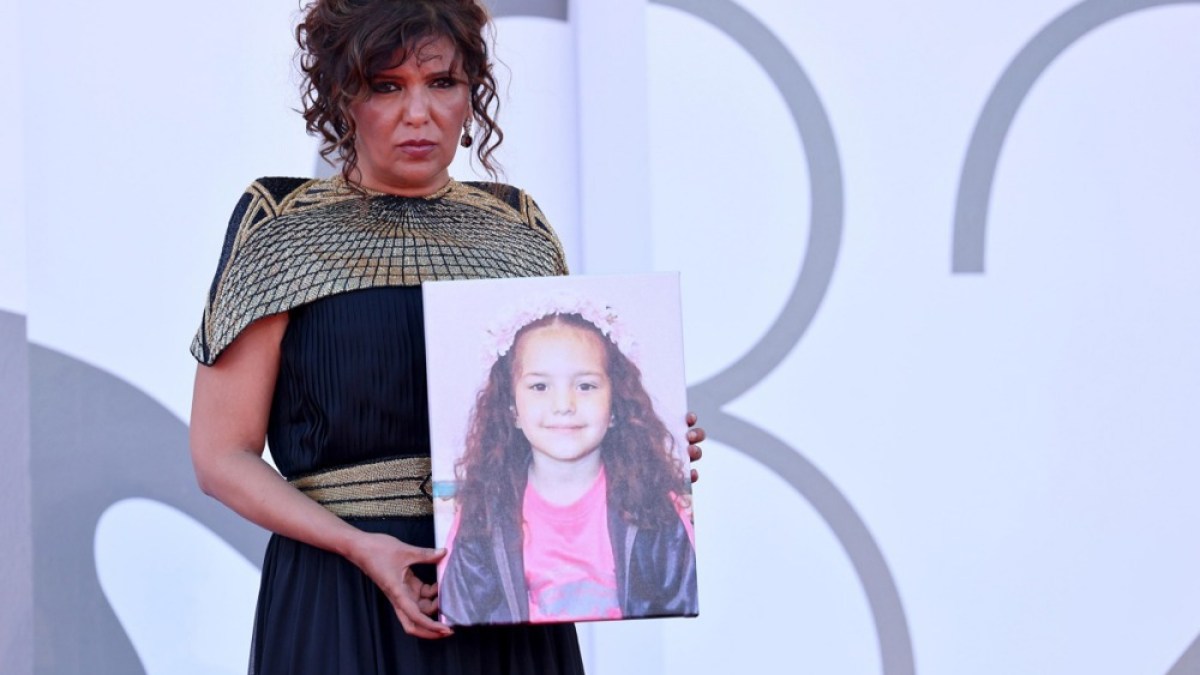

Tunisian director Kaouther Ben Hania has refused to accept a major award at the Berlin International Film Festival, leaving her trophy on stage to protest against the international political cover provided for Israel’s genocidal war in Gaza.
Accepting the “Most Valuable Film” prize at the Cinema for Peace Awards for her project The Voice of Hind Rajab, Ben Hania stated that the killing of the five-year-old Palestinian girl by the Israeli army was not an exception, but part of a systematic genocide.
“Peace is not a perfume sprayed over violence so power can feel refined, and can feel comfortable,” Ben Hania told the audience. “If we speak about peace, we must speak about justice. Justice means accountability.”
The director stressed that the Israeli military killed Rajab, her family and the two paramedics sent to rescue her, with the complicity of the world’s most powerful governments and institutions.
‘Institutional repression’
Ben Hania’s public stand serves as the climax of mounting internal dissent at the Berlinale. Her speech directly aligns with an open letter published in Variety, signed by 81 prominent film professionals, including actors Javier Bardem, Tilda Swinton and Brian Cox, alongside directors Mike Leigh and Adam McKay.
The signatories, all festival alumni coordinated by the group Film Workers for Palestine, condemned the Berlinale’s “anti-Palestinian racism” and its failure to demand accountability for international law violations. The letter highlighted a stark double standard, contrasting the festival’s institutional silence on Gaza with its vocal solidarity for Ukraine and Iran.
Advertisement
The coalition firmly rejected recent comments by Jury President Wim Wenders, who argued that filmmakers should “stay out of politics”. Indian author Arundhati Roy recently withdrew from the festival in protest against Wenders’s remarks.
“Last year, filmmakers who spoke out for Palestinian life and liberty from the Berlinale stage reported being aggressively reprimanded by senior festival programmers,” the letter read, noting that the festival leadership falsely implied that speeches rooted in international law were discriminatory.
Weapons and complicity
The cinematic boycott coincides with horrifying new details emerging from the besieged enclave. A recent Al Jazeera investigation documented how Israeli forces have “evaporated” 2,842 Palestinians using United States-made thermobaric weapons. These munitions generate temperatures exceeding 3,500 degrees Celsius [6,332 degrees Fahrenheit], leaving no remains other than blood or small fragments of flesh.
The filmmakers’ letter also condemned the host nation, Germany, which remains one of the largest exporters of weapons to Israel. Signatories accused the German government and festival leadership of actively policing and silencing artists who advocate for Palestinian human rights.
The global film industry is increasingly drawing a hard line. Last year, more than 5,000 film workers pledged to refuse work with Israeli film companies and institutions.
Refusing to let the industry use her documentary for “image-laundering”, Ben Hania left her award on the podium as a reminder of the structures that enabled the mass civilian killings.
“I refuse to let their deaths become a backdrop for a polite speech about peace,” Ben Hania said. “When peace is pursued as a legal and moral obligation, rooted in accountability for genocide, then I will come back and accept it with joy.”
Related News

Thai PM Anutin’s party takes early lead in general election race
At least 53 people dead or missing after boat capsizes off Libya coast
US Supreme Court rejects challenge to California redistricting effort