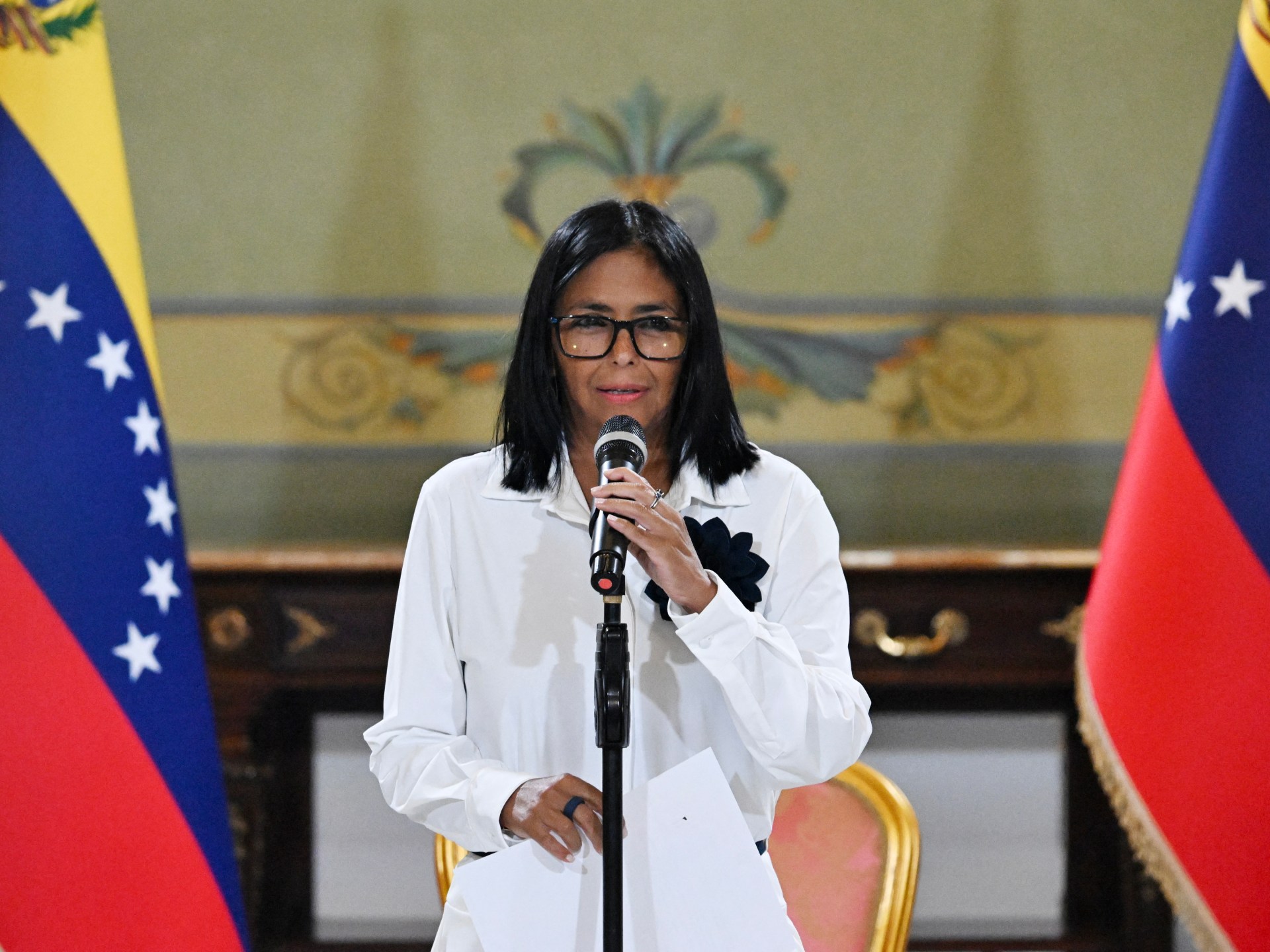

Venezuela’s interim President Delcy Rodriguez has called on the United States to lift the suite of sanctions that have hammered the country’s economy.
Her remarks on Tuesday came after the US Treasury Department announced it would issue new licences to allow transactions with certain Venezuelan banks and individuals.
- list 1 of 3Police in Venezuela block protesters calling for higher wages, pensions
- list 2 of 3US removes sanctions on Venezuela’s interim President Delcy Rodriguez
- list 3 of 3Cuban president will not ‘step down’ despite Trump pressure to resign
end of list
But Rodriguez argued the move was not enough to help Venezuela out of its ongoing economic crisis.
She framed her request as a necessary condition for foreign investment, a priority for US President Donald Trump.
“We reiterate the need to advance towards a Venezuela free of sanctions, as a means of providing institutional legal certainty to investors coming to our country – a setting where they are guaranteed sustained investment over time and a forward-looking perspective,” Rodriguez wrote on social media.
Rodriguez’s government faced protests last week from workers demanding higher wages and better pensions, amid frustration over Venezuela’s sluggish economy.
Venezuela continues to grapple with one of the worst economic crises in its modern history, with critics blaming factors like government mismanagement, corruption, and US restrictions for the instability.
Rodriguez was sworn in less than four months ago, after US military forces abducted and imprisoned then-President Nicolas Maduro on January 3. Previously, she was Maduro’s vice president.
Since her inauguration, Rodriguez has sought to cooperate with Trump’s demands.
Trump has made it a priority to open Venezuela to foreign investment, following a decades-long movement to nationalise the country’s major industries.
Advertisement
He has also insisted on a degree of control over Venezuelan policy related to oil and minerals.
Since Maduro’s removal, Trump has threatened to “run” Venezuela and used the threat of further military action to pressure the Rodriguez government into alignment with his policies.
In response, Venezuela’s government has passed laws to loosen restrictions on oil exploration and mining.
It also authorised a sweeping amnesty bill to release political prisoners, though critics say the legislation did not go far enough and was ambiguous in its terms.
Rodriguez has insisted that US economic restrictions put in place against the Maduro government must be relaxed to open up more space for economic recovery.
She has pledged to address concerns over workers’ wages on May 1, a day commonly associated with labour rights.
On Tuesday, she met with US Assistant Secretary of Energy Kyle Haustveit and expressed interest in hearing from energy executives about potential projects in Venezuela and changes to regulation.
Since Maduro’s removal, the US has moved to tighten relations with Venezuela after years of severed ties.
It has reopened its embassy in Caracas, for instance, and it has gradually eased sanctions on certain sectors, including its oil industry.
The US currently approves all Venezuelan oil sales abroad, with the proceeds placed in a US-controlled bank account.
Tuesday’s sanctions relief targeted Venezuela’s central bank, as well as other state-owned banks and financial services firms, like Banco de Venezuela, Tesoro and Digital de los Trabajadores.
Another general licence was issued to lift sanctions against certain transactions with the government of Venezuela to help foster “commercial-related negotiations”.
Related News
Drones, Iran war escalating horror as Sudan war enters fourth year
French-owned container ship transits Hormuz Strait in first since Iran war
Italy’s Meloni meets Qatar emir to discuss energy issues amid Iran war