China stages military drills around Taiwan to warn ‘external forces’ after US, Japan tensions
 29 December 2025

China’s military on Monday dispatched air, navy and missile units to conduct joint live-fire drills around the island of Taiwan, which Beijing called a “stern warning” against separatist and “external interference” forces. Taiwan said it was placing its forces on alert and called the Chinese government “the biggest destroyer of peace.”
Taiwan’s aviation authority said more than 100,000 international air travelers would be affected by flight cancellations or diversions.
The drills came after Beijing expressed anger at what could be the largest-ever U.S. arms sale to the self-ruled territory and at a statement by Japan’s prime minister, Sanae Takaichi, saying its military could get involved if China were to take action against Taiwan. China says Taiwan must come under its rule.
The Chinese military did not mention the United States and Japan in its statement on Monday, but Beijing’s foreign ministry accused the Taiwanese ruling party of trying to seek independence through requesting U.S. support.
Taiwan’s Defense Ministry said rapid response exercises were underway, with forces on high alert. “The Chinese Communist Party’s targeted military exercises further confirm its nature as an aggressor and the biggest destroyer of peace,” it said.
Beijing sends warplanes and navy vessels toward the island on a near-daily basis, and in recent years it has stepped up the scope and scale of these exercises.
Senior Col. Shi Yi, spokesperson of China’s People’s Liberation Army’s Eastern Theater Command, said the drills would be conducted in the Taiwan Strait and areas to the north, southwest, southeast and east of the island.
Shi said the activities would focus on sea-air combat readiness patrol, “joint seizure of comprehensive superiority” and blockades on key ports. It was also the first large-scale military drill where the command publicly mentioned one goal was “all-dimensional deterrence outside the island chain.”
“It is a stern warning against ‘Taiwan independence’ separatist forces and external interference forces, and it is a legitimate and necessary action to safeguard China’s sovereignty and national unity,” Shi said.
China and Taiwan have been governed separately since 1949, when a civil war brought the Communist Party to power in Beijing. Defeated Nationalist Party forces fled to Taiwan. The island has operated since then with its own government, though the mainland’s government claims it as sovereign territory.
Drills will continue on Tuesday
The command on Monday deployed destroyers, frigates, fighters, bombers and unmanned aerial vehicles, alongside long-range rockets, to the north and southwest of the Taiwan Strait. It carried out live-fire exercises against targets in the waters as well. Among other training, drills to test the capabilities of sea-air coordination and precise target hunting were conducted in the waters and airspace to the east of the strait.
Hsieh Jih-sheng, deputy chief of the general staff for intelligence of the Taiwanese Defense Ministry, said that as of 3 p.m. Monday, 89 aircraft and drones were operating around the strait, with 67 of them entering the “response zone” — airspace under the force’s monitoring and response. In the sea, the ministry detected 14 navy ships around the strait and four other warships in the Western Pacific, in addition to 14 coast guard vessels.
“Conducting live-fire exercises around the Taiwan Strait … does not only mean military pressure on us. It may bring more complex impact and challenges to the international community and neighboring countries,” Hsieh told reporters.
Military drills are set to continue Tuesday. Taiwan’s Civil Aviation Administration said Chinese authorities had issued a notice saying seven temporary dangerous zones would be set up around the strait to carry out rocket-firing exercises from 8 a.m. to 6 p.m. on Tuesday, barring aircraft from entering them.
The Taiwanese aviation authority said more than 850 international flights were initially scheduled during that period and the drills would affect over 100,000 travelers. Over 80 domestic flights, involving around 6,000 passengers, were also canceled, it added.
The Chinese command released themed posters about the drills online accompanied by provocative wording. One poster depicted two shields with the Great Wall alongside three military aircraft and two ships. Its social media post said the drills were about the “Shield of Justice, Smashing Illusion,” adding that any foreign interlopers or separatists touching the shields would be eliminated.
Last week, Beijing imposed sanctions against 20 U.S. defense-related companies and 10 executives, a week after Washington announced large-scale arms sales to Taiwan valued at more than $10 billion. It still requires approval by the U.S. Congress.
Under U.S. federal law in place for many years, Washington is obligated to assist Taipei with its defense, a point that has become increasingly contentious with China. The U.S. and Taiwan had formal diplomatic relations until 1979, when President Jimmy Carter’s administration recognized and established relations with Beijing.
Asked about the drills, Chinese foreign ministry spokesperson Lin Jian said Taiwan’s Democratic Progressive Party has attempted “to seek independence by soliciting U.S. support and even risk turning Taiwan into a powder keg and ammunition depot.”
“External forces’ attempts to use Taiwan to contain China and to arm Taiwan will only embolden the Taiwan independence forces and push the Taiwan Strait toward a dangerous situation of military confrontation and war,” he said.
There was no immediate U.S. statement on the drills.
Taiwanese army on high alert
Karen Kuo, spokesperson for the Taiwanese president’s office, said the drills were undermining the stability and security of the Taiwan Strait and Indo-Pacific region and openly challenging international law and order.
“Our country strongly condemns the Chinese authorities for disregarding international norms and using military intimidation to threaten neighboring countries.” she said.
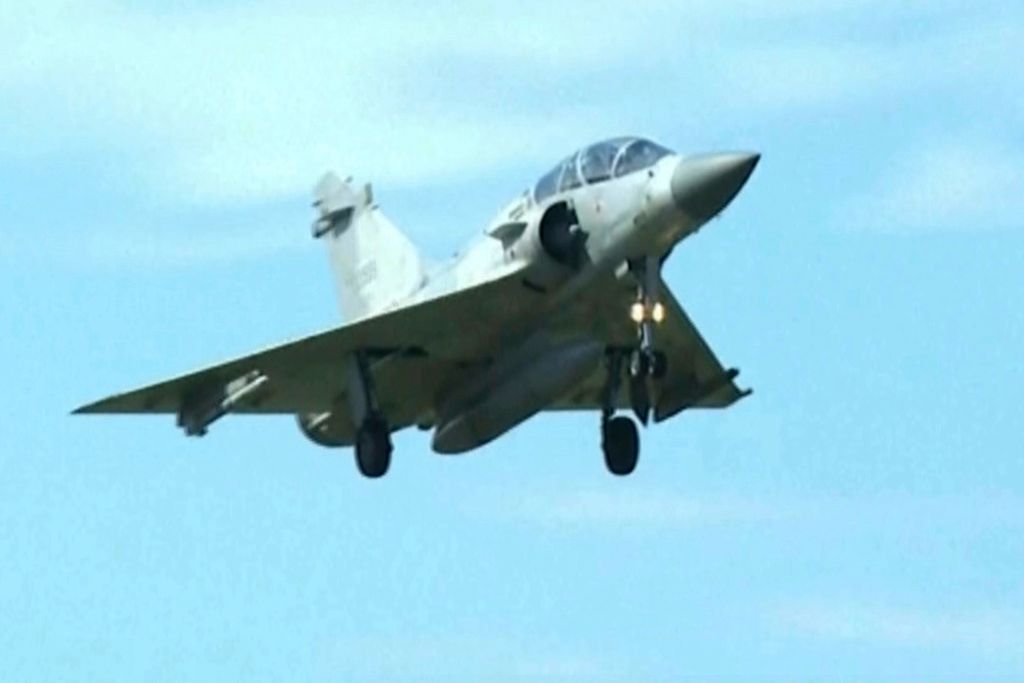
Taiwan’s Defense Ministry released a video that featured its weapons and forces in a show of resilience. Multiple French Mirage-2000 aircraft conducted landings at an air force base.
In October, the Taiwanese government said it would accelerate the building of a “Taiwan Shield” or “T-Dome” air defense system in the face of the military threat from China.
The military tensions came a day after Taipei Mayor Chiang Wan-an said he hoped the Taiwan Strait would be associated with peace and prosperity, instead of “crashing waves and howling winds,” during a trip to Shanghai.
Related News
PM non-commital on T&T’s energy future despite Maduro’s indictment in US
Maduro arrives at courthouse to face drug trafficking charges
Rubio says US won’t govern Venezuela but will press for changes through oil blockade