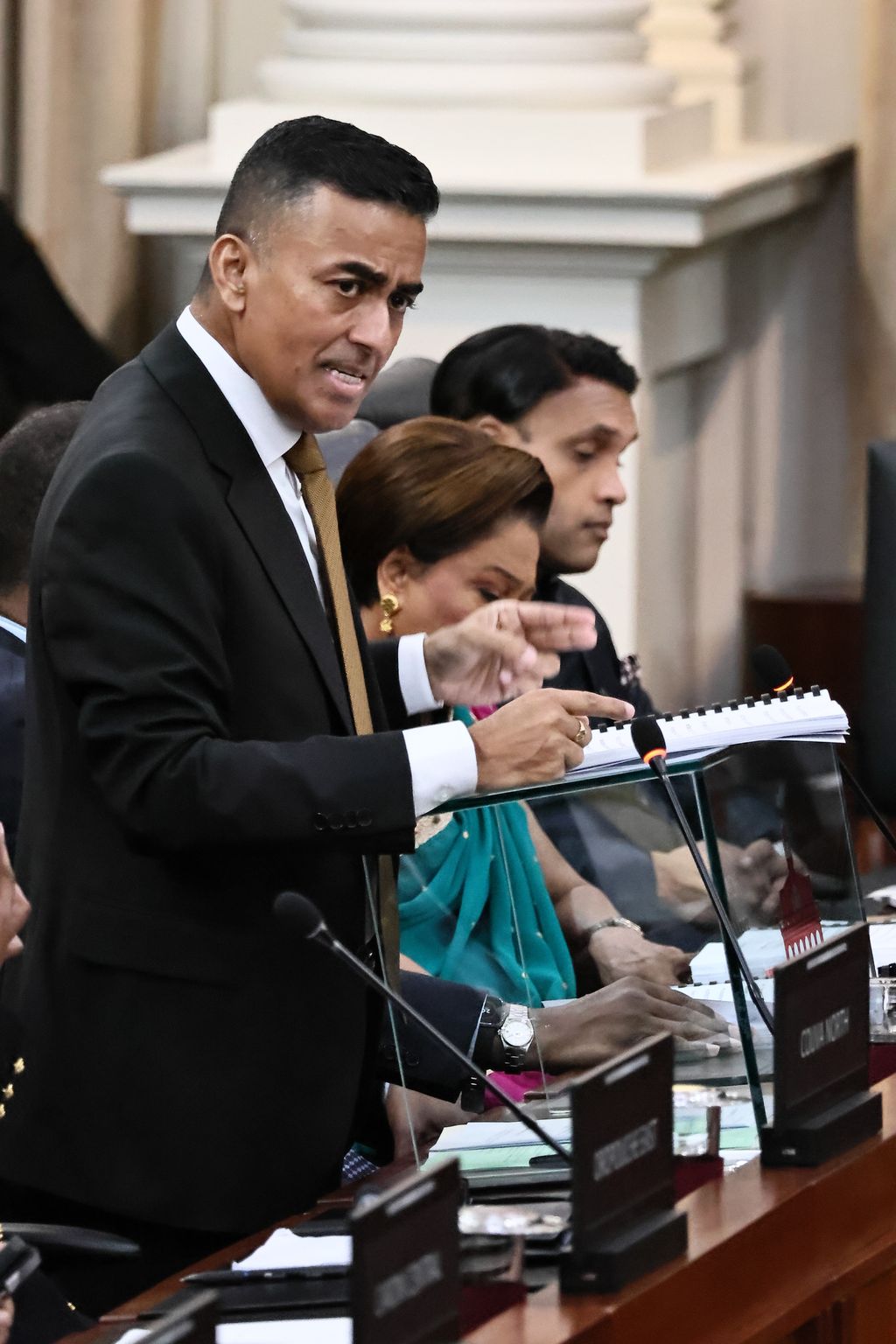

Presented by Minister of Finance Davendranath Tancoo
October 12, 2026
Introduction
It is my privilege to present the 2027 National Budget to this Honourable House and to the people of Trinidad and Tobago.
When this UNC Administration entered office 18 months ago, we inherited the legacy of the PNM: a significant debt burden, including $12.04 billion due almost immediately.
They left $10.6 billion due in VAT and other tax refunds, and billions owed to workers in negotiations settled and to be settled.
But more than that, considerable public liabilities constrained cash flows and narrowed fiscal space to such an extent that it was challenging to achieve our development objectives.
We met a Ministry of Finance forced to manage its cash flow on a day to day basis.
We did not throw our hands in the air.
The population gave us a mandate to make this country better and we rose to the challenge.
Under the decisive leadership of the Honourable Kamla Persad-Bissessar, through responsible fiscal management, and transparent governance, we began restoring confidence, creating new jobs, rebuilding institutions and laying the foundations for Trinidad and Tobago’s renewal. We promised. We delivered. More to come!
The dire circumstances we met upon assuming office demanded fundamental reform and the decisive leadership of a competent Administration, laser-focused on making the long-overdue, difficult but necessary decisions.
Those opposite had the time, resources and opportunity to diversify the economy, build stronger and more accountable public institutions, attract investment, expand production and create meaningful jobs.
But they failed to deliver.
Under the PNM,
Projects stalled.
Public assets deteriorated.
Energy production declined.
The middle class was decimated.
Businesses struggled.
Public confidence eroded.
Foreign exchange became scarce.
Foreign investment collapsed.
Our international reputation was compromised.
A bloody crime wave engulfed our country.
70,600 persons lost their jobs.
The economy contracted by 17 per cent.
Public debt skyrocketed.
And hope for brighter days evaporated.
I recount these facts not to simply rehash the past but to put in perspective, the magnitude of our task and the significance of the progress already made.
In the year ahead, this Government will increase its investment in our people and in the productive sectors of Trinidad and Tobago.
We will continue to restore confidence in our economy and institutions.
We will continue to invest in the expansion of the energy and non-energy sectors and diversify our economy in the areas of agriculture, manufacturing, tourism and technology.
National security will remain a central priority.
I extend my heartfelt gratitude to the Honourable Prime Minister, Kamla Persad-Bissessar, for her continued confidence in me to guide our nation’s fiscal and economic affairs.
I also thank my Cabinet colleagues, the dedicated staff of the Ministry of Finance, other Ministries and State Agencies, as well as our partners in the private sector, labour, academia and civil society for their invaluable contributions to the development of this Budget.
Building on Our First Year: Moving Trinidad and Tobago Forward
This Government has positioned our nation on a path to sustainable growth and economic resilience. Following a decade of reckless PNM mismanagement, this country is finally moving steadily forward, and the results are visible.
We restored fiscal stability: They left us with a deficit that was 5.8 per cent of GDP. By June 2026, we reduced the deficit to 4 per cent of GDP and moved the country closer to a near-balanced primary position. We promised. We delivered. More to come!
We rebuilt international confidence: In May 2026, the IMF signaled increasing international confidence in the Government’s policy direction. In June 2026, Moody’s upgraded Trinidad and Tobago’s rating outlook from Negative to Stable while reaffirming the country’s Ba2 rating. In July 2026, Standard and Poor’s reaffirmed Trinidad and Tobago’s investment-grade credit rating and just a few days ago, CariCRIS also reaffirmed our Cari-Double A credit ratings, with a Stable Outlook. They all agree: Trinidad and Tobago’s economic direction is improving, confidence is returning and the Government’s strategy is delivering results. We promised. We delivered. More to come!
But there’s more. We are no longer blacklisted: Under the PNM, Trinidad and Tobago was placed on the EU’s list of non-cooperative jurisdictions burdening our country with serious reputational and economic harm.
In February 2026 we were removed from the EU’s blacklist. In April 2026, we secured a permanent World Bank Group presence and in June 2026,he country was elected to serve as a non-permanent member of the United Nations Security Council for 2027–2028. Promise made. Promise kept. More to come
We protected the nation’s savings for future generations: Under our stewardship, the HSF grew from US$5.98 billion as at April 30, 2025 to US$6.58 billion as at August 31, 2026, the highest level of savings in the history of the Fund. We promised. We delivered. More to come!
We improved the public’s access to foreign exchange: Since July 2026, the Central Bank has injected an additional US$10 million cash every month to commercial banks to ease the foreign exchange challenges faced by the average citizen. We promised. We delivered. More to come!
We saved the National Insurance Fund from collapse: The former Administration brought the National Insurance Fund to the point of collapse, having to sell off its assets to meet monthly bills. This means that the NIB would not have been able to pay retirement, maternity, sickness, survivors’ benefits and funeral grants. We have extended the life of the Fund by more than a decade. Promise made. Promise kept. More to come
We empowered our citizens: In January 2026, we enacted the Home Invasion (Self Defence and Defence of Property) Act, 2025, criminalising home invasions and empowering homeowners and occupants to legally defend themselves and their property.
We are restoring safety and security to our communities: In 2025, murders fell by 42 per cent from 626 the year before to 369, the lowest annual murder toll in more than a decade!
Shootings and wounding, robberies, burglaries and break-ins have all declined by over 20 per cent! We promised. We delivered. More to come!
We strengthened Trinidad and Tobago Police Service: We refurbished police stations in La Horquetta, Morvant, Four Roads and Point Fortin. We provided 67 new SUVs to the TTPS and by December 2026, 700 new officers would be added.
We are establishing 30 joint police-army posts across Trinidad and Tobago: We have already operationalised the first 3 micro police units. Tomorrow, the Prime Minister will launch 3 more units in Tobago. We promised. We delivered. More to come!
We improved the administration of justice: We enacted 36 pieces of legislation addressing critical national issues, including victims’ rights, workers’ rights, bail reform, DNA evidence, parole and advanced passenger information and passenger name record systems to strengthen border security. We promised. We delivered. More to come!
We honoured our commitment to Teachers: From March 2026 11,000 teachers benefitted from higher salaries, together with the consolidation of the COLA. Last month we paid off all the arrears valued at approximately $688 million.
We honoured our commitment to the NUGFW: We ratified the Agreement for approximately 20,000 daily-rated workers resulting in a 10 per cent wage increase and $510.2 million in arrears.
We honoured our commitment to the PSA: We commenced wage negotiations affecting almost 40,000 public-sector workers, and to date, we have provided approximately $224.8 million in backpay and put all 40,000 public servants on their new higher salary. We promised. We delivered. More to come!
We removed taxes on private pensions: This allows beneficiaries to retain more of the benefits they worked throughout their lives to earn. We promised. We delivered. More to come!
We established the Women’s Health Fund: The Women’s Health Fund Committee is working and soon, menstrual kits, health education and public outreach will be provided to support women and girls, particularly those in vulnerable communities. In fiscal 2027, I propose to allocate a further $5 million to this initiative. Promise made. Promise kept. More to come
We expanded healthcare for all citizens: In November 2025, we reopened the Couva Children’s Hospital. By the end of July, 2026, 1,075 same day surgeries were conducted, 950 children had already received specialist clinical services and 1,338 persons accessed outpatient pharmacy services. We opened the Accident and Emergency Department at the Arima General Hospital in May 2026 bringing critical emergency services to thousands of citizens in east Trinidad. We promised. We delivered. More to come!
We established a National Prosthetics Centre: With the assistance of the Government of India and Jaipur Foot USA, we established Trinidad and Tobago’s first-ever National Prosthetics Centre in Clarke Road, Penal. This Centre provides on-site rapid custom fitting and adjustments for prosthetic limbs, free of charge to our citizens. We promised. We delivered. More to come!
We strengthened Fire Services and Emergency Response: We commissioned 6 new fire appliances and absorbed 280 fire officers. We reopened the Princes Town Fire Station restoring 24-hour fire and emergency-response services to 56 communities and approximately 118,000 citizens of South Trinidad. Promise made. Promise kept. More to come
We made Government services faster and easier: We expanded digital public services to create a more efficient customer-focused public sector through VerifyTT, the country’s first national standard for digital verifiable credentials; we implemented the long-overdue Airport Online Arrival/Departure Forms expediting passenger movement through our ports of entry. We promised. We delivered. More to come!
We introduced electronic payments at the Customs and Excise Division: In November 2025, LINX debit-card service was introduced at the CED making payments by importers and traders safer, faster and easier. Work is progressing to expand payment services to include credit-card and online payment options all of which will improve the ease of doing business and facilitate efficient and effective trade.
We increased staffing at the Customs and Excise and Inland Revenue Divisions: To date, more than 200 posts have been filled across these 2 critical Divisions. I will elaborate on the significant progress being made at both Divisions later in this presentation. Promise made. Promise kept. More to come
We enhanced NGC’s profitability: The National Gas Company recorded profit after tax for the year ended December 31, 2025 of $3.46 billion, its highest level in over 10 years, up by 111 per cent from 2024.
In May 2026, TTNGL issued a special interim dividend payment, returning $154.8 million to shareholders. This marks TTNGL’s first dividend payment to more than 11,400 shareholders in almost four years. We promised. We delivered. More to come!
We revived the Steel Industry at Point Lisas: An asset that once symbolised industrial decline is now attracting hundreds of millions of US dollars in investment, creating hundreds of jobs and positioning Point Lisas once again, as a centre of heavy industry and advanced manufacturing. We promised. We delivered. More to come!
We are expanding domestic agricultural production to reduce our food import bill: We removed VAT from all machinery and equipment, as well as inputs for hydroponic and greenhouse farming, zero-rated key materials for cultivation and animal health, and removed Customs Duty on feed used for livestock.
We opened the Brechin Castle Agro-Processing Facility, creating new opportunities for cassava flour, fruit and vegetable processing and potential exports. We commissioned a 300-litre milk pasteurisation plant at the Sugar Cane Feeds Centre, strengthening the local dairy industry. Promise made. Promise kept. More to come!
We are strengthening the UNIMED Group Health Plan: We injected $20 million into the UNIMED Group Health Plan for monthly-paid officers of the Civil Service, the Teaching Service and certain office holders within the purview of the Salaries Review Commission. This intervention helped to reduce the Plan’s deficit and settle outstanding claims and provided much needed relief to members. We promised. We delivered. More to come!
I leave the details of these and other numerous achievements of this Administration to my colleagues.
The global economy continues to be characterised by heightened uncertainty, geopolitical tensions, changing trade patterns and relationships, rapid technological advancement and intensifying climate risks.
The IMF projects global growth to decelerate in 2026 with elevated energy prices, inflationary pressures and heightened global competition continuing to present significant challenges, particularly for small, open economies seeking to expand exports, attract investment and strengthen their competitiveness.
Trinidad and Tobago is not immune to the crises in the global economy, exacerbated by the perilous financial predicament left behind by the former Administration.
In the first quarter of 2026, real GDP contracted by 1.8 per cent when compared to the same period in 2025. The energy sector contracted by 2.8 per cent due largely to the declining gas fields.
For the same period, the manufacturing sector marginally contracted by 0.7 per cent. However, the non-energy manufacturing sector grew by more than 11.6 per cent and the Food, Beverage and Tobacco sector grew by 20.5 per cent.
Inflation remains well contained into the first half of 2026, with headline inflation at 0.6 per cent in July 2026. Food inflation fell from 4.7 per cent in April 2025 to 1.7 per cent in July 2026.
As at today, our Net Official Reserves stands at US$5.4 billion, equivalent to 6.2 months of import cover.
Over the last 18 months we had to borrow over $21 billion to refinance debts left by the PNM, with another $70 billion in debt due over the next 5 years.
But we are up to the task. As the recent international financial market engagement and the reports of the rating agencies demonstrate the global investment community is comfortable that this Government can and will meet its obligations.
Labour Market Developments and Demand
We have heard the dangerous claims repeated from the other side that 60,000 people have lost their jobs under this Government.
The facts tell a different story.
In the first quarter of 2026, 5,100 more persons were employed compared to the first quarter of 2025, bringing the total employed to 564,000. The Labour Force Participation Rate also increased to 55.1 per cent, compared with 54.3 per cent under the PNM.
Increases in Social Grants and Senior Citizens’ Pension
We are a Government that cares. The last time that the Senior Citizens’ Pension was increased was 12 years ago, under the then Prime Minister Kamla Persad-Bissessar.
Today, this Kamla Persad-Bissessar Government will increase the Senior Citizens’ Grant by $250 per month, putting more money into the pockets of 124,000 senior citizens.
The Public Assistance Grant will be increased by $250 in each tier benefitting 13,637 recipients.
The Disability Assistance Grant for adults and eligible children will also be increased by $250. This is expected to benefit 28,000 recipients.
These increases will put more money directly into the hands of those who need it the most and will be effective January 1, 2027.
Promise made. Promise kept. More to come.
I turn now to the Medium-Term Economic Framework.
Medium-Term Economic Framework
We have already commenced initiatives to improve the framework for medium-term economic planning and management at our revenue collection and cash management agencies.
As part of this process, the Ministry of Finance will explore the development of a National Fiscal Responsibility and Resilience Framework and give serious consideration to publication of an annual Fiscal Strategy Statement that sets out Government’s medium-term fiscal objectives, the economic and fiscal assumptions underpinning those objectives, the expected path for revenue, expenditure, the fiscal balance and public debt, and the principal risks that could affect that outlook.
The intention is not to impose rigid constraints on the Government’s ability to respond to changing economic circumstances. Rather, it is to strengthen transparency, improve medium-term planning and provide the nation with a clearer understanding of the direction of fiscal policy and the basis for Government’s decisions.
The Government will examine the potential for a set of underlying fiscal principles and tools to help guide fiscal policy, strengthen accountability and reduce the extent to which Government expenditure is influenced by temporary fluctuations in energy revenues.
A Government that Works for the People
A competent State requires strong institutions, skilled public officers, modern technology and clear accountability.
Over the past 18 months, this Government has begun rebuilding that capacity.
Building a Modern and Efficient Treasury Division
The Treasury Division is responsible for Government banking operations, cash management, payment and receipt arrangements as well as implementing the legislative and regulatory framework which governs financial operations.
The former Administration sabotaged these functions.
Through our international partners we engaged a Public Financial Management Specialist to assess and undertake a comprehensive process re-engineering at the Treasury Division.
On the basis of the consultant’s Report, Cabinet agreed to a phased Treasury Modernisation Programme which we are now implementing. The Treasury’s human resource capacity was enhanced by the promotion and appointment of over 120 officers.
This will improve the way the Treasury operates and facilitate the smooth implementation of the Integrated Financial Management Information System (IFMIS).
Over time, these reforms will support the consolidation of the Government’s cash resources, reduce reliance on multiple bank accounts, improve the timeliness and accuracy of financial information, and provide greater and real-time visibility of the Government’s cash position. We promised. We delivered. More to come!
Rebuilding the Inland Revenue Division: Boosting Revenue Collection, Improving Service Delivery
The former Administration sabotaged the IRD creating an annual $10 billion tax gap which should have been collected in revenue and could have provided substantial fiscal surplus to benefit the lives of citizens.
We are now rebuilding the IRD. The existing establishment has been strengthened through the filling of 136 vacancies with an additional 102 Auditors to be onboarded this month.
Further, 24 ICT professionals will be transitioned to 3-year contracts and a further 27 ICT professionals to be onboarded during fiscal 2027.
Additionally, $113.4 million was approved to upgrade the Integrated Tax Processing System from Version 9 to Version 26, scheduled to begin in early-2027 and completed within 18 months.
For taxpayers, these upgrades mean more reliable online services, faster processing, improved access to account information and fewer manual transactions. For the Government, it will strengthen compliance, audit, data analysis and revenue collection.
We are enhancing the exchange of information between the Integrated Tax Processing System and the Customs Border Control System to improve trader verification, customs valuation, compliance monitoring, audit, risk management and inter-agency collaboration. We promised. We delivered. More to come!
Enhancing Border Control and Customs Administration
I now turn to the Customs and Excise Division.
Under the PNM, the CED was burdened with manual processes, limited payment options, depleted human resources, dilapidated infrastructure and outdated ICT systems.
Today we are building a modernised and adequately staffed, technology-driven CED.
Last year, I committed to increase the staffing of the Division. To date we have onboarded 120 officers at various levels to support surveillance, cargo examination and border enforcement.
The upgrade of ASYCUDA which commenced in October 2025 is advancing in partnership with UNCTAD. This initiative strengthens risk management and aligns with Government’s overarching digitization framework. Complementing this initiative is the ASYHUB Port Community System, which electronically connects Customs with shipping agents, port operators and other trading partners.
Together, these systems improve cargo visibility, reduce processing delays, and help position Trinidad and Tobago as a more competitive and investment-friendly trading environment.
At the CES in Port of Spain, extensive upgrade and refurbishment works have been completed and the facility is now fully operational. Similar upgrades at the Point Lisas CES are also nearing completion. Promise made. Promise kept. More to come
Combating Illicit Trade
Illicit trade distorts competition, places unsafe and counterfeit goods in the hands of our citizens and deprives the State of valuable revenue.
That is why we revitalised the Anti-Illicit Trade Task Force, combining the public sector, private sector and civil society under the joint leadership of the Ministries responsible for Trade and Homeland Security.
Over the period June 2025 to August 2026 over 40,000 litres of illegal alcohol, and over 920,000 packs of illegal cigarettes were seized by the CED.
In fiscal 2027, we will accelerate these actions, to combat illicit trade, while making legitimate trade easier and more competitive.
These initiatives, include a reference pricing system for alcohol and tobacco to help the CED identify suspiciously undervalued shipments and better target high-risk consignments.
We are implementing the Customs Recordation and Information System to give customs officers access to verified information on rights holders, authorised distributors and shippers, and distinguishing product and packaging features.
This will improve the detection of counterfeit goods while supporting more efficient clearance of legitimate consignments.
We are also reinforcing coordination and specialised training across the CED, the Police Service and other enforcement agencies, while pursuing greater regional information-sharing and track-and-trace arrangements through Caricom.
Fiscal Reforms for Fairer and More Equitable Tax Collections
The following measures were introduced in Budget 2026 and implemented during the fiscal year. The results to date are as follows:
The Asset Levy on Banks and Insurance Companies generated $397 million.
The Landlord Business Surcharge resulted in the registration of 18,678 landlords, generating $48.4 million in registration fees and $85.6 million in landlord surcharge payments.
The Electricity Surcharge on industrial and commercial consumers contributed $89.4 million in revenue.
The Club Gaming Tax rate adjustment applicable to liquor licence holders generated $65.2 million in new revenue collections.
The increase in Customs and Excise Duties on Alcohol and Cigarettes generated $1.23 billion in revenue.
The increase in other Fees, Charges and Licences yielded $2 million in revenue.
The introduction of MVT, VAT and Customs Duties on luxury EVs generated $15.5 million in revenue.
The introduction of a Single Use Plastic Tax generated $14.1 million in revenue.
Public Sector Investment Programme
In fiscal 2026 we budgeted approximately $5 billion in capital expenditure, but spent approximately $3 billion, though bills are still coming in.
Of course, this is concerning.
Early in the year we realised that the PSIP was constrained by significant impediments that compromised execution.
This is a legacy problem.
Capital expenditure by a Government is an important engine of growth, and when projects are delayed the benefits to citizens such as employment, economic stimulation and the delivery of goods and services remain unrealised.
We undertook a review of the PSIP to determine the factors constraining its implementation. That review identified procurement as one of the major impediments to the timely advancement and completion of projects.
To address this, we amended the Public Procurement and Disposal of Public Property Act to increase approved procurement limits and removed certain entities from the application of the Act.
Through these reforms, we will be able to provide better infrastructure, stronger economic activity and tangible improvements in the lives of our citizens. Promise made. Promise kept. More to come
Reforming the VAT System: Fairer, Faster and More Efficient
Under the last Administration, reform was repeatedly deferred, allowing long standing deficiencies to deepen, leaving businesses to carry the financial burden of years of inaction, with delayed refunds tying up working capital, weakening cashflow and constraining their ability to invest, expand and create jobs.
Last year, I signalled our intention to review the current VAT regime and, if feasible replace it with a Sales Tax.
We engaged one of our international multilateral partners to conduct a comprehensive diagnostic review of the VAT system and assess the suitability of a Sales Tax to Trinidad and Tobago.
The Review recommended, that a reformed and modernised VAT system is the more appropriate consumption tax for Trinidad and Tobago.
We have accepted the key recommendations of the Review and have already started the process of corrective implementation to the VAT system.
One such recommendation to reduce the build-up of VAT, is the un-registration of Government entities that do not produce taxable outputs.
Building a Globally Trusted Tax System
In fiscal 2026, the following milestones were accomplished towards achieving a more robust, transparent and credible tax framework:
MOUs were signed between the FIUTT and key State agencies. These arrangements protect the integrity of our financial system, strengthen information-sharing, enhance regulatory oversight and prevent illicit activity;
Regional cooperation was also advanced through an Agreement with the Compliance Unit of the Anti-Money Laundering Authority of Barbados;
The Caribbean Financial Action Task Force, is evaluating the country’s effectiveness in complying with the 40 Recommendations of the Financial Action Task Force. The process will conclude with the adoption of the country’s Mutual Evaluation Report at the CFATF Plenary next month. This Mutual Evaluation Report will identify Key Recommended Actions which will strengthen our institutions, protect our economy from illicit financial activity and reinforce Trinidad and Tobago’s commitment to meeting international standards. These recommendations will also guide future policy, operational priorities and resource allocation across the national Anti-Money Laundering, Combating the Financing of Terrorism and Counter-Proliferation Financing framework;
The Global Forum’s Second Round Peer Review under the Exchange of Information on Request Standard, was completed. Trinidad and Tobago received an overall rating of ‘Largely Compliant’;
The Peer Reviews for the 2025 BEPS Action 13 (Country-by-Country Reporting) and the 2024 OECD BEPS Action 5 on Harmful Tax Practices, were successfully completed requiring no change to our domestic legal and administrative framework or the exchange of information framework;
Improved the rating for Trinidad and Tobago’s Automatic Exchange of Information legal framework under the OECD Common Reporting Standard. The implementation of the Automatic Exchange of Information Standard was a critical milestone to Trinidad and Tobago being removed from the EU’s blacklist;
The Global Forum adoption of Trinidad and Tobago’s Follow-Up Pre-Exchange Confidentiality and Data Safeguards Assessment Report confirms that Trinidad and Tobago has implemented the necessary confidentiality and data safeguards required under the Common Reporting Standard framework; and
We are finalising our position with a comprehensive review of Trinidad and Tobago’s Model Tax Convention to avoid double taxation. We promised. We delivered. More to come!
Advancing the Transfer Pricing Regime
We have taken decisive steps to ensure that multinational corporations operating within our borders contribute their fair share to national development. As promised in Budget 2026, following extensive consultations with key stakeholders and an international review, this Government has completed a draft national policy framework. We have now engaged the OECD to review and strengthen the draft policy.
In this fiscal year, priority will be given to finalising the Transfer Pricing Policy and the accompanying primary legislation and to prepare for effective execution.
By closing the loopholes in our tax system we will ensure that we collect every dollar due to the State and put those dollars to work for all of our citizens. Promise made. Promise kept. More to come
EXIMBANK: Expanding Exports and Supporting Production through Foreign Exchange Access
When this Administration assumed office, we inherited a foreign exchange allocation system that was riddled with corruption, inefficiencies, weak oversight and unfair practices that often left legitimate businesses struggling for access to much needed foreign exchange.
In less than 18 months, we transformed the EXIMBANK into a disciplined and equitable institution.
In the last year, we undertook a review of the EXIMBANK’s operations and policies and identified as our first priority, fairness in the allocation of foreign exchange. To achieve this, we:
Revised the Bank’s allocation framework to broaden access for small and medium-sized enterprises and manufacturers;
Introduced a transparent eligibility criteria and stronger reporting arrangements;
Initiated a limit on allocations to individual entities;
Implemented a dedicated access for eligible SMEs; and most importantly
Ensured that greater consideration was given to businesses that either earned foreign exchange through exports or reduced the country’s dependency on imports.
The results are evident.
Since May 2025, the EXIMBANK has disbursed US$555.7 million through its dedicated foreign exchange facilities, with 43 per cent allocated to small and medium-sized enterprises.
To ensure that fairness in allocation is balanced by integrity in verification, EXIMBANK has strengthened its coordination with the CED to identify questionable documentation and discrepancies, including fabricated bills of lading, inflated invoices, goods represented as shipped when no shipment occurred, and inconsistencies between declared values and the underlying supporting documentation. We promised. We delivered. More to come!
National Investment Fund (NIF)
In Budget 2026 I announced a third tranche of the NIF bond as another investment opportunity for our people and means of further diversifying our financial market.
We have resolved all of the administrative issues that deferred issuance of the bond this year and I am pleased to announce that NIF 3 will be launched in the coming months.
NIF 3 will provide a safe and attractive investment avenue with healthy returns for the public and will generate approximately $1 billion in revenue.
Re-igniting the Energy Sector: Powering Growth
Natural Gas
Our energy sector remains the main pillar of our economic strength. It is the key ingredient for our diversification thrust. Over 70 per cent of our foreign exchange earnings come from the export of energy commodities. It is this very income which facilitates the operations and development of our non-energy sectors.
For the PNM the entire energy sector hinged on Dragon Gas and despite multiple excursions to Venezuela, they came back with nothing.
It was those opposite who orchestrated the precipitous collapse in natural gas production and consequently that of LNG and petrochemicals which the country is grappling with today. Under this Prime Minister in 2014, natural gas production peaked at 4.4 bcf. But after the decade of decimation by the PNM, natural gas supply today, stands at a meagre 2.4 bcf.
This is a staggering 45 per cent collapse in our natural gas output, causing the permanent closure of Atlantic LNG Train 1 and several other petrochemical plants. Today the Point Lisas Estate is almost a ghost town and even those plants still operating are producing significantly below capacity. They have devastated our energy security but we are fixing it.
Reigniting the natural gas supply was this UNC Government’s first priority. We immediately engaged all the major energy stakeholders to revive growth of this vital sector. We were met with open and willing interests. It really begs the question, what were they doing?
In mere months, this Government:
Established the Energy Accelerator Hub within the Ministry of Energy and Energy Industries: to fast track all regulatory, logistical and administrative approvals for major energy investments to move from project concept to production. This now brings under one umbrella institution, 33 separate approvals across 8 Ministries and agencies, reducing delays that compromised investment and postponed production. Independent analysis shows that shortening project timelines by just 1 year can unlock approximately US$120 million in value. We promised, we delivered, more to come.
To date, new gas supplies have come from bpTT’s Cypre project. In addition, the EOG-operated Mento development project has achieved first gas, reaching peak production of 281.58 million scf per day in June 2026.
The gas that those on the other side could not find, is on its way in the immediate future:
The bpTT Ginger is targeted to deliver first gas in the first quarter of 2027, with projected peak production of 335 million scf per day;
Mahogany A Extended Field will deliver first gas in 2027 with an expected peak of 200 million scf per day;
Juniper Phase II will deliver first gas in 2027 with peak production at 272 million scf per day;
Angelin Extended Field is currently producing 127 million scf per day;
Manakin-Coquina will see final investment decision in November 2026;
Mento Phase II is expected to produce 225 million scf per day when it comes on stream;
Coconut is expected to deliver first gas in 2027 with peak production estimated at 300 million scf per day;
Aphrodite is expected to come on stream in 2027 with a production of 100 – 130 million scf per day; and
Manatee Plus is expected to produce first gas in late 2027 with peak production of 600 million scf per day.
This is all in 2027. There are several other ongoing initiatives in the pipeline that will contribute additional gas to the industry.
BpTT has secured an exploration and production license for Loran Phase II, which places this country in a strategic position to monetise potentially more than 4 trillion cubic feet of natural gas from several cross border and regional fields using the country’s existing energy infrastructure.
Furthermore, bpTT has agreed to acquire Woodside’s 70 per cent stake in the Calypso Gas Field, giving bpTT full control of one of this country’s largest undeveloped gas discoveries. This is expected to close by the end of 2026 and will significantly strengthen the country’s long-term gas supply and export outlook.
Negotiations are well advanced with Shell and other energy companies for the further exploitation of cross-border and deep-water gas. Promise made. Promise kept. More to come
In 2015, oil production averaged 78,683 barrels per day. After the decade of decimation, oil production has fallen to 52,357 barrels per day in April 2025.
The only thing we heard about oil from the PNM was the closure of our refinery. With the stroke of a pen, they turned us into an import-dependent economy for the fuel we need in our cars, factories and kitchens.
Within four months of assuming Office, we secured a potential investment of US$21 billion in oil exploration and production with ExxonMobil.
The ExxonMobil 3D seismic acquisition programme is now completed and an analysis of the data to identify potential drilling targets within the ultradeep-water block is at an advanced stage. Not surprising, we now have interest from other major international operators, including Chevron, Curlew Mid-stream, Occidental Petroleum. This further demonstrates renewed confidence in Trinidad and Tobago’s energy potential.
Major international operators are once again investing substantial capital to exploration, development and production activities in Trinidad and Tobago. Upstream capital expenditure is estimated to exceed US$2 billion in 2026, with further investments projected at US$2.3 billion in 2027, US$2.6 billion in 2028 and US$1.4 billion in 2029. These investments will support the development of new oil and gas resources, expand offshore infrastructure and optimise mature producing assets.
We are also incentivising smaller foreign and local private operators to develop and monetize our marginal oil reserves. In addition, we are making direct investment through Heritage Petroleum Company Limited which is executing a drilling and workover programme across producing fields, including East Soldado and South West Soldado.
We cannot speak about energy without speaking about the Petrotrin Refinery. This is more than just reviving a dormant industrial asset to protect our fuel security. This is about reinstating the very lifeline to communities, downstream contractors, micro-enterprises, doubles vendors, roti shops, etc.
Thousands of residents in communities from Couva to Cedros were suddenly left traumatized by a loss of income to meet the needs of their family since 2018.
We went with a stroke of a PNM pen from being a net exporter of refined products to having to import every single litre of diesel, of gasoline, of pitch oil and of engine oil used in this country.
We will restart the refinery. We are advancing the phased restart of the Guaracara Refinery at Pointe-a-Pierre. Following receipt of the Comprehensive Report of the Refinery Restart Committee, Government is evaluating proposals from a shortlist of serious local and international investors. Let me be clear, we will approach the restart of this national asset with fiscal discipline. Our objective is to secure a credible, commercially viable and fully financed arrangement that protects the national interest while creating the conditions for renewed economic activity.
We will return economic momentum and retore confidence in many communities linked to the refinery and dependent on the energy sector.
The Ministers of Energy and Energy Industries will provide further details of the substantial other activities in this sector which promises to revitalise the industry and increase contributions to Trinidad and Tobago revenue stream.
Wage Negotiations
I report next on the progress made by this UNC Government on fulfilling our promise to public servants.
Despite trying financial circumstances, in December 2025, the UNC Government provided for a partial cash payment of $230 million to PSA members.
In 2027 and based on the Chief Personnel Officer’s proposal to pay 40 per cent of outstanding arrears in cash, we have an allocation in fiscal 2027 to meet this obligation.
We have also allocated:
* $252 million for NUGFW new wage rates and COLA and $510 million for arrears;
* $44.9 million for arrears for Port-of-Spain City Corporation;
* $45.4 million for arrears for San Fernando City Corporation; and
* $281.8 million for arrears for the Defence Force.
* This represents close to $2.5 billion which we are putting in the hands of current and retired public officers.
This Persad-Bissessar Government did more for the Workers’ Agenda in 18 months than the PNM did in 10 years.
We intend to continue engaging with trade unions with unresolved negotiations including: the OWTU, the TIWU, the Trinidad and Tobago Postal Workers’ Union and Contractors and General Workers’ Trade Union representing workers at T&TEC, UWI, UTT, NP, NatPet, the National Training Agency, National Quarries, YTEPP, National Helicopters, MTS, PTSC, TTPost and LATT.
Motor Vehicle Accident Fund
In 2015, the Kamla Persad-Bissessar Government approved the establishment of the Motor Vehicle Accident Victims’ Fund, with an initial capital injection of $20 million.
The purpose was to provide financial redress to eligible victims who suffer serious injury, and to the families of persons who lose their lives due to accidents caused by uninsured or untraced drivers.
For ten years under the PNM, the Fund remained non-operational during which time, citizens were unable to appeal to this Fund for financial redress.
It took a UNC Government to right this wrong. We have constituted the Committee to establish the necessary legislative framework to operationalise the Fund. Promise made. Promise kept. More to come
Accelerating Digital Services: Bringing Government Closer to the People
Accelerating digital services is key to improving productivity and efficiency. Our digital transformation agenda will improve service delivery, strengthen institutional capability, and build greater national resilience.
Already, under the new VerifyTT initiative, 803 digital credentials were issued, 55,927 credentials were uploaded to the platform, and 387 verification transactions were completed. VerifyTT has been integrated with EmployTT and the newly established LearnTT.
This digital eco-system enables citizens to securely store and share trusted digital credentials while allowing employers, educational institutions and Government agencies to instantly verify their authenticity reducing administrative processing times and minimising document fraud.
The TATT, has deployed 32 TTWiFi sites at schools and hospitals and distributed more than 300 devices to persons with disabilities. We have also completed the Roxborough AI Centre in Tobago and the Indian Trail AI Centre, alongside support for digital training initiatives such as ICT4Seniors and Tech4Girls.
Our next phase includes the development of the:
* National Citizen Services Platform;
* CARE-TT social benefits wallet; and
* BenefiTT, to modernise the way citizens access social benefits.
* Promise made. Promise kept. More to come
My colleague, the Minister of the People, Social Development and Family Services will share details on these initiatives.
In February 2026, we launched the National AI Academy. We are well advanced in modernising the Electronic Transactions Act and the Data Protection Act and in fiscal 2027 we will continue to develop CodeTT as a foundation for building local digital capability and fostering home-grown innovation.
The Minister of Public Administration and Artificial Intelligence will expand on these and other initiatives under his purview during the debate.
The world is racing at an exponential rate towards digital transformation. This UNC Government is putting in place the necessary initiatives to ensure that Trinidad and Tobago remains current. Promise made. Promise kept. More to come
Global Partnerships: Opening Doors to New Investments and Opportunities
Through a renewed and more assertive approach to international diplomacy, we are strengthening relationships with key partners and translating those relationships into opportunities that support economic diversification, energy security, technology transfer and sustainable growth.
Our engagement with the United States, India, Venezuela, Japan, Ghana and other strategic economies has intensified at the highest level moving beyond dialogue to implementation. We are engaged in bilateral cooperation towards expanding trade, energy security, artificial intelligence, national security, food security, steel manufacturing among so many others. We are laser-focused on attracting foreign-direct investment, strengthening supply chains, logistics and infrastructure all aimed at reigniting growth and creating sustainable and future-ready employment opportunities for our people.
My colleague the Minister of Foreign Affairs will provide greater detail on these and other developments.
Building for Growth: Investing in National Infrastructure
Healthcare: World-class Facilities for Every Citizen
Under the PNM, approximately $80 million in pharmaceuticals and medical supplies were allowed to expire. Think of the cancer, diabetes and heart patients who could have benefited. Instead, many had to make the sacrifices to buy these drugs or do without.
The truth is we inherited a health care system on a ventilator.
We have started the resuscitation process.
With the recommissioning of the Couva Children’s Hospital, and the near-completion of the new Central Block of the Port-of-Spain General Hospital, we expect a significant cut in waiting times for patients in need of life-saving surgeries, and we are expanding the Cardiac Catheterisation Laboratory at the Eric Williams Medical Sciences Complex to facilitate quicker diagnosis and treatment of cardiovascular disease.
Following the Prime Minister’s instructions, we have amended the Children’s Life Fund Act to allow international medical specialists to work alongside our local medical professionals to treat critically ill children.
We are also making medicine more affordable by approving new pharmaceutical products for local use and by adopting the Indian Pharmacopoeia, which will help reduce the cost of medication for citizens.
My colleagues in the Ministry of Health will provide further details on the achievements of this sector.
I now turn to infrastructure.
Roads Investments for Reduced Congestion and Improved Commerce
Between 2010-2015, this Prime Minister invested in an extensive programme of highway expansion to create a transportation network required to open up economic spaces and promote localised economic zones including tourism hubs and retail centres.
Those opposite sabotaged the highway programme. For 10 years, the PNM could not even fix the crack in the Creek. We have fixed it.
The highway to Point Fortin, Fyzabad and San Francique abandoned. The highways to Princes Town and Mayaro discarded. We will fix it.
Every driver and passenger know of the abysmal state of the roads left by the Pothole National Movement.
During fiscal 2026, the Highways Division repaired 7,800 potholes and over 1,000 defects associated with WASA works, and 752 road depressions.
In fiscal 2027, we will continue the National Rehabilitation and Restoration of Roads Programme, with an additional allocation of $15 million for repairs throughout the road network.
We are advancing the Chaguanas Ring Road, with an initial allocation of $20.0 million for surveys, traffic studies, geotechnical investigations, environmental and social assessments and design review in fiscal 2027.
Our approach reflects a clear and sustained commitment to maintain what we have, complete what was started, repair what has deteriorated and invest strategically in the infrastructure our country will need for the future.
Revitalisation Blueprint: Economic Diversification
The Revitalisation Blueprint was launched in November 2025 by the Honourable Prime Minister and is this country’s largest infrastructure undertaking.
The Blueprint brings together a single phased implementation programme, to convert national assets and underutilised spaces into productive centres of economic activity, public service and community life. Employment under this Programme is projected to average close to 51,000 jobs annually, rising to a peak of approximately 72,000 jobs in 2028. Opportunities for engineers, tradesmen, structural steel workers, road pavers and transport providers will become available.
The Minister of Works and Infrastructure will provide further details.
Road Safety and Efficiency Measures
To promote safety of the travelling population, we implemented modernised measures over the last year. These include the installation of a modern Reversible Lane Control System to mitigate traffic congestion along the Eastern Main Road between St Joseph and Mt Lambert.
We introduced 15 signal-controlled intersections across Port-of-Spain and 20 new speed-measuring devices to improve road safety enforcement.
This was supported by increases in fixed penalties for a range of road traffic violations which I announced in Budget 2026. Though unpopular this was a necessary decision. It was never about raising revenue. It was always about saving lives. The results speak for themselves.
Road fatalities have declined by 31 per cent, serious injuries by 35 per cent and minor injuries by 33 per cent. In just 1 year, this UNC Government achieved a staggering 42 per cent decrease in traffic incidents compared to fiscal 2025.
Strengthening Aviation and Regional Connectivity
When we left Government in 2015, Trinidad and Tobago was well on its way to being the aviation hub of this region.
During the decade of decimation, our aviation industry became a shell of what it was: 6 airlines ceased commercial operations to Trinidad and Tobago, including Frontier Airlines, LIAT, Suriname Airways, Virgin Atlantic and West Jet.
We have reversed that trend. WINAIR and InterCaribbean Airways started serving passengers in February and March of this year. Contour Airlines launched flights from Dominica this month and Suriname Airways will resume service in November.
We have signed Air Services Agreements with Chile, Ghana, Panama, Dominican Republic and Rwanda and are finalising agreements to bring on new routes with Brazil and Columbia.
Improved regional connectivity means more passengers through our airports, more opportunities for tourism and cargo, greater demand for aviation and support services, and ultimately, more business, investments and jobs for the people of Trinidad and Tobago.
The Minister of Transport and Civil Aviation will give further details.
Expanding Access to Reliable Public Utility Services
I now turn to public utilities to give a brief account which will be substantively supplemented by my colleagues in the Ministry of Public Utilities later on in the debate.
Water
We inherited ageing pipelines, intermittent schedules and communities still waiting for a dependable pipe-borne supply.
In fiscal 2026 we delivered:
* 12 new and refurbished pipeline projects, more than 21 kilometres of mains and improved service for 66,842 persons;
* New production wells at Carapal, Chatham and St Ann’s strengthened water security for 24,064 persons;
* Freeport and Maraval Water Treatment Plants were upgraded, critical equipment at Tyrico was rehabilitated, and 4 booster stations were improved across north, south and south-west Trinidad;
* 7 tank farms were commissioned. Across the wider storage programme, more than 9,375 households are expected to benefit from greater resilience during supply interruptions;
* WASA repaired 11,835 leaks between January and May 2026;
* In Tobago, refurbishment of 2 boosters at Bloody Bay were upgraded, while further Refurbishment of the Hillsborough Dam spillway progressed for the benefit of approximately 15,000 residents;
* Wastewater infrastructure also advanced. Rehabilitation of the Beetham Wastewater Treatment Plant will strengthen a system serving approximately 302,000 persons; and
* We are advancing 3 proposed desalination plants at Mayaro, Morne Diablo and Tobago.
Electricity
In fiscal 2026, we spent $23.3 million for electricity initiatives. We:
* Installed 254 LED streetlights;
* Illuminated 8 parks and recreational grounds and 3 public spaces;
*Completed 23,222 street-light repairs;
* Replaced 2,252 LED along the nation’s highways;
* Completed 7 electrification projects;
* Connected 17,660 new customers;
* Undertook grid resilience and transformer works at 7 locations; and
Targeted assistance
More than 13,000 persons received support under the Utilities Assistance Programme between May 2025 and June 2026.
This programme assists with utility bills, water tanks, solar panels for low-income households beyond the economic reach of the electricity grid.
Under the 35 per cent Rebate Programme, 137,378 customers received assistance between May 2025 and June 2026. For fiscal 2027, approximately $60 million is proposed to continue this support.
Promise made. Promise kept. More to come!
Building Resilience through Disaster Preparedness and Flood Mitigation
Over the past year, we advanced several critical Disaster Preparedness and Flood Mitigation Projects:
• 51 projects for desilting, dredging and drainage clearance works;
• 90,000 sandbags were distributed through the Municipal Corporations;
• 6,000 Community Emergency Response Team volunteers were trained to strengthen disaster preparedness in communities;
* The Community Flood Early Warning System was enhanced to give earlier warning signals to at-risk communities; and
• ODPM and DMUs at the Municipal Corporations benefited from increased emergency shelter supplies and specialised rescue equipment.
We will deepen this preventative approach in fiscal year 2027, through an allocation of $30 million to the Flood Mitigation and Erosion Control Programme. This will advance new projects along critical watercourses throughout Trinidad, and progress the next phase of rehabilitation and other interventions aimed at reducing flooding and erosion in vulnerable communities.
National Programme for the Upkeep of Public Spaces (NPUPS)
We recognise that the upkeep of our public spaces is a serious responsibility of the State.
This Government established the National Programme for the Upkeep of Public Spaces and initiated a pilot project in fiscal 2026. This created 2,900 real jobs.
In fiscal 2027, we will expand this Programme.
The Minister of Rural Development and Local Government will provide details on this and other initiatives.
Economic Diversification: Building Long Term Economic Resilience
We on this side, understand that oil and gas are non renewable resources.
In fiscal 2027, we will continue our accelerated thrust toward expanding agriculture, manufacturing, tourism, and technology-based industries.
Agriculture and Food Security
We have advanced a series of strategic initiatives designed to increase domestic production, strengthen agro-processing, encourage value-added production and improve the competitiveness of our farmers and agroprocessors.
In addition to the achievements already mentioned, there have been immense revolutions in the agricultural sector over the past 18 months.
I will identify further initiatives later in my presentation.
The Minister of Agriculture to provide greater details on how we are building capacity here at home, to strengthen the resilience of our food supply, reduce our food import bill, and create sustainable employment.
Strengthening Trade and Investment: Producing More, Exporting More
Mr. Speaker, improving the ease of doing business is a key priority for this Government, as it is vital to improving Trinidad and Tobago’s efficiency and competitiveness.
In Fiscal 2027, will continue to roll out our Ease of Doing Business Reform Agenda and expand TTBizLink partnership with the Tobago House of Assembly.
Our successful initiatives over the past fiscal year are testament to our commitment to supporting our manufacturers, trading partners and entrepreneurs.
Non-energy Manufacturing
In Budget 2026 we set a target to generate an additional US$2 billion in non-energy exports by 2027 and US$5 billion by 2030 and there are already encouraging signs of momentum which are already yielding results.
Non-energy exports increased to US$7.16 billion January to June 2026 compared to US$6.46 billion during the corresponding period in 2025 reflecting an upsurge of US$696.38 million.
Steel and Vanadium
After a decade of exile under the PNM the UNC has brought steel back to Point Lisas. Pinnacle Steel and Vanadium Corporation and its local subsidiary, Ibis Steel, are making an initial investment of US$250 million to commence the refurbishment of the former ArcelorMittal plant.
An additional US$750 million will follow.
First production is targeted for the end of 2027.
This milestone project will position Trinidad and Tobago as a key member of a western critical supply chain, providing vanadium, a strategic metal used in advanced manufacturing, aerospace and battery technologies, opening the doors to develop a technological industrial frontier for our economy.
As we bring a major idle industrial asset back into productive life, 1,000 new permanent skilled jobs are expected to be created.
After a decade of PNM stagnation; T&T is once again open for business!
We have 45 potential projects valued at approximately US$2.17 billion in our investment pipeline at various stages of readiness.
These projects have the potential to generate over 7,100 new jobs, while strengthening economic diversification and future foreign exchange earnings.
We are well on our way to achieving our investment target of US$9 billion by 2030.
Tourism: Trinidad and Tobago, a Destination for Visitors, Investment and Growth
Our target for the tourism sector is to increase its contribution to GDP from approximately 6 percent to 12 percent by 2030.
To achieve this, we are moving beyond the tunnel vision of those on the other side who focused only on visitor arrivals by placing greater emphasis on visitor value, investment, employment, foreign exchange generation, and national competitiveness.
Following a comprehensive Tourism Sector Re-think, 6 priority growth segments have been identified:
• Entertainment and Culture Tourism;
• Eco-Tourism;
• Business Tourism;
• Health and Medical Tourism;
• Sports Tourism; and
Page 118 of 204
• Yachting Tourism.
Each of which is being developed as distinct economic opportunities.
In fiscal 2027, we will launch the SailClear arrival and departure digital clearance system, reducing yacht processing times from approximately 4 hours to 15 minutes. Additionally, a Port Health Office has been established in Chaguaramas, reducing health clearance from 2 days to less than 2 minutes.
As we expand access to Trinidad and Tobago, we must expand our accommodation capacity to keep pace with the growth we are projecting. I am pleased to report that investor interest in building room stock for our tourism sector is strong.
A 100-room Hampton by Hilton at Piarco, is set to open in March 2027, and a 109-room Hilton Garden Inn at South Park, San Fernando, is targeted for completion by March 2028.
Additionally, tomorrow the Prime Minister will turn the sod to start construction of the Marriott-branded 200room Hotel and Resort at Rocky Point, Mount Irvine, Tobago.
These investments will create hundreds of jobs during both construction and operations and generate new opportunities for local suppliers, contractors and small businesses.
• We will continue to build our tourism sector,
• to make it more competitive and resilient;
• creating opportunities for communities and businesses,
• attracting investment,
• earning foreign exchange
• and delivering lasting economic value to Trinidad and Tobago.
My colleagues at the helm of the Ministry of Trade, Industry and Tourism will share more on these and other
initiatives.
Protecting our Children and the Vulnerable Reducing Child Poverty: Investing in Our Nation’s
Future
In 2025, a UNICEF Study on Child Poverty revealed that 1 in 3 children in Trinidad and Tobago live in multidimensional poverty.
These are children going to school hungry or falling behind in school because their parents cannot afford to meet their basic needs. Poverty in childhood does not remain in childhood. Its effects can follow a person throughout life. We are fixing this. An investment in our children is an investment in our future.
Our Child Poverty Reduction Strategy brings stakeholders together ensuring that assistance reaches those most in need.
Among the measures being considered are:
• stronger support during the earliest years of a child’s life;
• strengthened school nutrition;
• wider access to Early Childhood Care and Education;
• earlier identification of developmental needs;
• better access to water for vulnerable households; and
• improved sharing of information across Government so that children in need do not disappear between
the gaps of different agencies.
We are also examining proposals for additional support to families with new-born children, because we recognise that the first years of life are among the most important in determining a child’s future.
Whether a child is born in Rancho Quemado or Talparo, Moruga or Mayaro, Sangre Grande, Tobago or anywhere else, he or she must know that this country sees them, values them and is prepared to invest in their future.
We cannot promise that poverty will disappear overnight. But we can promise that it will no longer be treated as somebody else’s problem.
Above all, we can give our children something that poverty too often takes away, hope.
Social Investment for our Vulnerable
Mr. Speaker, there are those who argue that government’s large allocation to transfers and subsidies must be significantly reduced.
We must return growth to this economy and develop the productive sectors to generate sustainable jobs at every
stratum of our society. But we must also protect the vulnerable.
Mr. Speaker, in fiscal 2026:
• Under the Senior Citizens Grant over $4.2 billion was spent to support 123,393 pensioners;
• Under the Public Assistance Grant over $233 million was spent to support 15,525 persons;
• Under the Disability Assistance Grant over $569 million was spent to support 27,071 persons;
• Under the Food Support Programme over $102 million was spent to support 37,066 households;
• Under the Chronic Disease Assistance
Programme 124,945 citizens received essential prescription medication, valued at $35.6 million;
• Over $171 million was spent on subsidised PTSC services, supporting more than 3.47 million
passenger trips; and
• $53.0 million was spent on subsidised Water Taxi Service for over 423,000 passenger journeys.
These social interventions represented an expenditure of more than $5.3 billion to ensure that pensioners,
families, persons with disabilities, patients and those dependent on public transportation receive the support
they need to live with greater financial security.
My colleagues with the responsibility for Social Services will speak more on this.
Fuel Subsidy
In Budget 2026, to protect the purchasing power of citizens, we reduced the price of super gasoline by
$TT1.00 per litre.
This decision put immediate savings directly into the pockets of motorists and families.
It is now common knowledge that international fuel prices rose drastically during fiscal 2026.
We could have revisited the subsidy on super gasoline, but instead this caring Government chose to absorb the increased cost rather than pass it on to our citizens and ensured that transportation costs did not fuel inflation.
This cost the Government $290 million during the fiscal year.
Had we not done so the average price per litre for the period March to September 2026, would have been $7.64 instead of $5.97 per litre that citizens pay now.
Simply put Mr. Speaker, a driver who filled their 50-litre gas tank 4 times a month with super gasoline during the past year, saved $332 per month or $3,984 for the year!
I don’t have to remind this Honourable House of the PNM’s approach to gas subsidy when they raised the price of gas over and over and over and sneered “They eh riot yet!”
Today the cost of super gasoline on the world market is $8.72 per litre.
Those opposite would have been raising the price to you again.
This Kamla Persad-Bissessar Government has
Housing and Homeownership
Revitalising the housing sector is a critical aspect of this Administration’s wider strategy for expanding opportunity and rebuilding the economy.
While the primary objective is to construct affordable homes, this also supports significant opportunities to
• stimulate economic activity,
• create employment, increase demand for local building materials
• and professional services, support small contractors and contribute to the development of new communities.
Fiscal 2027 will see increased activity in the home construction sector via a combination of Public Private Partnerships and State funded projects.
The Honourable Minister of Housing will say more on this.
Sport and Youth: Inspiring Excellence, Building Industry
Over the past year, our athletes have once again carried the Red, White and Black with distinction, particularly at the 2025 World Athletics Championships in Tokyo, the 2025 Junior Pan American Games and the 2026 Central American and Caribbean Games.
As a sports fan and patriot, I am pleased to belong to an administration that is deeply passionate about supporting our athletes, and facilitating the development of local talent.
During our last term in Government, we constructed the world-class sporting infrastructure necessary to pivot Trinidad and Tobago as a sport tourism destination.
In the past 10 years, those on the other side allowed billions of dollars in productive investment to rot.
But we are fixing it.
Over the past year, 11 regional and international sporting events were hosted in our sporting facilities and we welcomed over 842 foreign athletes and their accompanying support staff and families. In fiscal 2027, we will target and attract more high profile competitions, further strengthening our sporting infrastructure as we position Trinidad and Tobago to become the premier sport tourism destination in the Caribbean.
Our youth is our future and our priority.
We are revising the National Youth Policy and developing a new National Service Policy to provide a more coordinated, relevant and inclusive framework that
responds to the changing needs and aspirations of our young people.
In fiscal 2027, we will launch 10 new skills programmes in heavy machinery repairs,
• heavy equipment operations,
• automotive repairs,
• auto body works,
• motor rewinding,
• electric power transformers,
• construction tendering
• and cost training, forklift operations, manufacturing, coding, and AI.
These programmes create direct opportunities for skilled jobs and will also provide pathways for small and medium sized businesses.
The Minister of Sport and Youth Affairs will provide more details in his contribution.
Education and Skills Training
During her 30 years in Parliament, the Member for Siparia built a legacy of revolutionising education in Trinidad and Tobago.
Mr. Speaker, in the 2027 fiscal year, we will continue this transformation through the following initiatives:
• The PEARL initiative which was scoped and designed over the past year to assist students with cognitive challenges, is set to be implemented in fiscal 2027.
This will benefit almost 16,000 children immediately;
• To ensure that our students are technologically prepared, we are expanding digital educational resources and electronic learning to 200,000 students, 12,000 teachers and 1,500 administrators;
• We are establishing After-School Study Centres for students from Standard 1 to Form 3 in 100 schools, comprising 65 primary schools and 35 secondary schools across the 7 education districts.
This will ensure that our children have the necessary foundation to increase their chances of success;
• To support parents becoming partners in their children’s educational success, we will train 300 facilitators, establish Parent Support Teams and introduce a National Parent Portal through the National Parental Training and Support Programme;
• We will advance work on the proposed Parental Responsibility Act, reinforcing the principle that education and nurturing are shared responsibilities among the home, the school and the state;
• To bring our education system firmly into the digital age, we will allocate $6.6 million to the AI in Education Programme, NEXTCLASS TT and
ELEVATE TT. In 2026, we scoped and designed these programmes and in fiscal 2027 we will roll them out;
• In fiscal 2026, we put 17,188 laptops in the hands of students across 154 schools. In fiscal 2027, we will invest $100 million dollars to continue to provide laptops to our children; and
• We will continue our investment in UWI, UTT and COSTAATT and strengthen workforce development through the OJT Programme and other national
skills training programmes.
My colleagues will provide further details on the initiatives we have taken and will be taking in fiscal 2027 to fix our education eco-system.
Community and Culture: Uniting People, Preserving Identities
We recognise culture as a unifying force that defines our national identity. We will harness its potential to generate significant employment, stimulate economic activity and boost tourism.
The Minister of Culture and Community Development will provide more details in her contribution.
Safety and Security: Protecting Our People
Restoring law, order, and public safety is a national priority of this Government.
For 10 years, the PNM’s failures had citizens and businesses living in fear, despair, apprehension, desperation, petrified of being robbed, slaughtered and violated. For 10 years, they offered no solution, no workable plan.
Instead, they gave us Edmund Dillon, Fitzgerald Hinds, Port of Spain North / St. Ann’s West, Port of Spain South and Arouca/Lopinot. Every one of them failed.
Today, they are intent on blocking every reasonable crime-fighting solution this Government offers. It really raises the question: who are they really protecting?
Despite the PNM’s deliberate sabotage, our plans and polices are working and here is the proof.
From January to July 20, 2026:
• serious reported crimes fell by 1,217 incidents compared to the same period in 2024; and
• There were 118 fewer murders compared to the same period in 2024;
Behind every one of those numbers is a person, family and community. That is why suppressing crime matters.
Promise made. Promise kept. More to come!
As the Honourable Prime Minister said:
“There will be no safe haven for gangs, traffickers, extortionists or organised criminal networks.”
Smarter Policing Through Technology
Criminal organisations are increasingly using technology and sophisticated networks to hide their activities and evade detection.
This Government is therefore evolving our approach to policing through,
• an integrated digital platform and the expanded use of facial recognition technology,
• automatic licence plate recognition,
• geo-fencing, surveillance systems
• and other intelligence capabilities.
These tools will enhance our protective services’ ability to identify crime hotspots, connect information across investigations, track suspicious activity, and deploy resources where they are most needed.
Securing Our Borders
Our geographical location makes Trinidad and Tobago vulnerable to the movement of illegal firearms, narcotics, human traffickers and wider transnational criminal networks.
We are therefore strengthening our borders by enhancing maritime surveillance, intelligence sharing, and operational coordination.
To strengthen document security, fraud detection and the integrity of our borders, Trinidad and Tobago will transition to a modern Electronic Passport Issuing
Control System in January 2027.
We will also intensify the operational readiness of the Trinidad and Tobago Defence Force through further investment in Coast Guard vessels, maritime assets,
surveillance, naval infrastructure and logistical support.
Stronger Prisons, Safer Communities
Reform must also extend behind prison walls. It is the belief of this Government that a prison should disrupt criminal networks rather than become a headquarters where these networks operate, grow, and thrive.
Government is therefore progressing the $29.9 million Golden Grove Prison Perimeter Security Upgrade Project, while strengthening security, inmate transportation and emergency response capacity throughout the correctional system.
To offset the high attrition and staffing shortages in the prison service, 246 prison officers have been recruited, with a further 250 to follow. Promise made. Promise kept. More to come!
I now turn to Tobago.
Support for the Tobago Blueprint: Pathway to Prosperity 2026–2030 and the THA’s fiscal 2027 programme represents a shift towards investment that
delivers measurable results, expands productive capacity and creates opportunities for the people of Tobago.
Towards this end, in 2027, the THA will continue:
• Destination marketing;
• Strengthening Tobago’s air connectivity through a new wave of direct routes between Tobago and Toronto, Ogle Guyana as well as Miami;
• Restoration and modernisation of historical and strategic tourism sites
• Enhance cultural and creative tourism through the development of various festivals and programmes
• And tomorrow the Prime Minister will officially open the new terminal at the ANR Robinson International Airport.
In 2027, the THA will expand its Mega Farm Programme at Friendship Agro Park, continue to improve agricultural access roads and increase technical and financial support to farmers.
With respect to Infrastructure investment, priority projects include,
• the Friendship Estate Development Project,
• the Scarborough Redevelopment Project,
• the Roxborough–Bloody Bay Road Retaining Wall,
• the South West Drainage Project,
• and island-wide road improvements.
In fiscal 2027, the THA will advance e-government services, digital payments and digitisation of public records, supported by secure digital platforms.
Plans for education include investments in classroom technology, teacher training, early childhood education and expanded vocational and tertiary opportunities.
The Assembly will continue to support local businesses by advancing its successful trade initiatives, and collaborate with the TTMA to expand regional and international market access.
The Assembly will prioritise, the establishment of an Oncology Centre and the acquisition of:
• an MRI machine,
• hyperbaric equipment,
• and other specialised diagnostic tools,
to provide modern, Tobago-based medical services thereby reducing the need to travel to Trinidad for critical medical care.
In addition to investing in roads, drainage, community infrastructure, rural electrification and streetlighting in underserved communities, in 2027, the THA will continue to bring affordable housing to the people of Tobago.
It will deliver:
• 130 units at Riseland;
• 120 housing units at Adventure Phase III;
• 52 service lots at Adelphi, 15 at Blenheim and 19
in Castara; and
• 350 housing grants ranging from $20,000 to
$50,000.
The THA will continue to invest in the social sector through the REACH Programme and the Emergency Food Card programme in Fiscal 2027.
The THA’s plans for youth and sport include the return of the Tobago Games, upgrades to Recreational Grounds, professional sporting scholarships and Tobago’s semiprofessional sport leagues.
In fiscal 2027 $100 million in CAF financing will facilitate projects for coastal protection, reforestation, the Sargassum Response Project, marine infrastructure and electric-vehicle charging facilities.
I am pleased to announce that this Government is allocating $2.756 billion to the Tobago House of Assembly for Fiscal 2027, representing 4.35 percent of the National Budget.
However, there is more. In addition, a further $716.5 million will be spent by various Ministries on services and projects for the benefit of Tobago.
In this regard, the total allocation to Tobago in fiscal 2027 will be $3.473 billion which equates to 5.48 percent of the National Budget.
The Nation’s Finances: Estimates of Revenue and Expenditure and the Fiscal Outlook 2026 Fiscal Performance
The revised estimate for Fiscal 2026 projects a deficit of $7 billion with revenue of $54.247 billion and expenditure of $61.247 billion. This is consistent with
the Mid-Year review estimates.
Fiscal 2026/2027 Estimates of Revenue and Expenditure
Our oil price assumption for 2027 is US$77.00 per barrel, compared with US$73.25 per barrel in 2026; and our natural gas price assumption will be US$5.00 per MMBtu, compared with US$4.25 per MMBtu in 2026.
As a result of these commodity price estimates, we expect:
• Total Revenue $59.729 billion
• Total Expenditure $63.368 billion
• Fiscal Deficit $ 3.639 billion
The total estimated revenue of $59.729 billion
comprises:
• Oil revenue $14.355 billion
• Non-oil revenue $ 45.062 billion
• Capital revenue $ 0.312 billion
It should be noted that the fiscal deficit of $3.639 billion is 2.1 percent of GDP, again within the international benchmark of 3 percent.
Pursuant to our Public Policy Agenda, the central fiscal 2027 allocations are as follows:
• Education and Training $ 8.033 billion
• Health $ 8.061 billion
• National Security $ 7.321 billion
• Public Utilities $ 4.087 billion
• Infrastructure $ 2.081 billion
• Rural Development and Local Government $ 2.323 billion
• Transport $ 1.712 billion
• Agriculture $ 0.987 billion
• Housing $ 0.904 billion
Fiscal and Other Measures
I now turn to the fiscal and other measures.
Revenue Raising and Protecting the Tax Base
1. Introduce a limit on carried-forward losses for general trade and business:
Our tax system must strike a balance between supporting business activity and ensuring that profitable enterprises make a fair and timely contribution to the revenues required for our national priorities.
Currently, businesses may carry forward accumulated losses to reduce taxable profits in subsequent years. While the Government recognises the importance of this provision to allow businesses to recover from periods of financial difficulty, we also believe that there should be an appropriate balance in the amount of accumulated losses applied in any one year.
Accordingly, I propose to limit the utilisation of carried forward losses for all businesses to 75 percent of chargeable profits in any income year.
This measure will contribute $430m to revenue and takes effect on January 1, 2027.
2. Increase in Unemployment Levy:
The Unemployment Levy was unchanged at 5 percent since 1989. Over that period, the needs of our workforce and the economy have evolved considerably.
To ensure that we have adequate resources to support workers and strengthen their development, I propose to increase the Unemployment Levy on the taxable profits of petroleum companies from 5 to 8 percent.
This measure will generate an additional $155 million and takes effect on January 1, 2027.
3. Adjustment to Withholding Tax Rates on Distributions:
I propose to increase the withholding tax on distributions made to non-resident individuals and companies from 8 to 10 percent, while the rate on distributions to non resident parent companies will increase from 3 to 5 percent.
4. Reforming the Taxation of Alcoholic Beverages:
Government has reviewed the effect of the increase in excise duties on alcoholic beverages
• ↓with the objective of achieving a fairer balance between supporting local production,
• ↓ensuring consistent treatment of imported products
• ↓and maintaining an appropriate contribution to the revenues of the State.
I propose to reduce the applicable excise rates by 25 per cent.
These revised excise rates will be extended to imported alcoholic beverages, establishing a more consistent excise treatment between locally produced and imported products.
We will also reform the customs duty structure on imported alcoholic beverages by moving from the existing specific duties charged by volume to an ad valorem rate based on the value of the product. This will affect imported alcoholic beverages which do not benefit from preferential customs treatment under Trinidad and Tobago’s existing trade agreements, with higher-value imports bearing a higher amount of customs duty.
These measures will provide some relief to our local manufacturers, establish greater consistency in the application of excise duties and create a more appropriate customs duty structure for imported alcoholic beverages.
These measures will take effect from January 1, 2027.
5. Standard-rate all supplies of digital and remote services:
Much of the digital services consumed in Trinidad and Tobago are supplied by businesses located outside of our borders. These entities do not contribute to our country’s income.
Accordingly, the Government proposes to apply VAT to digital services supplied by non-resident providers to persons in Trinidad and Tobago.
To facilitate compliance and collection, a simplified registration will be introduced for non-resident suppliers, including suppliers of taxable services connected with real property situated in Trinidad and Tobago, allowing them to register, collect and remit VAT electronically.
This measure will broaden our tax base, strengthen the collection of VAT and promote more consistent tax treatment between services supplied from abroad and those supplied domestically.
The measure will generate $18 million in revenue and takes effect on March 1, 2027.
6. Amend the definition of “Payments” in Section 50(1)(b) of the Income Tax Act Ch. 75:01:
Under the existing withholding tax framework, the treatment of certain payments to non-residents depends on whether the payment or underlying income arises in Trinidad and Tobago.
This creates circumstances in which services supplied remotely to Trinidad and Tobago businesses fall outside the withholding tax net.
I propose to amend the Income Tax Act to clarify the circumstances in which payments for management technical and other prescribed services to non-residents will be treated for withholding tax purposes.
The amendment will consider where the obligation to make the payment arises and where the relevant cost is incurred.
This measure will close a legislative loophole and protect our country’s tax base.
The measure will generate $300 million in revenue and takes effect on January 1, 2027.
7. Amend Section 10 of the Income Tax Act to disallow a deduction for expenses incurred in earning exempt income:
At present, expenses incurred in earning exempt income may, in certain circumstances, be deducted in determining taxable income. This can reduce the tax payable on other income, although the related income is itself exempt from tax.
To address this inconsistency and strengthen the integrity of our tax system, I propose to amend Section 10 of the Income Tax Act to expressly disallow deductions for expenses incurred in earning exempt income.
This amendment will provide greater clarity and consistency in the tax treatment of exempt income, while ensuring that tax concessions operate as intended.
This measure is expected to generate $75 million in revenue and will take effect from January 1, 2027.
8. Strengthening Tobacco Controls and Regulating Vaping Products:
I propose to amend the Tobacco Control Act to provide clearer rules for the commercial possession and importation of cigarettes.
Possession of 10,000 or more tobacco products will now constitute prima facie evidence of distribution, while the importation of 800 or more cigarettes will require an appropriate import licence.
Government will also bring all vaping products within an appropriate regulatory framework.
Vaping in public places and the sale of vaping products to persons under the age of 21 will be prohibited. I also propose to establish a 20 percent rate of customs duty on vaping devices and products. These measures will take effect from January 1, 2027.
9. Establishing a Framework for Classic, Antique and Vintage motor vehicles:
The Government is developing a niche industry around the collection, restoration and preservation of historic motor vehicles, creating opportunities for skilled trades and specialised services while supporting automotive shows, cultural events and tourism.
We will establish regulations for the importation, registration and use of Classic, Antique and Vintage motor vehicles, including import controls and differentiated rates of Motor Vehicle Tax.
Under the new arrangements, the rate of Motor Vehicle Tax will increase by 100 percent for Classic vehicles, 50 percent for Antique vehicles and 25 percent for Vintage vehicles.
The measure will take effect from January 1, 2027.
10. Promoting Energy Conservation and Supporting Low-Usage Households:
Efficient management of our energy resources should encourage conservation while protecting households with modest energy needs.
I therefore propose to introduce an electricity surcharge of 5 cents per kilowatt-hour on residential consumption above 3,000 kilowatt-hours per billing period.
This threshold will ensure that average households with moderate levels of electricity usage remain unaffected. I am advised that 90% of households fall below this threshold, in other words this surcharge will apply to 10% of citizens, households that are using much more that the average usage of electricity.
The revenue generated from this surcharge will help finance the existing electricity subsidy provided to households with very low levels of electricity consumption.
This measure is expected to generate an additional $17.8 million in revenue and will take effect from January 1, 2027.
11. Increase in Personal Allowance for pensioners:
In fiscal 2026, we provided meaningful relief to thousands of senior citizens by making their private pensions tax-free.
However, many pensioners, particularly retired public officers, remain subject to tax on pension income exceeding $90,000.
Our public officers have given decades of service to this country and deserve greater financial security in retirement.
I therefore propose to increase the Personal Allowance for pensioners from $90,000 to $102,000 per year.
This measure will provide approximately $11 million in tax relief to pensioners and will take effect from January 1, 2027.
12. Supporting the Formalisation and Growth of Agricultural Enterprises:
Government will develop a Farm Business Formalisation Programme to assist registered farmers who wish to formalise and strengthen their agricultural businesses.
The programme will be a one stop shop, providing support in areas such as land tenure, business registration, record-keeping, financial management, access to finance and other agricultural support programmes.
This measure will take immediate effect.
13. Building the Next Generation of Agricultural Entrepreneurs and Professionals:
To strengthen our agricultural ecosystem, we must equip more young people with the skills and opportunities to build successful futures in agriculture.
I therefore propose to expand the Agricultural Internship Programme from 30 interns to 100 interns.
The Programme will connect young people with opportunities across the agricultural value chain, from primary production and agro-processing to technology, research, distribution and other agricultural services.
We will also explore appropriate support for those interns who wish to establish agricultural enterprises of their own.
Modernising Tax Administration and Strengthening Compliance.
14. Conversion of zero-rated items to Exempt
Status: The Government has carefully considered the recommendations arising from the recent review of our VAT system.
The review makes a strong case for simplifying the VAT system, reducing the extensive use of zero-rating and broadening the VAT base.
These reforms can strengthen revenue collection, improve the administration of VAT and reduce some of the pressures associated with VAT refunds.
This Government is committed to preserving price stability and avoiding measures that could place unnecessary pressure on household prices.
We will therefore preserve zero-rating on selected basic and essential items, while moving selected items from zero-rated to VAT-exempt status.
I wish to emphasise that these goods will continue to attract no VAT at the point of sale.
This measure will take effect from January 1, 2027.
15. Introduce a VAT clearance fee:
At present, a fee of $100 applies to a standard Tax Clearance Certificate, but there is no cost for a VAT clearance certificate.
I propose to introduce a fee of $100 for the issuance of a VAT Clearance Certificate.
This measure will provide an additional $500,000 in revenue and will take effect from January 1, 2027.
16. Rationalisation of VAT Registration of Government Entities:
The Government has also reviewed the VAT registration of statutory agencies and other public bodies and found that a number of entities are currently VAT-registered even though they do not make taxable supplies, primarily as a result of an earlier administrative policy.
Entities that do not meet the requirements for VAT registration will therefore be unregistered, while those making taxable supplies will continue to be assessed in accordance with the VAT Act.
This measure will improve VAT administration and reduce unnecessary refund claims within the public sector.
This measure will take effect within the first quarter of 2027.
17. Introduce a penalty for non-filing VAT Returns:
While penalties currently apply for the non-filing of Income Tax and Corporation Tax returns, there is no comparable penalty for the non-filing of VAT returns.
To address this gap and strengthen VAT compliance, the Government will introduce a penalty of $100 for every two months that a VAT return remains outstanding.
This measure will encourage timely filing, strengthen VAT administration and improve the information available to support revenue management and economic planning.
This measure will provide an additional $5 million in revenue and will take effect from January 1, 2027.
18. Mandatory e-filling through GENTAX:
Government will introduce mandatory electronic filing through the Inland Revenue Division’s GENTAX system for all taxpayers. This measure represents an important step in the modernisation and digital transformation of tax administration in Trinidad and Tobago. GENTAX will provide all taxpayers with a single, streamlined and more efficient platform through which they can meet their tax obligations without having to manually file returns.
This removes unnecessary administrative barriers while strengthening compliance.
It facilitates more effective administration of the tax system and provide greater convenience to taxpayers.
19. Increase penalties for false declarations under the Customs Act:
To strengthen compliance and deter all false Customs declarations, I propose to increase the penalty under Section 212 of the Customs Act from $125,000 to $250,000. The measure will take effect from January 1, 2027.
20. Increase in the Foreign Currency Declaration Threshold:
The existing US$5,000 foreign currency declaration threshold places a reporting requirement on travellers at a relatively modest level.
Government considers that this threshold should now be updated to better reflect present-day travel and commercial realities, while allowing Customs to remain focused on higher-risk movements of currency.
Accordingly, I propose to increase the foreign currency declaration threshold from US$5,000 to US$10,000.This threshold is also consistent with the benchmark used in a number of jurisdictions.
This measure will take effect from January 1, 2027.
21. Modernising the Regulation of Customs Brokers and Customs Clerks:
Legislation governing customs brokers and clerks dates back to 1970 and does not reflect modern standards of governance, accountability and professional practice.
Government therefore proposes to amend the Customs Brokers and Customs Clerks Act, Chap. 78:03, to provide an enforceable code of ethics, strengthen the licensing regime, restructure the Customs Brokers and Customs Clerks Board, update offences and penalties, and revise the applicable fees.
We will also establish a formal appeals tribunal to provide an appropriate mechanism for reviewing decisions made under the Act.
This measure will take effect from January 1, 2027.
22. Amend the Registration of Clubs Act to pay taxes quarterly:
To provide greater flexibility and encourage timely compliance, I propose to amend the Registration of Clubs Act to allow registered members’ clubs to pay their taxes on a quarterly basis, rather than annual, basis. This measure will allow businesses to better manage their cash flow while providing Government with a more regular and predictable flow of revenue throughout the year.
The measure will take effect from January 1, 2027.
23. Expanding Technical and Vocational Education in Secondary Schools:
Government will provide $16.3 million in fiscal 2027 to commence the Integrated Expansion of Technical and Vocational Education in Secondary Schools.
We will undertake targeted workshop improvements and provide equipment in 22 priority secondary schools, while practical learning materials will be provided across all 56 schools covered by the programme.
Students will have expanded opportunities for practical learning in areas including agriculture, carpentry, plumbing, electrical and electronic technology, air conditioning and refrigeration, welding, automotive systems, technical drawing, computer-aided design and steelpan manufacturing. The programme will also support curriculum development, teacher and assessor preparation and career guidance.
24. Establishment of the READY Internship Programme:
Government proposes to allocate TT$2 million in fiscal 2027 to launch the Real Experience and Development for Youth Internship Programme - READY, providing approximately 1,300 secondary school students aged 16 years and over with structured work experience during the July-August 2027 vacation period. Participants will undertake four-week internships across Government Ministries, the Tobago House of Assembly and participating private-sector organisations, combining practical workplace experience with training in financial literacy, entrepreneurship, workplace ethics, résumé writing and interview preparation. Each participant will receive a TT$1,500 stipend.
25. Strengthening Support for Our Most Vulnerable Citizens:
As mentioned earlier we propose to increase:
The Senior Citizens’ Grant, Public Assistance Grant and Disability Assistance Grant will be increased by $250 per month.
These measures will cost an additional $555 million and take effect from January 1, 2027.
26. Establishment of the National Care and Support Programme:
Government has begun the transformation of Geriatric Adolescent Partnership Programme into a broader National Care and Support Programme comprising home care and support for:
• Older Persons;
• Persons with Disabilities; and
• Persons requiring temporary or short-term assistance.
Each component will be designed around the needs of beneficiaries, with appropriate eligibility requirements, caregiver competencies, supervision and safeguards.
27. Increase in Penalty for non-payment of National Insurance Contributions:
Employers are responsible for ensuring that National Insurance contributions due for their employees are paid.
Failure to do so compromises workers’ contribution records and, ultimately, their access to National Insurance benefits.
I therefore propose to strengthen the penalties for employers who fail or neglect to pay the required National Insurance contributions.
The maximum fine on summary conviction will increase from $4,000 to $8,000.
The National Insurance Board will be empowered to waive statutory penalties in whole or in part, subject to appropriate oversight transparency and accountability.
This measure will take effect from January 1, 2027.
28. Improving the National Insurance Claims and Appeals Process:
The Government inherited a longstanding backlog of National Insurance appeals, with over 1,000 unresolved matters. Behind these outstanding appeals are pensioners, persons with disabilities and workers seeking benefits to which they may be legitimately entitled.
In fiscal 2027, this Government will undertake a comprehensive review of the National Insurance claims and appeals system.
The review will conduct with technical assistance from an international development partner and will examine the causes of delays and make recommendations for resolution.
29. National Insurance Benefit Eligibility
Following the COVID-19 Shutdowns: During the COVID-19 pandemic, restrictions on economic activity resulted in the temporary closure of several sectors, leaving many workers unable to earn an income or make National Insurance contributions for an extended period.
We therefore propose to amend the National Insurance legislation to make appropriate provisions for workers who were unfairly denied benefits as a result of COVID 19 shutdowns.
To improve the ease of doing business Government proposes to amend the Foreign Investment Act by simplifying the rules for foreign acquisition of land and shares, including transactions up to US$100,000 in total. We will also exempt Caricom nationals from the consideration rule.
I propose to introduce a legal requirement for beneficial ownership information disclosure from foreign investors, and streamline administrative processes to reduce unnecessary delays.
These reforms will make the foreign investment process faster, simpler and more transparent while also strengthening regulatory oversight.
This measure will take effect from January 1, 2027 with the relevant delegation arrangements to be implemented separately.
30. Improving the Administration of the Foreign Exchange Regime:
Government proposes to make targeted amendments to the Exchange Control Act to clarify the existing arrangements governing the importation and exportation of foreign currency notes.
They will also require authorised dealers to provide full disclosure to the Central Bank concerning movement of cash.
This measure will take effect from January 1, 2027.
31. Transitioning to a Permanent Regulatory Framework for Virtual Assets:
The existing transitional arrangements under the Virtual Assets and Virtual Asset Service Providers Act, 2025 are due to expire on December 31, 2026.
Government proposes to extend the existing regulatory sandbox and provide for full licensing of virtual assets and service providers.
This will include strengthening governance, cybersecurity, consumer protection, safeguarding of client assets, financial integrity and regulatory oversight.
This measure will take effect from January 1, 2027.
32. Launch of Government Savings Bond Programme:
This Government will launch a Government Savings Bond Programme, creating a new and accessible avenue for citizens to invest directly in securities issued by the Government of Trinidad and Tobago.
The programme is designed primarily with individual citizens and small savers in mind, allowing persons to invest amounts such as $1,000, $5,000, $10,000 or more. We intend to offer these Bonds with a fix rate of interest, in both Trinidad and Tobago and United States dollars and with various tenors.
These bonds will provide citizens with an additional investment opportunity, offering competitive returns while helping them build long-term financial security.
They will also deepen the local capital market, broaden investment options, and importantly, provide a domestic avenue for US dollar savings.
33. Empowering the Average Citizen through Expanded Investment Opportunities:
This Government is taking another bold step in building a more inclusive and dynamic capital market by introducing a Retail Government Securities Programme that will place Government bonds within the reach of ordinary citizens.
For too long, investment in Government securities has been concentrated among institutional investors and financial institutions.
We intend to change this by offering securities in smaller denominations,
• ↓including investments from as little as TT$5,000,
• ↓allowing teachers, nurses, young professionals, small business owners, pensioners and first-time investors
• ↓to participate directly in one of the country’s safest and most important investment classes.
This initiative is about empowering citizens to save, invest and build personal wealth.
This programme will be supported by the Government’s move towards the dematerialisation of Government securities, replacing paper certificates.
The securities will be recorded electronically through the Trinidad and Tobago Central Depository and will be listed on the Trinidad and Tobago Stock Exchange, with trading facilitated through licensed brokers.
34. Capital Market Deepening:
To develop the local capital market, the Government will engage an international partner to conduct a diagnostic on Trinidad and Tobago’s Government Local Currency Bond Market.
Following the completion of this diagnostic, this Government will produce a sequenced reform roadmap which will be incorporated into the Ministry of Finance’s cash and debt management framework.
This will support improved planning, cash-flow forecasting and the development of a deeper and more effective yield curve.
Conclusion: Delivery Underway. Progress Ahead
18 months ago, this Government accepted the responsibility of restoring stability, rebuilding confidence and returning the interests of the people to the centre of national decision-making.
The task was difficult, but we did not retreat from it. We made the difficult but necessary decisions.
Today, the evidence of progress can be seen in our improving fiscal position, renewed international confidence, investments in public infrastructure and several reforms underway across Government.
We recognise that much remains to be done.
Progress must be accelerated, implementation strengthened and results felt more directly in the homes and communities of our citizens.
This Budget therefore marks the next phase of our national agenda.
It is a Budget to attract investment, expand production, create employment, strengthen resilience and open new opportunities for citizens and businesses.
Promise made. Promise kept. More to come!