A year called Kamla! PM’s historic comeback earns her GML’s Newsmaker 2025
 04 January 2026

Senior Political Reporter
There was obviously only one choice for Newsmaker of 2025—Kamla!
And that is whether her name was cried out in joy and love by United National Congress supporters, uttered with deference and reverence by her Government team, hailed with fraternal warmth by the United States and other international associates or muttered in annoyance and disgust by Opposition People’s National Movement (PNM) members, shouted in anger by Venezuelan leaders and citizens, aired with astonishment and disappointment by regional leaders, or expressed in general concern—or meatier language—by assorted sectors of T&T’s population.
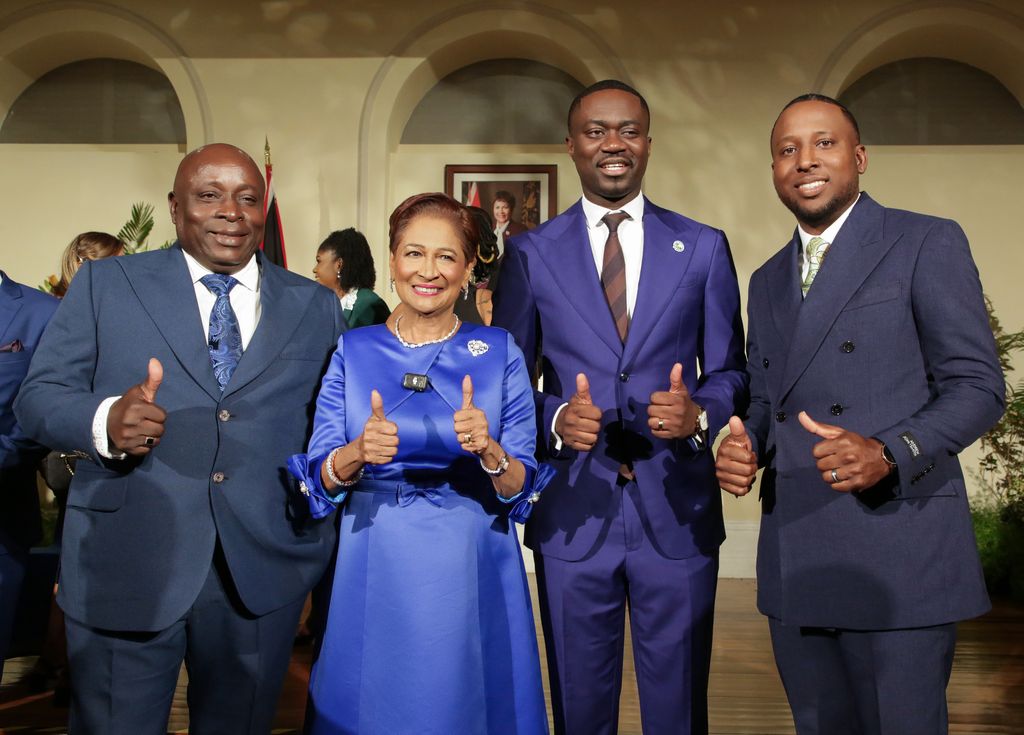
The year 2025 saw Prime Minister Kamla Persad-Bissessar writing herself into the top notch of the political spectrum—and the history books—once again, with a comeback that has been hailed as being on par with that of US President Donald Trump, now also in his second stint as president.
And as Trinidad and Tobago’s ninth Prime Minister, Persad-Bissessar is just as controversial as the US’s 47th president, whose “America First” policy has been highly emulated by her Government, where T&T is concerned.
It was a year that Persad-Bissessar, 73, showed that older women were a force to be reckoned with and a year when the UNC’s trademark yellow became “Golden”, as Persad-Bissessar led her party into fulfilling the lyrics of Huntrix’s big 2025 hit of the same name.
The UNC’s first female political leader, who etched her name in the male-dominated halls of power as the country’s first female prime minister in 2010, powered the UNC into ending a 10-year political drought with the April 28, 2025, General Election.
The PNM was routed after a two-term tenure, suffering a crushing defeat by the UNC’s Coalition of Interests, whose MPs now occupy the right-hand side of Parliament’s House of Representatives.
Persad-Bissessar, moulding the coalition since 2024, renewed ties with partners from smaller parties and the labour movement, similar to the People’s Partnership, which she headed in 2010. She co-opted PNM defectors John Jeremie, Kennedy Swaratsingh, Phillip Watts and others, rallying citizens, promising nightly on platforms: “When UNC wins, everybody wins!”
UNC won.
When Persad-Bissessar announced victory early on election night—after a 54.4 per cent voter turnout—her UNC had taken PNM strongholds in San Fernando and the East-West Corridor, while the Tobago People’s Party booted out both PNM Tobago MPs.
Her victory caused resignations in the PNM and new leadership. Persad-Bissessar now faces a female Opposition Leader—Pennelope Beckles. Both attorneys. Both south-born.
After opposition “wilderness”, Persad-Bissessar’s now guaranteed headliner status since taking the oath of office on May 1 made her the only woman to serve as Prime Minister twice, pledging to lead a “compassionate, inclusive, and decisive” administration—launching her prime ministerial tenure with an address concerning hope, unity and renewal, and a promise that “From Charlotteville to Barrackpore, everybody will win.”
In these first eight months of her new Government, Persad-Bissessar has made it very clear that today’s Kamla 2.0 is not the Kamla of 2010. Even her record-large Government team has been made acutely aware of this via quite strenuous warnings of “buss head” and firing for misdeeds.
Changes Persad-Bissessar helmed with her numerically strong team have been felt not only locally but regionally and internationally. Determined to improve on her last tenure and wielding a steely hand, her Government’s changes have, however, left some with the view that all that glitters isn’t always gold.
Among seeking to fulfil campaign promises—including reducing crime—effects of ultra-speedy moves to retool systems, programmes, appointments and certain personnel were expansive and swift. Some of her Government’s undertakings have been controversial and contentious, from the dismantling of CEPEP, URP and similar programmes to state board appointments.
By year-end, her Government’s changes had marked more than a dozen state board officials, chief executive officers and heads of entities fired or forced out via pre-retirement leave, resignation, appointment revocation or mutual separation agreements. The changes continue.
Parliament debates have been similarly heated, with Persad-Bissessar escaping—on a banter basis—the PNM’s bid to have her investigated by Parliament’s Privileges Committee.
Her re-election as UNC leader soon after becoming Prime Minister was a given, especially since she was re-elected unopposed.
Her Government received praise and pushback for its 100-day performance, which included launching a State of Emergency, as the PNM instituted in 2024, and which reduced crime between December 2024 and April 2025.
However, the Government’s “one love” with the US Trump administration and its fallout with neighbours—Venezuela, Caricom and some in Tobago—made Persad-Bissessar’s newsmaker status higher even than her return to office, in a country where the Opposition Leader and President are also female.
Venezuela was what put her (and T&T) on the global map alongside the US. Sparring with Venezuela first came regarding the alleged entry to that country via T&T by “terrorists.” She warned that any illegal incursion into T&T waters would be met with deadly force by this country’s armed forces. Venezuela deemed her statements “irate and unjustified”.
However, the US’s launch of military buildup in the southern Caribbean in August, with the stated goal of combating drug trafficking, marked a development which dominated global headlines for the rest of the year, catapulting Persad-Bissessar and this country into the limelight for their strong US support.
In months of US/Venezuela tensions and provocations, US missile strikes on alleged drug boats, and Venezuela’s fiery responses, Persad-Bissessar’s hot statements, locally and at the United Nations General Assembly, where she embarked on her first trip, held the US line. But she stressed no war will be launched from T&T.
She took extreme flak from Venezuela—including loss of energy links and name-calling—after the visit of the USS Gravely and US Marines training with the T&T Defence Force, allowing US military access to this country’s airports and the installation of the US radar in Tobago (and also Trinidad), where her reported flip-flopping on facts headlined her locally and internationally.
Her view on the Tobago radar—and the US military support there for the facility—catapulted it into a Tobago House of Assembly election campaign issue.
Declared persona non grata in Venezuela and the subject of street protests, Persad-Bissessar has maintained T&T’s distance from any war effort and US blockade of sanctioned oil tankers, and has defended the US/T&T relationship on the basis that the US is the “only country” that can defend T&T from any external threat.
While Persad-Bissessar has hosted India’s Prime Minister Narendra Modi, Ghana representatives and Grenada’s PM, wooing Grenada energy deals, she skipped Caricom’s July summit and further distanced herself from Caricom on the basis of her US support and criticism of Caricom’s call for the Caribbean zone of peace to be maintained. The latest sharp remarks were traded with Antigua, though the Prime Minister said Cabinet has not discussed withdrawing from the regional grouping.
Alongside warnings to her team regarding delivery in 2026, her Government’s latest issue has been negative public sentiment to the “surprise” Christmas Day legal notices of steep motor vehicle fines increases and other hikes in fees.
If 2025 was golden for Persad-Bissessar, whatever the colour of 2026, she will continue being a newsmaker of note all the way up to 2030.