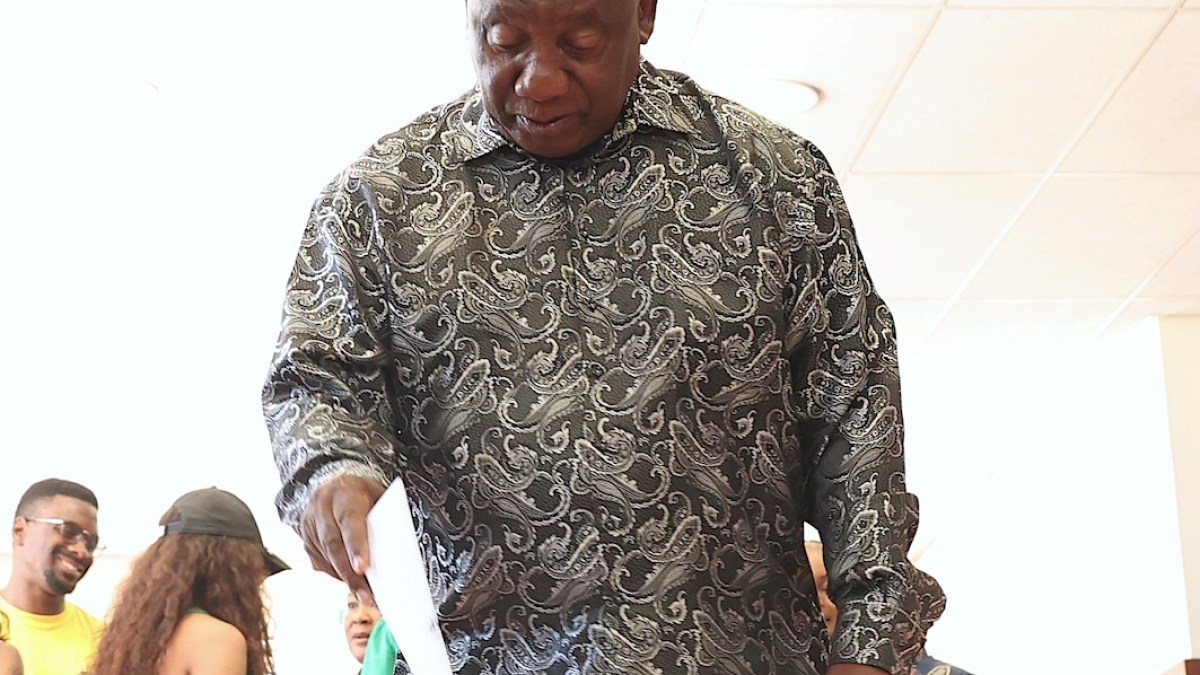

South Africa’s African National Congress (ANC) has recorded its worst-ever result in local elections, more than three decades after the party of Nelson Mandela led the country out of apartheid and into democratic rule.
While the ANC remains the country’s largest party, Wednesday’s vote appeared to confirm it is locked in a downward spiral amid long-held anger over corruption scandals and poor service delivery.
- list 1 of 3Opposition party organiser killed before South Africa elections
- list 2 of 3South Africans vote in local elections as failing services test ANC
- list 3 of 3Vote counting underway in critical South Africa elections
end of list
The elections were held to choose local government councillors who run South Africa’s eight biggest cities as well as its 44 district and 205 local municipalities. ANC Secretary-General Fikile Mbalula described the results of the vote as “catastrophic”.
President Cyril Ramaphosa, who also serves as the president of the ANC, said political parties should approach upcoming political negotiations to form coalitions for local rule with humility. “Our people’s interest must not be drowned by the quest of political parties or representatives to settle political scores or petty squabbles,” he said.
What are the results of the vote?
The ANC won 31 percent of the vote, versus about 25 percent for its main rival, the Democratic Alliance (DA).
The DA has sought to shed its historical reputation as a “white party”, a label it rejects. The party said it had won the votes of more than one million Black South Africans for the first time, based on its modelling.
The ANC lost its place as the largest party to the DA in the economic hub of Johannesburg, the capital Pretoria, and the large Ekurhuleni municipality east of Johannesburg. The DA also retained its control of South Africa’s second-biggest city, Cape Town.
Advertisement
While the ANC remained the largest party in terms of vote share, the results represent a sharp drop from the 46 percent it bagged in the 2021 local vote and less than half the vote share that the party had two decades ago: 66 percent in 2006.
In 2024, it lost its parliamentary majority for the first time in a national election, which brought about a coalition national government and a seismic shift in South African politics with the end of the ANC’s 30-year dominance.
South Africa held its first democratic elections in 1994, when the ANC won 63 percent of the vote under Mandela’s leadership. He was inaugurated as the first Black president of South Africa shortly afterwards.
Sandile Mnguni, a lecturer in political science and international relations at the University of KwaZulu-Natal in South Africa, said the “decline in electoral support should serve as a clear warning that the party can no longer rely on its historical political dominance or liberation credentials to retain the confidence of voters”.
“If the underlying grievances of the electorate remain unaddressed, the party could face even greater electoral challenges,” he told Al Jazeera.
What does this vote mean for the ANC?
Since no party won more than 50 percent of the vote in many cities, the ANC and DA have to team up or hash it out with smaller parties to form municipal governments. Parties have 14 days to negotiate before city councils are formed.
An ANC partnership with the DA would mirror an arrangement they have had in national government for the past two years, but the two are ideologically opposed on key issues such as how to address the deep economic and social inequalities left by apartheid.
The DA will be mindful of striking a partnership with the ANC, which analysts say was harshly rebuked by voters in this election over problems with basic services such as irregular water, electricity outages, dilapidated roads, broken street lights, and uncollected refuse.
Ramaphosa was also punished for being implicated in a corruption scandal known as “Farmgate” after burglars broke into his luxury private ranch in 2020 and stole $580,000 hidden inside furniture. The president was accused of covering up the theft and keeping efforts to trace the burglars private in a bid to avoid an investigation into where the money had come from.
South African author and political commentator Ralph Mathekga told Al Jazeera that the vote sent a “strong message” to the ANC “that the collapse of service delivery and the ensuing corruption has reached a point where it cannot be tolerated”.
Advertisement
Mathekga said voters no longer see the party as the solution to the problems faced by South Africans, but as the “chief culprit”.
“The elections were clearly a referendum on the ANC ‘s capacity to govern and turn the corner,” he noted.
South African political analyst and columnist Sipho Seepe said the vote was also a personal rebuke of Ramaphosa, who sought to present himself as a politically savvy and business-oriented leader for the party, but who has continually been accused of underperforming.
“He has been a total disaster, and the people this time have made it very clear,” Seepe told Al Jazeera. “People have been giving it [the ANC] a chance, and [now] they’re saying no more.”
The DA suggested it would steer clear of an agreement with the ANC when it said in a statement that it would initiate coalition discussions with “political parties that share a commitment to clean and accountable government, rooting out corruption, service delivery for all, the rule of law, and non-racialism”.
Ramaphosa is expected to step aside as party leader ahead of the 2027 ANC leadership contest and the country’s next general election in 2029.
What does this vote mean for South Africa?
The local election has ramifications for South Africa’s politics beyond local government.
Analysts say the vote confirms that the country is transitioning away from one-party dominance and towards political plurality. “From now on, we can accept coalitions to be the new normal,” Seepe said.
While this might lead to some political instability, the analyst said it may pressure parties to prioritise performance once in power. “The ANC government has been stable, but it has been failing the people,” he said, noting that being responsive to the electorate’s needs is now seen as more urgent than political continuity.
Mathekga, author of the book The ANC’s Last Decade, said voters have made it clear that they “do not want concentration of power in one party”.
“Coalitions are there to stay, perhaps until political parties demonstrate that they can be trusted with power to constitute government on their own,” Mathekga said, describing the shift as a “necessary evolution of South African politics”.
Mnguni, at the University of KwaZulu-Natal, agreed that South Africa appeared to be ready to trade a little less political stability in exchange for greater accountability.
“Of course, there may be instances of political stalemating, unstable alliances and disagreements that delay important municipal decisions [and] these risks should not be underestimated,” he said.
“However, I view the broader transition as an opportunity for South Africa’s democratic development, provided that political parties demonstrate political maturity and place governance above narrow partisan interests.”
Related News
Iran lawmakers call for withdrawal from NPT: Will we have war or peace?
‘Radical’ or ‘hero’?: France debates leftist candidate Jean-Luc Melenchon

Global stock markets rise as investors continue to bet on AI