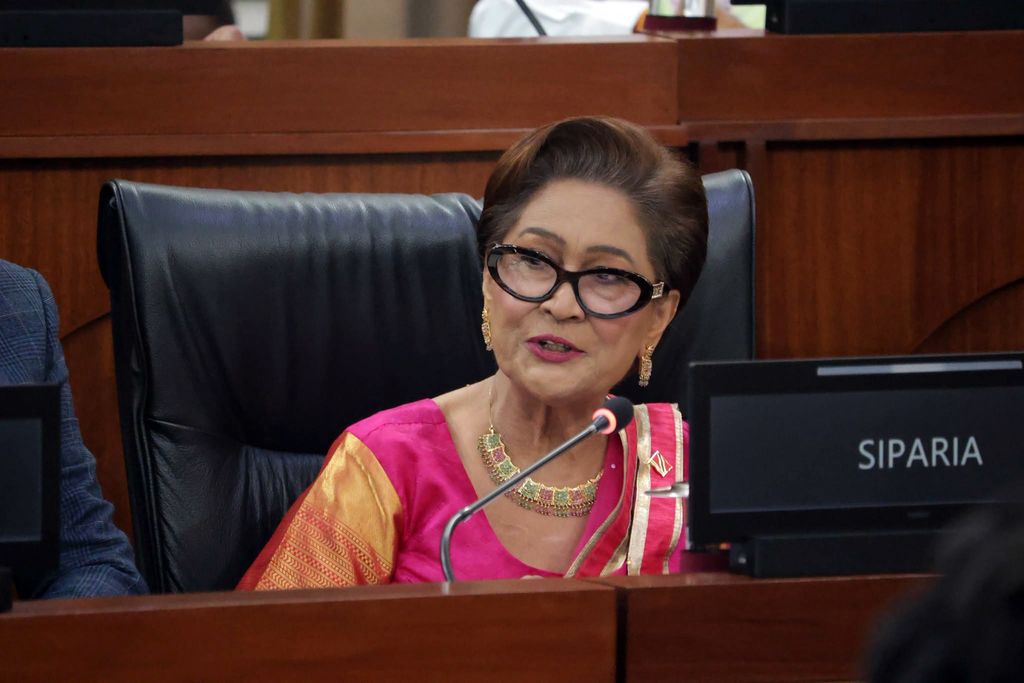

Prime Minister Kamla Persad-Bissessar has accused the former People’s National Movement (PNM) administration of spending $114 million on entertainment, the Prime Minister’s household expenses and conferences over ten years, vowing that the Office of the Prime Minister (OPM) will no longer be used as a “slush fund for the lavish lifestyles of those who treated themselves as emperors.”
It came yesterday before Budget 2027 was passed in the Lower House without support from the Opposition, whose members had earlier opted to “boycott” questioning the Prime Minister when she appeared before the Standing Finance Committee to be questioned on spending for OPM.
The budget was passed with 28 votes for, 12 against and no abstentions.
Prime Minister Kamla Persad-Bissessar, in her opening statement at the SFC, said the Office of the Prime Minister will no longer be used as a “slush fund for the lavish lifestyles of those who treated themselves as emperors.”
She told the committee that the OPM came before them as the main driver of national development, before detailing expenditure under the previous administration.
She said between 2016 and 2025, the OPM spent $19.2 million on official entertainment.
“From 2016 to 2025, while thousands lost their jobs, the office of the Prime Minister spent $80.5 million on the Prime Minister’s establishment, simply put, expenses for the Prime Minister’s household, not for the office of the Prime Minister, but for the household,” Persad-Bissessar said.
She said under the same period, the OPM spent $14.7 million on hosting conferences and seminars.
“In total, over the last ten years, the office of the Prime Minister spent $114 million on fine dining, vacations, fine wine, sightseeing, and splurging as our nation suffered. Those days are over,” Persad-Bissessar said, as Government MPs thumped their desks.
She said in her first year in office, her Government slashed spending at the OPM from $1.2 billion in fiscal 2025 to $465 million in fiscal 2026.
In fiscal 2027, the allocation, inclusive of the development programme, is $462.7 million.
Persad-Bissessar said the OPM’s recurrent expenditure increased by $26 million to support higher salaries for workers.
After her introduction, the committee’s chairman, Speaker Jagdeo Singh, read out the heads of expenditure so that Opposition MPs could ask questions on the allocations.
However, no Opposition MP asked any questions and the allocation for the OPM.
When asked, Opposition Chief Whip in the House Marvin Gonzales told Guardian Media that they decided to “boycott” the PM and they were not going to entertain what he described as a “PR stunt” from Persad-Bissessar.
Meanwhile, the Opposition said it voted against the 2027 Budget because the Government failed to present a credible plan for economic recovery, address job losses or account for promises made in the previous fiscal year. In a statement issued after the vote, the People’s National Movement (PNM) also accused the UNC administration of imposing further hardship on families, increasing borrowing and discriminating against communities represented by PNM-led municipal corporations.
“The Opposition could not support a Budget that asks citizens to accept more hardship, more borrowing and more promises while the Government refuses to account for its failures,” the statement said.
The Opposition claimed its assessment showed that more than 90 per cent of the Government’s promises from the previous fiscal year remained unfulfilled. However, the statement did not provide a breakdown of those promises or explain how that figure was calculated.
It accused Government members of using personal attacks and distractions during the parliamentary debate instead of reporting on the delivery of projects.
The Opposition also questioned the state of the public finances, claiming that a deficit initially projected at $3 billion had exceeded $7 billion by July.
“The country deserves an honest explanation for this deterioration in the public finances,” it said, adding that it expected the deficit to rise further.
On employment, the Opposition alleged that more than 60,000 people had lost their jobs under the UNC Government and argued that the Budget offered no credible programme to restore livelihoods or generate sustainable employment. The statement did not identify the source of that figure.
Turning to Tobago, the Opposition argued that reduced funding for the Tobago House of Assembly would threaten services and development.
It further accused the Government of denying PNM-led municipal corporations the resources required for road repairs, drainage maintenance, garbage collection and the upkeep of public spaces.
It said its vote represented workers, struggling families and communities seeking fair treatment, and pledged to continue pressing the Government for accountability and an economic plan that delivers jobs and opportunity.