
Senior Reporter
geisha.kow[email protected]
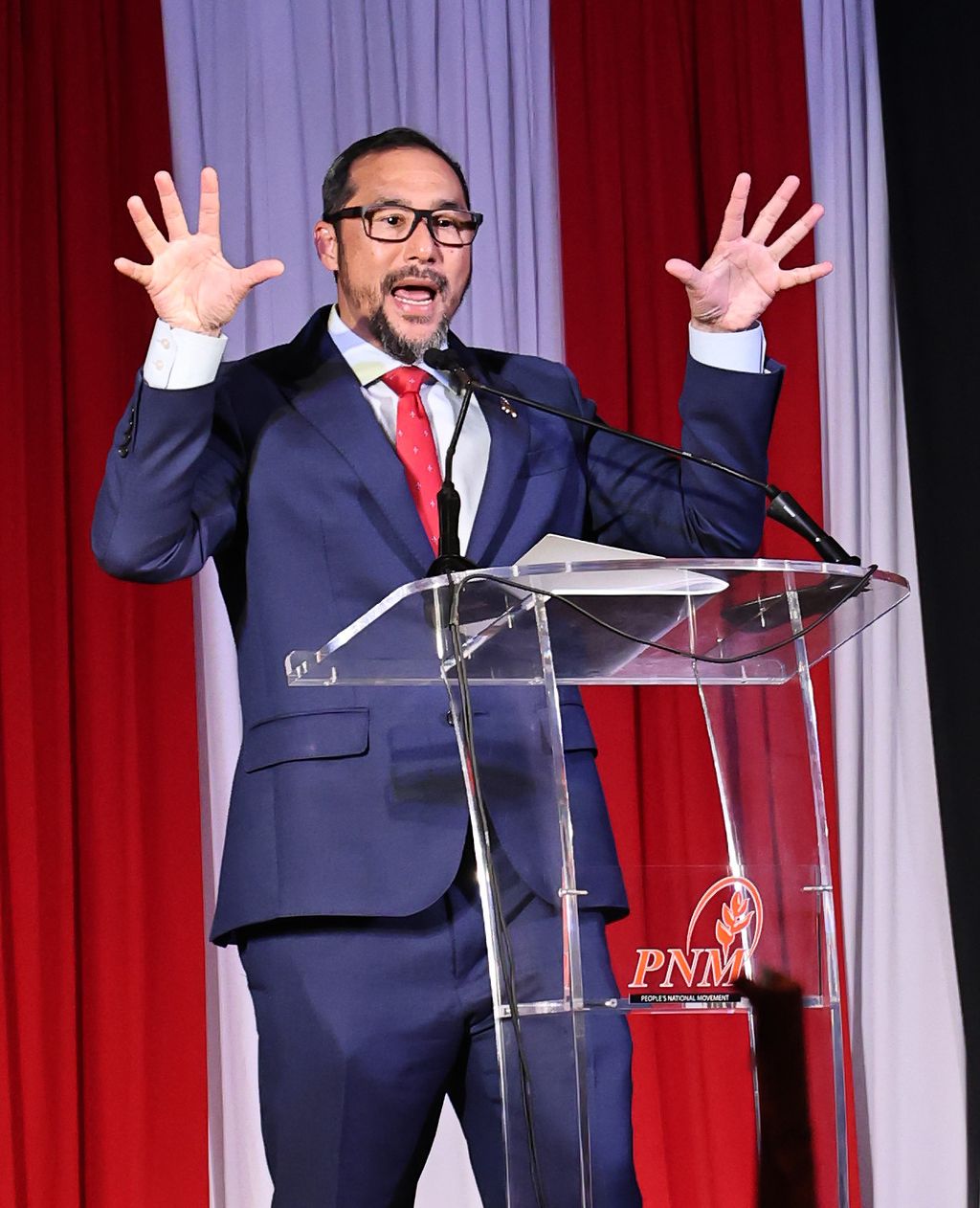
Former prime minister Stuart Young has alleged that political interference in T&T’s largest indigenous financial institution can threaten confidence in the country’s banking system, as he questioned the circumstances surrounding the departure of Republic Financial Holdings Ltd’s (RFHL) executive Richard Sammy and challenged Government’s claims that foreign exchange availability has improved.
Addressing a People’s National Movement (PNM) public meeting at City Hall in Port-of-Spain on Friday night, Young delivered a sharp critique of the Government’s handling of key economic issues, warning supporters that political interference in major financial institutions could have serious consequences.
His comments centred on Republic Financial Holdings, following last week’s announcement that Sammy had left the company by mutual agreement.
Sammy had previously been identified as the successor to long-serving group president and chief executive Nigel Baptiste and was expected to assume the role from January 1, 2027. Referring to Sammy’s departure, Young suggested the development deserved close public scrutiny.
“You see what happened this week with the removal and the resignation of Richard Sammy? This one painful to say,” Young told supporters, adding, “Mark my words, and keep your eyes on it very, very close. Because if what we hear on the ground is true and they have any truth to it about removing people because they ain’t giving money to certain friends and financiers of the UNC, we in real trouble in this country.”
Young argued that confidence in the country’s banking sector is critical to economic stability and warned against what he described as attempts to influence institutions for political purposes.
“You must never interfere with our banks and our financial system because you could bring collapse to Trinidad and Tobago... Because if they continue interfering, and the only reason they want to interfere there and put their people in place—you know why? They want to dip their hand,” he alleged.
Young also raised concerns about the availability of foreign exchange, rejecting claims that access to US currency has improved.
He argued that ordinary citizens and businesses continue to face difficulties obtaining foreign currency through commercial banks despite assurances from the Government that conditions have improved.
“I want to ask now, anybody in this room could walk into the bank now and get any amount of US that they ask for? The answer is no,” he said adding, “People going to the bank, they can’t even get a hundred US.”
The former prime minister said the continued shortage of foreign exchange remains one of the country’s most pressing economic challenges, affecting consumers, businesses and overall confidence in the economy.
While Young trained his fire on economic issues, PNM Political Leader Pennelope Beckles delivered a message centred on party rebuilding and election preparation.
She stressed that internal unity would be essential if the party hopes to regain political ground at the local government level, saying, “We cannot afford at this point in time to be still quarrelling, to be still complaining who you like, who you ain’t like. Those days finished.”
Her comments come as the party continues efforts to regroup following its defeat in the April 2025 general election and as preparations intensify for local government elections.
Beckles said constituency groups must become more active and urged supporters who had drifted away from the party to return.
“We cannot win elections without uniting and without encouraging people to come back to the fold. There are all kinds of reasons why some people didn’t vote. We’re not going back there. But in order to win, everybody has to be on board,” she said.
She argued that a united party would be capable of overcoming electoral boundary changes and other challenges expected during the campaign.
Former finance minister Colm Imbert, who also spoke, used his address to raise concerns about what he described as a weakening of democratic institutions and increasing political control of the State.
Imbert argued that T&T was exhibiting what he called ten warning signs associated with countries moving towards authoritarian rule.
Among the issues he identified were the concentration of political power, declining parliamentary independence, attacks on legal institutions, politicisation of the public service, hostility towards independent media and efforts to undermine institutions that challenge government decisions.
“When you have these ten things, and this is happening in Trinidad and Tobago, we are on our way to becoming a dictatorship,” Imbert said as he urged, “And we have to push back. You have to push back. You can’t be quiet.”