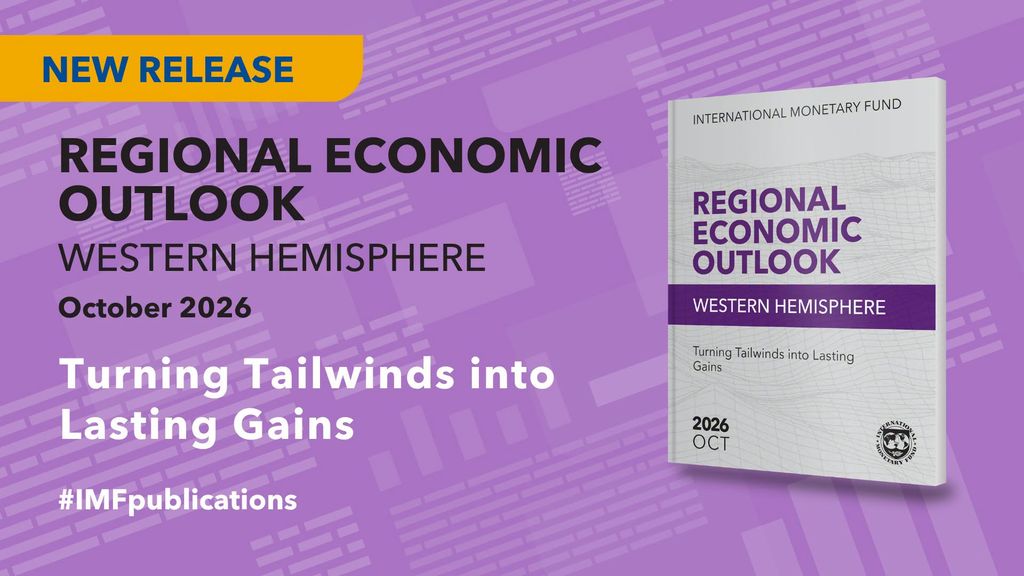

The International Monetary Fund (IMF) Friday said that growth across the Western Hemisphere has remained resilient, supported by strong United States demand, high commodity prices, easier financial conditions, robust tourism, and remittance inflows.
In its regional economic outlook for the Western Hemisphere, the Washington-based financial institution said that these tailwinds have cushioned the negative effects of trade uncertainty, higher and more volatile energy prices, and shifts in immigration.
But the IMF said that, public debt remains high, policy space is limited, and medium-term growth prospects are subdued.
It said higher global energy and food prices are also delaying the return of inflation to target and that policymakers should use the current favorable conjuncture to rebuild fiscal buffers, preserve price stability, and protect vulnerable households through targeted support.
The IMF said Latin America and the Caribbean (LAC) has attracted substantial foreign direct investment (FDI) but it remains less integrated into international trade than many peer emerging market (EM) regions.
It said that the stock of inward FDI in the region was valued at about three trillion US dollars trillion in 2024, equivalent to 44 percent of the gross domestic product (GDP) in the LAC, compared with 25 per cent in Asian EMs and 21 per cent in European EMs.
According to the IMF, real GDP growth for the Caribbean is estimated at 6.1 per cent in 2025, climbing to eight per cent in 2026 declining slightly to 7.4 and 7.2 per cent respectively for the years 2027 and 2028.
According to the IMF, the Caribbean tourism dependent countries will register economic growth of two per cent last year, declining to 1.4 per cent this year, before increasing to 2.3 per cent next year and dropping slightly to two per cent in 2028.
In the case of Antigua and Barbuda, the island recorded economic growth of three per cent last year, declining to 2.4 per cent this year and increasing to 2.5 per cent for the next two years.
The Bahamas economic growth last year had been set at 3.8 per cent, but will decline to 2.5 per cent this year, and further declining to1.9 and 1.8 per cent respectively for the years 2027 and 2028.
Barbados economic growth of 2.7 per cent last year, will decline to.18 per cent this year, before recovering to 2.2 and 2.1 per cent over the following two years.
In the case of Belize, economic growth in 2025 was projected at 2.6 per cent, declining to 1.9 per cent this year, before increasing slight to two per cent for the next two years. Dominica’s economic growth of 4.5 per cent in 2025, will decline to 3.1 per cent this year with further declines of 2.8 and 2.7 per cent projected for the next two years.
Last year, Grenada recorded growth of 4.8 per cent, but the IMF is projecting that for this year it will record 3.9 per cent, before declining to three per cent and 2.9 per cent over the 2027-28 years.
Jamaica is not expected to record any economic growth this year, a slight decline on the 0.1 per cent registered in 2025 and Kingston is projected to have economic growth of 2.4 and 1.8 per cent over the 2027 and 2028 period.
The 1.5 per cent increase registered by St. Kitts and Nevis last year, will increase slightly to 1.8 per cent this year, 2.3 per cent in 2027 and 2.4 per cent the following year.
St. Lucia, which had registered a minus 0.6 er cent economic growth last year, will this year register economic growth of 1.2 per cent this year, 1.8 er cent in 2027 and 1.6 per cent the following year.
St. Vincent and the Grenadines economic growth of 2.4 per cent last year, will decline slightly to 2.3 per cent this year before registering positive growth of 2.4 ad 2.7 per cent over the years 2027-28.
According to the IMF, the Caribbean non-tourism dependent countries will register growth of 8.2 per cent in 2025, increasing to 11 per cent this year before declining to 9.6 and 8.2 in the years 2027 and 2028.
Guyana leads the growth with projections put at 122.3 per cent this year, having registered growth of 19.3 per cent last year. The IMF is projecting that Guyana’s growth over the years 2027 and 2028, will be 16.8 and 9.2 per cent respectively.
Surname will maintain the same four per cent growth in 2026 as it had registered the previous year, increasing to4.1 per cent next year and declining to 28.2 per cent in 2028.
In the case of Trinidad and Tobago, which had registered a minus 0.5 per cent growth last year, the IMF is projecting that it will this year register growth of 0.2 per cent this year, increasing to 22 per cent next year and 3.1 per cent in 2028.
Haiti is the only Caribbean Community (CARICOM) country where economic growth for the next two years will be negative. According to the IMF, Haiti registered minus 2.7 per cent economic growth in 2025, minus 1.7 per cent this year and minus 0.5 per cent next year. But the French-speaking CARICOM country is expected to register a positive growth 0.7 per cent in 2028. —BANGKOK, Thailand (CMC)