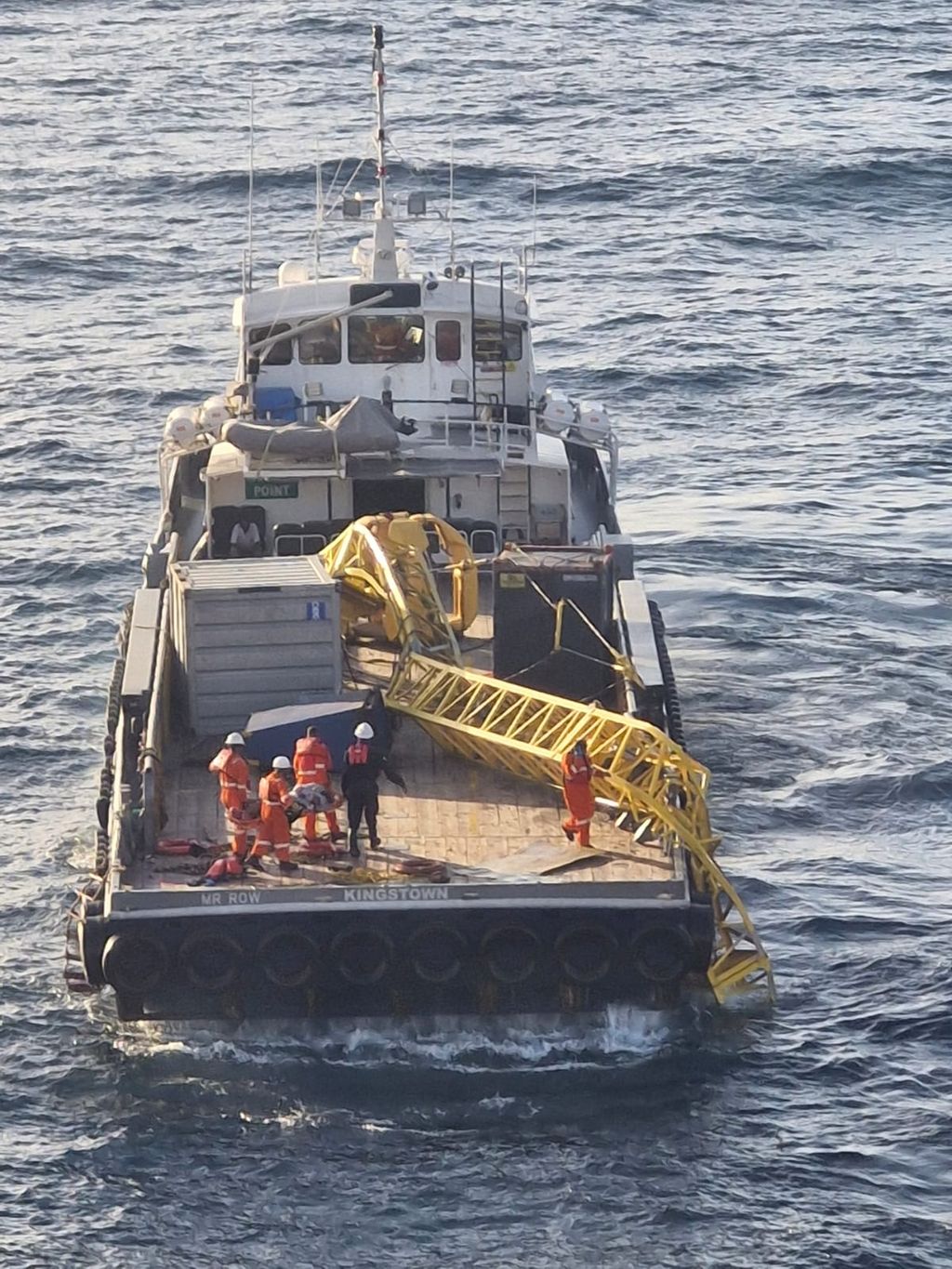

An operator is said to have died after a crane collapsed on a vessel he was working on at Perenco’s offshore Samaan field on Wednesday afternoon, with the worker’s body later brought ashore at the Port of Galeota.
The worker had not been identified up to Wednesday night.
The incident occurred around 3 pm, when the crane structure collapsed onto the offshore platform and parts of a supply vessel nearby, according to information received by Guardian Media.
The operator was inside the crane cab when the structure fell more than 100 feet into the water. The circumstances surrounding the collapse and the events leading to the worker’s death have not been established.
A source familiar with the incident recalled what occured.
“I hoped he survived, but a fall from that height and with a part of the crane landing on the barge — the force of the impact would have resulted in serious injury, if not death,” the source said.
Another source said a helicopter had been on standby to evacuate the worker, but questions arose about whether a night-time evacuation could be carried out.
However, Guardian Media understands the worker’s body was subsequently taken ashore by boat to the Port of Galeota.
Operations at the Samaan field were said to have been suspended following the incident.
Wayne Mohan, a process safety and operations professional with more than 30 years of experience in the petrochemical and petroleum industries, said the pending investigation into the incident should examine both the cause of the collapse and the effectiveness of the emergency response.
“Two distinct aspects of this incident that would deserve attention would be: one, prevention — what caused this incident; and two, mitigation and emergency response — how quickly was he recovered and were the rescue arrangements effective,” Mohan said.
Perenco operates the Samaan field as part of the Teak, Samaan and Poui block, an offshore oil-producing area in Trinidad.
The incident comes amid continued scrutiny of safety in the offshore energy sector following previous fatalities involving workers in high-risk operations.
In February 2022, divers Kazim Ali Jr, Yusuf Henry, Rishi Nagassar and Fyzal Kurban died after being sucked into a pipeline while carrying out maintenance work at Berth Six of Paria Fuel Trading Company Ltd’s facility at Pointe-a-Pierre. A fifth diver, Christopher Boodram, survived. The tragedy prompted a Commission of Enquiry into the circumstances surrounding the deaths and the rescue response.
In December 2024, offshore worker Pete Phillip went missing after a rig partially collapsed in the East Soldado Field in the Gulf of Paria. Phillip fell into the sea during the incident involving Well Services Limited’s Rig 110. Despite search and recovery efforts, he was not found.
In January, Energy Minister Dr Roodal Moonilal announced that the Government had cancelled the Safe To Work (STOW) certification requirement for access to the energy sector, saying the system imposed unfair costs and barriers on businesses.
The STOW framework had served as a pre-qualification system requiring service providers to meet minimum health, safety and environmental standards before bidding for energy contracts. The Government said it would revert to ISO standards and other codes that applied before the framework was introduced.
The cause of Wednesday’s crane collapse and whether any safety or regulatory failures contributed to the death remain unknown.
Guardian Media is awaiting a comment from Perenco and the Minister of Energy.
Related News
Sando bar owners brace for sales hit, harsh penalties under new bill

Owner Dealers Association questions effectiveness of crime measures
WASA overtime funding cut in 2027 estimates