
Senior Reporter
Prime Minister Kamla Persad-Bissessar says the illicit flow of firearms and narcotics remains one of the most pressing security threats facing Trinidad and Tobago and the wider Caribbean, and she intends to use this country’s seat on the United Nations Security Council to press for stronger international cooperation to eradicate this scourge.
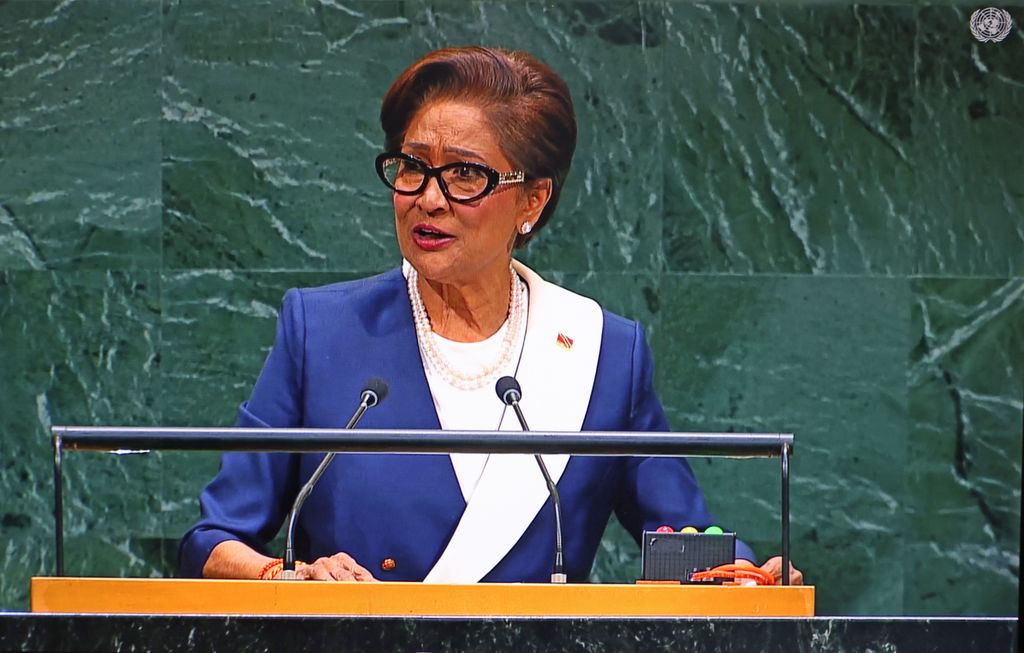
Speaking at the 81st Session of the United Nations General Assembly in New York yesterday, Persad-Bissessar outlined the plan as this country prepares to serve on the Security Council for the 2027-2028 term.
She warned that transnational organised crime continues to pose a serious challenge to small states, with major international criminal networks operating across borders.
“Small states face an asymmetric challenge from sophisticated criminal networks that move people, weapons, narcotics and illicit finance across national borders,” she said.
Persad-Bissessar said the threat is particularly acute for Trinidad and Tobago because organised crime directly affects citizens, institutions and national development.
“For Trinidad and Tobago, this is not an abstract threat. These networks directly endanger our citizens, our institutions and our development.”
She said restoring security has been a key objective of her administration.
“Since being elected to office in 2025, my government has pursued a people-centred agenda focused on safer communities, productive investment, modern public services and expanded opportunity. A central part of that agenda has been restoring security to our communities,” Persad-Bissessar told the General Assembly.
The Prime Minister added, “To this end, we have strengthened cooperative efforts with the United States and other partners to dismantle criminal syndicates that have wreaked havoc across our country and our region.”
She also expressed gratitude to US President Donald Trump for inviting T&T to join the newly established Shield of the Americas and the Americas Counter-Cartel Coalition.
“We remain confident that this partnership will continue to promote freedom, security and prosperity in our region.”
Persad-Bissessar said tackling the illegal movement of firearms and narcotics will be a central focus of T&T’s tenure on the Security Council.
She explained, “Although the region does not manufacture these weapons, their availability fuels gang violence, organised crime, drug trafficking and loss of life across our societies.”
Persad-Bissessar said T&T would advocate for stronger action to combat the cartels.
“While serving on the council, Trinidad and Tobago will advocate for greater international cooperation to address the sources, movement and diversion of illicit weapons, including stronger tracing mechanisms, information sharing, border and maritime cooperation, and deeper cooperation among source, transit and destination countries to disrupt weapons, narcotics and illicit financial flows.”
She added, “Trinidad and Tobago will bring the experience of the Caribbean to the council, where the impact of illicit firearms demonstrates how transnational organised crime can threaten the security and stability of States even in the absence of traditional armed conflict.”
The Prime Minister also identified Haiti as a major concern and reiterated T&T’s support for international efforts to restore security and stability there.
“Security assistance is necessary, but lasting stability will also require functioning institutions, economic opportunity and a credible political process.”
She stressed that Haiti’s future must ultimately be determined by Haitians.
“Trinidad and Tobago stands in full support of international efforts to help restore security and stability in Haiti, while maintaining that the country’s political future must ultimately be Haitian-led and Haitian-owned.”
Persad-Bissessar said T&T would work alongside Caricom and international partners to address Haiti’s challenges and broader regional security concerns.
She also outlined other priorities for the country’s Security Council term, including women, children, peace and security, as well as the impact of artificial intelligence and emerging technologies on global stability.
“T&T will advocate for an approach that safeguards international security without closing off innovation, development and opportunity, and that ensures developing countries have a meaningful voice in shaping the rules for this new technological era.”
T&T was elected to the Security Council for the 2027-2028 term with the support of 181 member states.
On this milestone, Persad-Bissessar said, “We regard that overwhelming expression of confidence not simply as an achievement, but as a solemn responsibility.”
She said T&T would approach its Security Council tenure with an independent, practical outlook and a commitment to building consensus among member states.
T&T lists 24 gangs as terrorist organisations
Prime Minister Persad-Bissessar has also joined fellow members of the US-led Shield of the Americas initiative in designating 24 criminal gangs and organisations as terrorist entities.
This came after Persad-Bissessar participated in the coalition’s meeting yesterday, which was hosted by the United States.
US President Trump and Secretary of State Marco Rubio addressed participants on regional efforts to combat organised crime, drug trafficking and gang violence, as the administration expands its counter-cartel strategy across the Western Hemisphere.
According to a Government statement, the designation is intended to restrict the ability of these groups to conduct acts of violence throughout the region.
The Government said T&T’s participation reflects its commitment to tackling crime and gang violence through regional partnerships and coordinated action.
The statement said participation in the initiative will strengthen cooperation with the US in three key areas: economic security, energy security and national security.
The Shield of the Americas was established by the Trump administration as a regional counter-cartel coalition. In March, Trump said member countries would coordinate efforts to deny criminal organisations territory, financing and resources, while supporting the training and mobilisation of partner security forces.