
Lead Editor–Politics
akash.sama[email protected]
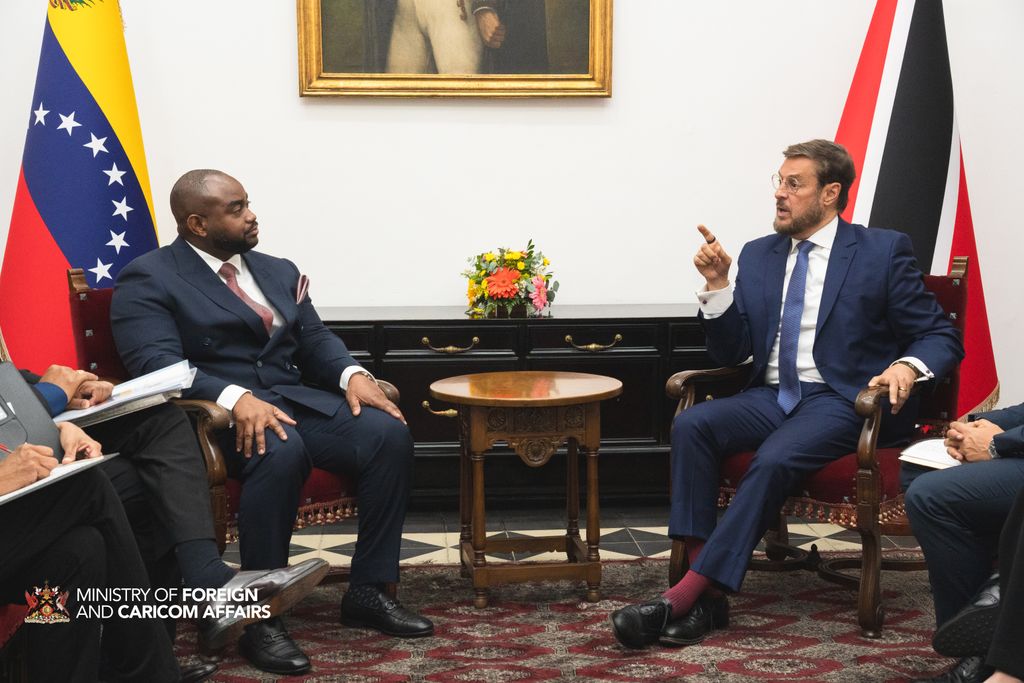
A former Trinidad and Tobago diplomat believes this country was “diplomatically insulted” during Foreign and Caricom Affairs Minister Sean Sobers’ visit to Caracas, arguing that Venezuela’s actions, rather than the cordial language contained in a joint statement, show relations remain far from repaired.
Speaking with Guardian Media on condition of anonymity, the former diplomat said the clearest indication came from the level at which Sobers was received, especially when compared with Venezuela’s recent engagements with Grenada and Barbados.
He pointed to acting Venezuelan President Delcy Rodríguez’s visit to Grenada and the recent trip to Caracas by Barbados Prime Minister Mia Mottley, both of which involved direct engagement at the highest political level.
By contrast, Sobers met Venezuelan Foreign Minister Félix Plasencia on Thursday, while Rodríguez was absent from the talks.
For the former diplomat, that difference spoke volumes.
“We went and they sent a junior to meet a junior,” he said.
“So you look at the actions.”
He argued that, stripped of diplomatic niceties, the level at which Trinidad and Tobago was received amounted to Venezuela effectively telling this country to “go to hell.”
The former diplomat also noted that Trinidad and Tobago initiated the latest engagement. He argued that if Rodríguez genuinely wanted to put tensions behind both countries, she could have reached out directly to Prime Minister Kamla Persad-Bissessar.
“If there was a thaw, Delcy would have by now written to Kamla and said, ‘Let’s bury the hatchet,’” he said. “She didn’t do that. We made the initiative.”
He cautioned against interpreting the cordial statements emerging from Caracas as proof that relations have improved.
“You don’t judge by what they write and what they say. That’s diplomacy,” he said. “Somebody comes to your place, you’re required to tell them nice things.”
“Judge me not by what I say, judge me by my actions.”
According to the former diplomat, “any serious student of international relations” reviewing the engagement would conclude: “That is not a warm embrace.”
He suggested Rodríguez may instead be buying time ahead of the United States midterm elections in November, after which he believes the political environment facing the Trump administration could change significantly.
He theorised that Democratic gains in Congress could bring greater scrutiny of US foreign policy, including the operation that removed Nicolás Maduro from power and Trinidad and Tobago’s role during that period.
“I think she is playing for time,” he said.
The former diplomat believes Rodríguez remains under pressure and currently has little choice but to work with Washington. However, he said November could become a turning point.
“She’s just waiting for when November comes,” he said. “Depending on what takes place, you’re going to see the truth.”
He predicted that lingering resentment could eventually be directed at Trinidad and Tobago because of a perception among Venezuelans that this country assisted Washington during the campaign against Maduro.
“To the average Venezuelan, whether we like it or not, we played a part,” he said, warning that questions about Trinidad and Tobago’s role could eventually resurface.
“People do not forget. And Venezuelans will not allow us to forget.”
Despite his scepticism, the former diplomat said sending Sobers to Caracas was strategically preferable to Persad-Bissessar personally leading efforts to mend relations.
He argued that the Prime Minister should remain “above the fray” on sensitive foreign policy matters, allowing her Foreign Affairs Minister to conduct difficult negotiations while preserving room for intervention at the leadership level if necessary.
“This is good in the sense that you have sent out Sobers,” he said.
However, he also questioned what tangible benefits Trinidad and Tobago has gained from its alignment with Washington, particularly in the energy sector.
He argued that US licences involving Venezuelan gas have strengthened the position of multinational energy companies while leaving Trinidad and Tobago dependent on arrangements involving firms such as Shell and BP.
“What are you getting out of all of this?” he asked.
For the former diplomat, the latest engagement represents an opportunity for dialogue rather than evidence that relations have been repaired.
“There is nothing in the reality of this thing that suggests that there is harmony,” he said.
“The last thing is, what are the results of this thing? Tangible results. Not nice talk.”
Former Foreign Affairs minister Winston Dookeran also views the latest engagement as an opening rather than proof that relations have been restored, describing it as a largely symbolic first step.
Dookeran said Prime Minister Kamla Persad-Bissessar’s persona non grata status will eventually have to be addressed if Trinidad and Tobago and Venezuela are to fully restore diplomatic relations.
“Obviously, it will have to be dealt with in order to have full-blown diplomatic relations,” Dookeran told Guardian Media.
“But the timing of that will be much later.”
He cautioned against expecting any immediate substantive breakthrough from the Caracas engagement.
“It was meant to say that we still have the prospect of building a diplomatic relation in spite of the past. But we are not yet ready to discuss any details,” he said.
“So I think it was just a symbolic meeting and an open step.”
Dookeran suggested this also explains why the Government has provided limited information about what emerged from the discussions.
“The fact that no one can give you details is because there were no details,” he said.
He added that whether the engagement ultimately proves successful will depend on the agenda developed by both governments.
“Whether it’s positive or negative will depend on the future agenda that will develop. But it’s an open step,” he said.
Dookeran was equally cautious about expectations surrounding energy cooperation, questioning recent optimism expressed by Energy Minister Dr Roodal Moonilal about what evolving US-Venezuela energy arrangements could mean for Trinidad and Tobago.
He said major questions remain unanswered about those arrangements and the tangible benefits they could deliver.
Dookeran accused Moonilal of engaging in “plain optics” and attempting to “create victory when there’s no substance.”
Despite those reservations, the former Foreign Affairs Minister said renewed engagement with Venezuela remains worthwhile.
“I see this as an open step and I see it as a symbolic step,” Dookeran said, “and I see it as something that we must follow through on.”