
Senior Reporter
shane.su[email protected]
Deputy Commissioner of Police (DCP) in charge of Administration Junior Benjamin is boasting about the Trinidad and Tobago Police Service’s ability to keep the murder rate at lower levels than last year.
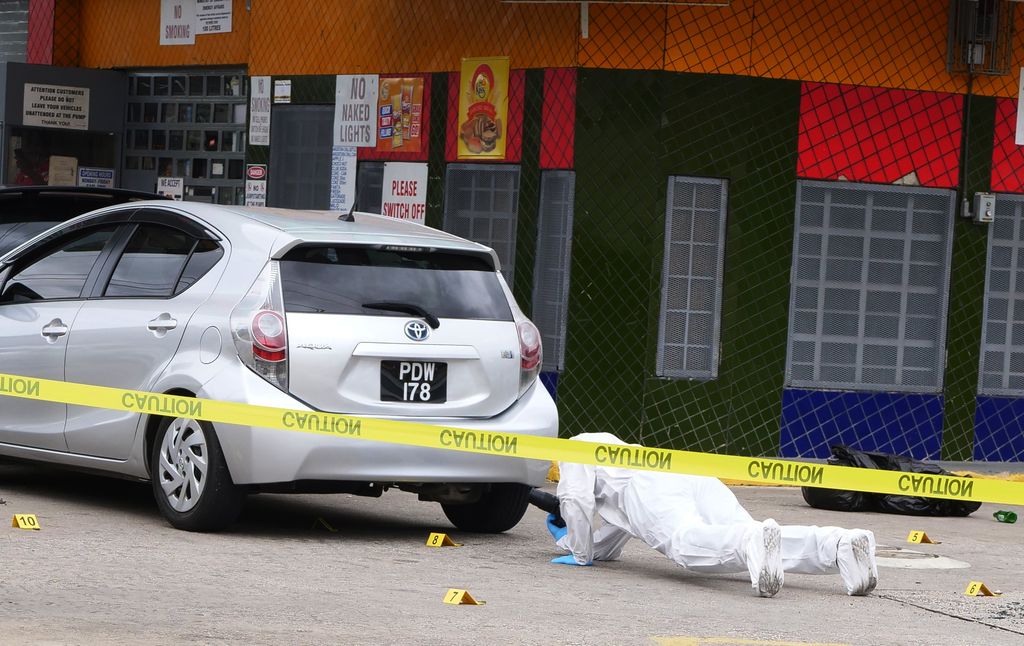
This despite a triple murder in Laventille and a double murder in Siparia over the weekend.
Speaking with reporters during a tour of the 1990 exhibit of the TTPS Museum on St Vincent Street, Port-of-Spain, yesterday, Benjamin reported that there were seven fewer murders for the year thus far compared to the same corresponding period in 2025.
As of yesterday morning, there were 213 murders recorded, compared to 220 murders for the same period last year. On June 30, however, the murder toll for the year matched 2025’s figure when it reached 190. This was the first time in over a year that the murder toll matched a previous figure.
Addressing the police’s ability to keep the murder rate down, Benjamin said, “Last year we looked at we had 41-42 per cent reduction in terms of murders, from over 600 to about 300 murders and even when we look at our statistics now, we are at least seven murders less than we had last year.
“That in itself is a tremendous feat. So even though we were so low last year, we are still under it in the mix of all that is going on.”
However, he admitted that while this was significant, as it reflected the crime-fighting efforts of the TTPS, he was also aware of the unease the public would feel after the recent bloodshed.
Benjamin, therefore, accepted that while the public would not be interested in any data declines, it was important to note that policing activities would continue across the nation.
“We have to take it holistically and every murder, every death is one death too much,” he said.
“Even though we (our murders) were so low last year, we are still trending downwards in the midst of all that is going on.”
He added, “At the end of the day, the public is not interested in our stats, the fact that people are dying is still a great issue and we are saying that we are putting those systems in place to ensure curb the situation as much as we can.”
He also noted that crime-prevention was a “team effort” and implored the public to do their part by partnering with the police by sharing information on criminals.
“Crime is everybody’s business so if you see something, say something,” Benjamin said in a now familiar appeal by the TTPS executive.
“Let us work together, but the TT Police Service continues to really create history by reducing the crime situation and we are saying if the public comes on board, together we can seriously reduce crime so that even the fear of crime can be eradicated and that is a win-win situation.”
Contacted for comment on the current situation yesterday, pastor, social advocate and former member of the Police Service Commission (PolSC), Clive Dottin, said while the fear of crime and violence in some communities was a major concern, the decline in the murder toll should not be dismissed.
Referring to the ongoing State of Emergency (SoE), Dottin said without such a response, it was possible that more murders would have happened.
“Imagine if we didn’t have a State of Emergency, the murder rate might have skyrocketed beyond where we are and beyond where we were last year,” Dottin said.
“You have to always grapple with the issue that if things are rough with a State of Emergency, they could have been even rougher without a State of Emergency.”
Dottin, however, acknowledged that the spate of murders over the weekend was unfortunate, as he called on law enforcement, together with the Government, Opposition and even faith-based organisations, to each unite behind building safer communities.
Referring to a recent conversation with the head of security of a school, Dottin said there were fears that children as young as 14 were being recruited by gangs and called on communities to stage an urgent intervention to prevent violence before it began.
“That has to be examined and we have to do our homework into that situation, which is ‘what do we have to do to get the young people to not see gangs as an attractive option?” Dottin said.
Apart from preventing gang recruitment, Dottin also lamented that such widespread bloodshed was testament to the challenges faced by the proliferation of guns and drugs within communities, even in spite of efforts by the police.
“We have to make a critical effort to deal with a group that we are not happy to deal with and that is the element of those who own the drug trade,” he said.
“Once you have drugs coming in, you’re going to have weapons coming in and I know individuals right now who have come to me for help on cocaine, so cocaine is still flowing in the country and that has to be arrested.”
Criminologist Dr Malisa Neptune-Figaro attributed the fear of crime among certain communities to several factors, including how widely publicised some murders and violent incidents were, which she said could magnify unease even in the face of favourable statistics.
She therefore suggested that in addition to simply monitoring data about crime trends, careful examination should be given to the type of trust and relations that communities have with the police and other authorities.
“In terms of increasing this idea of safety and reducing fear of crime is to monitor not only the statistics, but the quality of life of people in T&T and their trust in the system. So, the relationship they have with the police,” she said.
“Do they believe that the criminal justice system ... meaning all the things we have put in place, including programmes, policies, institutions are working in favour of the public and how they feel about their perception of safety.”
She added that it was also possible that on a smaller scale, families and neighbourhoods could be fearful of violent crime given their proximity to the victims of murders, as losing a relative or someone known to them could amplify the grief and trauma.
“Fear of crime is based on personal experiences, especially when you have a lot of people being victimised by property crimes and they have faced indirect murder ... so their indirect experiences of family members being murders,” Neptune-Figaro said.
“The mere fact that there are so many crimes being shared on social media, so whether there are more encouraging crime statistics, the environment every day doesn’t equate to people feeling safer.”
Neptune-Figaro added that this unease leads to citizens continuing to take precautions with their daily activities to avoid being confronted by criminals.
MURDER TOLL COMPARISON
Year by Year
2025: 220 2026: 213 (up to yesterday)
MONTHLY TOTAL
July 2025: 30 July 2026: 23
Related News

Three tankers hit in the Strait of Hormuz as US revokes license authorizing sale of Irania...

Government signs MOU to revive Point Lisas steel plant

PNM rejects public financial disclosure amid Balisier House probe