
After nearly two decades of governing the Gaza Strip, Hamas has announced it will dissolve its government and hand over power to a new, Palestinian technocratic governing authority.
The move comes as a United States-backed peace process, which resulted in a ceasefire last year, has largely stalled and as Israel’s bombardment of the Strip continues regardless.
- list 1 of 4Hamas dissolves civilian governing body in Gaza after 20 years
- list 2 of 4Israeli attacks on Gaza kill at least 6 as ‘ceasefire’ violations continue
- list 3 of 4Israel’s Smotrich declares ‘revolution’ in West Bank settlement expansion
- list 4 of 4The pitfalls of institutionalising US military aid to Israel
end of list
Analysts say Hamas is likely looking to put pressure on Israel by using this action to appeal to US President Donald Trump, and show that the group is committed to handing over governance and allowing the peaceful rebuilding of a devastated Gaza.
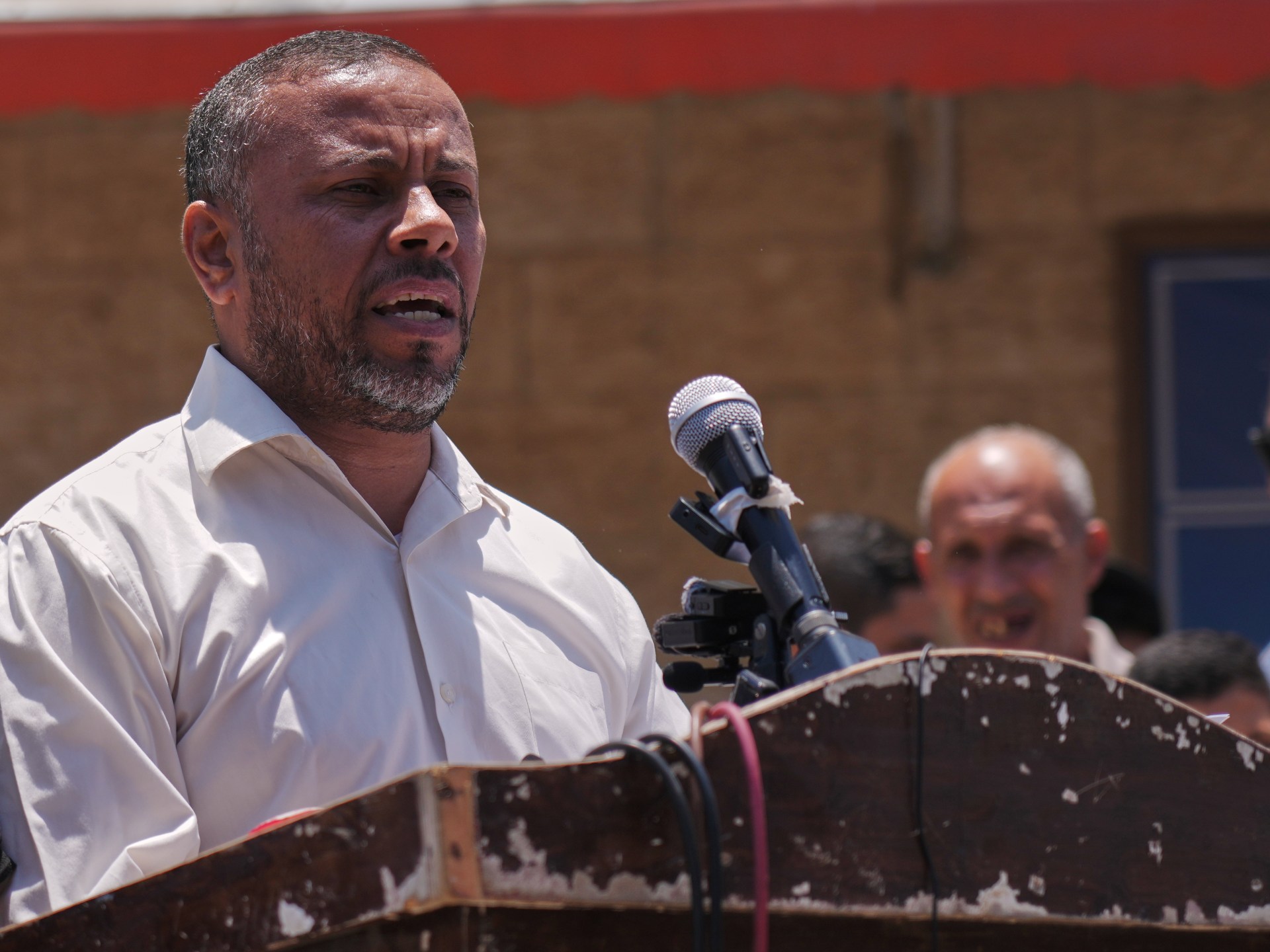
“We hope that this important step on the ground will help bring an end to the aggression, stop the genocide, secure the withdrawal of the Israeli army from the Gaza Strip, reopen the crossings to allow the entry of aid trucks and end the policy of starvation,” Ismail al-Thawabta, general director of the Government Media Office, told Al Jazeera on Monday, following a major press briefing.
At least 1,005 people have been killed in Gaza since the US-brokered ceasefire was agreed in October 2025, and at least 73,098 people have been killed in total since Israel’s war on Gaza began in October 2023.
Furthermore, Israel continues to control about 70 percent of the besieged Strip, crowding Palestinians into the tiny, congested areas that remain.
Here’s what we know about Hamas’s latest move and what the new Palestinian-run Gaza authority will look like.

What has Hamas announced?
Speaking to journalists in the courtyard of Al-Aqsa Hospital in Deir el-Balah, central Gaza, al-Thawabta said Hamas’s head of administration, Mohammed al-Farra, had resigned from his position on Monday and that Hamas would be transferring power to the National Committee for the Administration of Gaza (NCAG) – a Palestinian-run technical committee backed by the United Nations as part of the US-mediated ceasefire.
Advertisement
Al-Thawabta said only “technical and professional staff” would remain in their posts to keep day-to-day affairs in the Strip running.
“All employees working in service provision are ‘state employees’ and are fully prepared to work under the National Committee for the Administration of Gaza,” he said.
Hamas spokesperson Hazem Qassem, meanwhile, called the move “a positive step forward on the path to implement the ceasefire deal”.
What is the new Gaza administration?
The National Committee for the Administration of Gaza (NCAG) was formed in January 2026 under the UN Security Council’s Resolution 2803 as part of the US-backed 20-point peace plan to end Israel’s war on Gaza.
It is a transitional body led by Palestinian technocrats, including Acting Commissioner Ali Abdel Hamid Shaath, who are seen as neutral and non-partisan.
However, Israel has not yet allowed the committee members to enter the Gaza Strip. The committee is temporarily headquartered in Cairo.
“We call on all concerned and relevant parties to immediately accelerate the steps for the National Committee for the Administration of Gaza (NCAG) to enter quickly and assume its national and administrative duties and responsibilities, in order to strengthen the steadfastness of our noble Palestinian people and heal their wounds,” al-Thawabta told the media on Monday.
The NCAG reports to a High Commissioner on President Trump’s Board of Peace and to the UN Security Council. The Palestinian Authority, which currently controls the West Bank, is expected to eventually take over, tentatively in 2027.
The NCAG’s mandate is largely civilian affairs – restoring health, education and water services. However, it is also mandated to maintain law and order under a unified police force.
In a statement posted on X on Monday, NCAG head Shaath said the body had noted Hamas’ announcement and was ready to take over governance of the Strip but only if certain “fundamental” conditions were in place.
“We affirm that NCAG stands fully prepared to assume its national responsibilities as soon as the necessary conditions and enabling measures for its work are in place,” Shaath said in the statement.
“The essential requirements for the Committee’s effective functioning include the existence of a single governing authority operating under one legal framework with a clear mandate, and a unified security apparatus accountable to that authority.”

Does this mean Hamas is disarming?
Israel and the US have repeatedly called for Hamas to disarm before the second phase of the Gaza peace process can begin. However, Hamas says that Israel has not fulfilled its own part of the first phase agreement to withdraw from Gaza, either.
Advertisement
In its announcement on Monday, Hamas did not explicitly mention disarmament, although it said it was ready to hand over security as part of a transition to a new governing body.
Responding to Hamas’s announcement on Monday, Israeli Foreign Minister Gideon Saar dismissed the move and called it a “trick”.
“Hamas seeks to replicate the ‘Hezbollah model’ in Gaza: a technocratic administration would be responsible for garbage collection and other municipal services, while Hamas would remain the dominant military force,” he said. “As long as Hamas retains its weapons, any civilian government will of course operate as Hamas dictates.”
“Israel insists on the full implementation of the Trump plan, with its core principles being the disarmament of Hamas and all other terrorist organisations, and the complete demilitarisation of the Gaza Strip,” Saar added.
Why has Hamas announced this now?
Hamas’s move is likely calculated to counter Israel’s claims that Hamas is not truly ready to give up governance of the Strip, Muhammad Shehada, political analyst and visiting fellow at the European Council on Foreign Relations, told Al Jazeera.
“The announcement comes on the backdrop of Israel spending months and months trying to persuade the Trump administration that Hamas is retrenching, that Hamas is regrouping … that Hamas’s government is in absolute control and that Hamas is only stalling for time because they want to reassert their absolute dominance in Gaza and that they don’t mean business and are not going to leave government,” Shehada said.
In May, the Trump-appointed high representative for Gaza, Nickolay Mladenov, blamed Hamas for delaying the peace process in a report submitted to the UN Security Council.
Hamas, however, says it has signalled its willingness to step down since 2023 when US-led negotiations began under former US President Joe Biden, although the move did not gain traction at the time, analyst Shehada noted.
What Hamas is doing now is demonstrating to Trump that Israel is the only party obstructing the Trump 20-point peace plan, Shehada said, while hoping that Trump will not care about the details of the dissolution, and simply declare Hamas’s move as positive.
Importantly, Shehada said, Hamas is likely also seeking to block Israel’s “dangerous” plans to limit any future administration to a small portion of Gaza that Israeli officials are calling “New Rafah” while it continues to control most of the Strip.
The Trump administration has previously backed Israeli plans for what it has called a “humanitarian city” in Gaza, although critics have called it a “concentration camp”.
Responding to Hamas on Monday, Trump’s Board of Peace said in a post on X that it acknowledged the announcement but was looking for signs of action.
“Ultimately, our assessment will be guided by actions, not promises, to meet the critical needs of the people of Gaza,” the Board posted.
“The core principle remains one authority, one law and one weapon. This means the consolidation of all weapons under the control of the NCAG as provided for in the Comprehensive Gaza Peace Plan and United Nations Security Council Resolution 2803.”
Advertisement
Since the US-brokered ceasefire was signed between Israel and Hamas in October, negotiations have largely stalled over how to move on to its second phase, which requires Hamas’s disarmament and plans to rebuild Gaza.
Among the sticking points is Hamas’s insistence that the first phase must be implemented, including Israel’s promise to allow in “sufficient” humanitarian aid to Gaza, allow displaced Palestinians to return home and withdraw from the strip.
Hamas has repeatedly accused Israel of not meeting these conditions as aid continues to be limited and military bombardments continue – almost daily. Israeli strikes continued on the Strip on Monday after Hamas’s announcement it would step down, Al Jazeera’s Hani Mahmoud reported.
Israel claims it is targeting Hamas operatives in Gaza who are planning more attacks. However, many civilians, including children, have been killed.
Related News
What the US and Iran agreed – and disagreed – on first day of talks
US judge blocks Trump subpoenas into transgender care at New York hospitals
Palestinian baby dies in West Bank after Israel blocks urgent medical care