Venezuelan security guard pulled alive from building basement 8 days after twin quakes
 02 July 2026
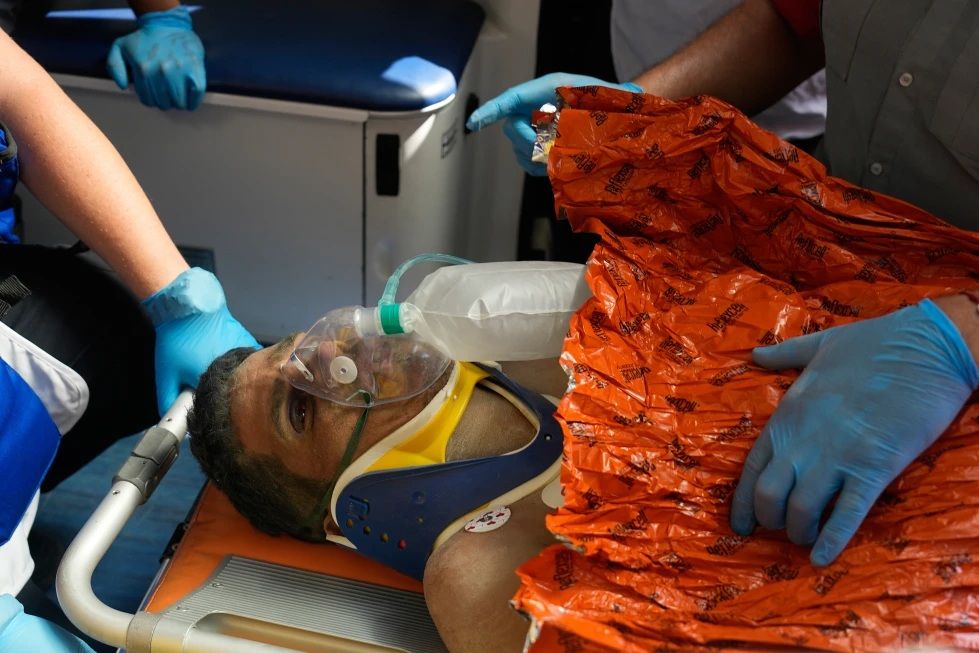

Rescuers pulled a 43-year-old security guard alive from a collapsed basement early Thursday, ending a grueling days-long operation that became a symbol of hope after the devastation of twin earthquakes that struck Venezuela eight days earlier.
Hernán Alberto Gil Flores was extracted safely after being trapped since June 24 under the rubble in the basement of the Galerías Playa Grande shopping center in the coastal town in La Guaira. Rescuers initially made contact with him over the weekend.
Teams carrying flags from across the world cheered as rescuers carried Gil on a stretcher covered in an orange tarp through throngs of people into a Red Cross ambulance. A group of men in red Costa Rican Red Cross uniforms embraced and laughed in relief.
Gil Flores, who worked as a night-shift security guard at the complex, was inside his small security cabin when the first violent tremor struck. While the surrounding concrete structure collapsed around him, his workstation cabin held ground, shielding him from crushing debris and creating a vital pocket of air.
“When we found him, he asked us not to tell his wife that he was alive, just in case he wouldn’t make it,” Costa Rican Red Cross rescuer Minyar Collado told The Associated Press.
A specialized team from the Costa Rican Red Cross first detected signs of life and established contact with him on Sunday.
His wife, Gusbimar González, told the AP, that she had days of despair before rescuers made contact, but that then “ when I learned he was alive, I saw a ray of light in the darkness.” The couple has two children, ages 8 and 10.
The operation was coordinated by an urban search and rescue team of Chilean firefighters, who worked around the clock with specialized teams from the United States, Portugal and Mexico, among others.
“We (were) never going to leave him here,” Collado said before the rescue.
Rescuers navigated highly unstable structural conditions, torrential rain and persistent aftershocks to tunnel down to the survivor. They used a telescopic camera to maintain constant contact with Gil Flores, passing water and liquid nutrients through a narrow shaft to keep him hydrated during the final three days of the extraction.
María Paz Campos, a veteran firefighter from Chile, talked him through the entire operation, and kept him calm during the final excruciating hours of Thursday.
In a video published by the Chilean firefighters in the hours before the rescue, Gil Flores is seen drawing, seemingly to pass the time. Campos then gently tells him to look at the camera and to wear protective goggles.
“I need that you keep the goggles on, for the small particles that are falling, to avoid them getting into your eye,” Campos told the Venezuelan survivor.
The collapse of the building was triggered by two back-to-back earthquakes on June 24 that registered magnitudes of 7.2 and 7.5, respectively.
The shallow, violent tremors damaged or destroyed tens of thousands of buildings across northern Venezuela, killing more than 2,200 people, injuring over 11,000 and leaving La Guaira state as the hardest-hit region in the country. —CATIA LA MAR, Venezuela (AP)
_______
Story by FERNANDA PESCE and JUAN PABLO ARRAEZ | Associated Press
Associated Press video journalists Andry Rincón and Brayan Antequero contributed to this report.
Related News
Woman granted $6m bail in alleged $20m fraud case
Gazetted detention orders on Hadeeds, Sabga outline full allegations
UK report reveals over 180 gangs operating in T&T