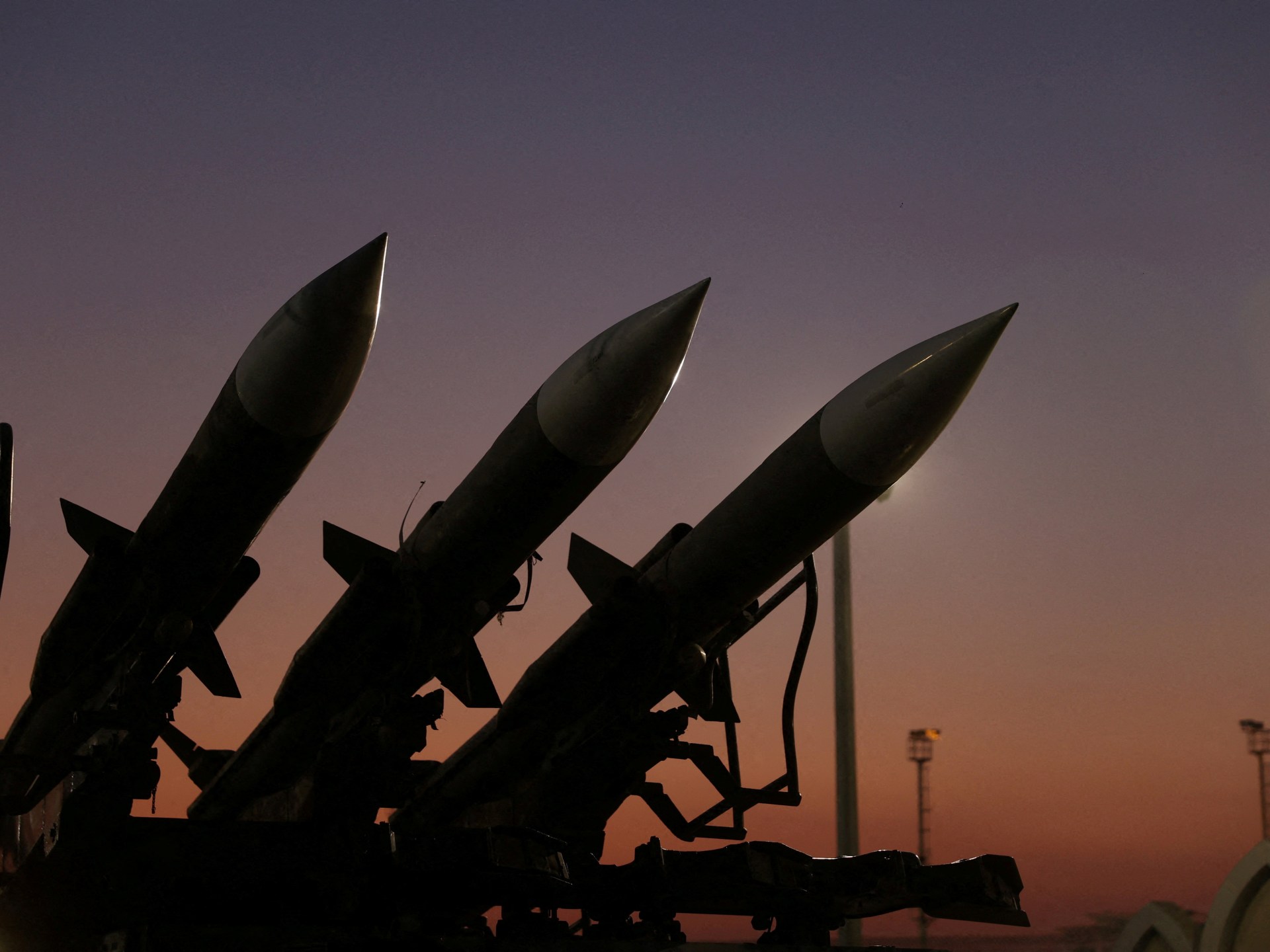

Iran has said it used a new air defence system to shoot down a United States MQ-9 Reaper drone near the Strait of Hormuz earlier this week, an incident analysts say shows that Tehran has retained its capacity to repel US and Israeli attacks despite months of strikes on its military sites.
Iranian media said the drone was brought down near Qeshm Island in the Strait of Hormuz, adding that the interception marked the first combat use of a locally developed system called Arash-e Kamangir.
- list 1 of 4Google employee charged with insider trading over Polymarket bets
- list 2 of 4Ghana welcomes home citizens evacuated from South Africa
- list 3 of 4Ebola outbreak: What travel restrictions have countries imposed?
- list 4 of 4‘Freakish’: Cricket world heaps praise on India’s ‘wonder boy’ Sooryavanshi
end of list
There has been no independent corroboration of Iran’s claim of a new interception system.
The US’s loss of a drone close to one of the world’s most sensitive shipping routes comes as it has reportedly carried out new attacks on an Iranian military site near Bandar Abbas. Iran’s Islamic Revolutionary Guard Corps (IRGC) later said it had attacked an “American airbase” in retaliation.
As tensions between Iran and the US continue to rise despite a fragile ceasefire, Tehran’s claim that it intercepted a US drone has renewed questions about how much of Iran’s air defence capability survived months of Israeli and US attacks – and whether Iran retains the resilience to withstand another round of attacks should negotiations collapse.
What has Iran said?
Iran’s semi-official Fars News Agency said the Arash-e Kamangir system was used to intercept a “hostile” reconnaissance drone over the Strait of Hormuz. It described the system as having stealth-detection capabilities, but gave few technical details.
Iranian media said it was a warning to hostile aircraft operating near Iranian airspace and maritime borders, particularly at a time when Iran seeks to leverage its partial control of the strait in any ceasefire negotiations with the US.
Advertisement
“This operation, which was carried out using a system with hidden capabilities, is a clear and decisive message from Iran,” Fars quoted unnamed officials as saying.
The new interceptor system announced by Fars translates, in Farsi, to “Arash the archer”, and is named after the eponymous hero from Persian mythology who is described in folklore as having fired an arrow to draw the border between Iran and Central Asia. More broadly, Arash is venerated in poems and other literature as a hero who helped Iran fight foreign domination.
How credible is Iran’s claim?
The claim should be treated carefully, analysts say. Iranian officials have a long history of publicising military advances that are difficult to independently verify.
But experts also say the broad idea behind the claim is plausible, with Iran investing heavily in cheaper, mobile and domestically produced defence systems designed to threaten drones and aircraft without relying on large fixed radar sites that are easier to detect.
Mark Hilborne, a senior lecturer in the school of security studies at King’s College London, told Al Jazeera that while there was “very little independently verified information” about Arash-e Kamangir, the attack would “fit a wider pattern”.
“Iran has become quite self-sufficient in various forms of missile design and, like Ukraine, has been clever at changing the economics of warfare. Cheap, simple systems can hold much more complex systems at risk.”
The reported shooting down of the Reaper drone could also force the US to rely more on expensive missiles rather than drones when attacking Iran.
Meanwhile, Tehran can continue using comparatively cheap-to-produce Shahed drones, potentially giving Tehran a longer-term economic advantage in any prolonged conflict.
What might Arash-e Kamangir be?
Analysts who spoke to Al Jazeera said the Arash-e Kamangir interception may be less a revolutionary new weapon than another step in Iran’s wider shift towards mobile, lower-cost air defence.
Alex Almeida, a security analyst at Horizon Engage, a New York-based strategic intelligence platform, told Al Jazeera the system may be related to other Iranian short-range or loitering surface-to-air weapons.
“I suspect it’s a further development of one of those systems,” he said. “It doesn’t rely on fixed guidance from a traditional air defence radar site. It’s probably using some kind of electro-optical or heat-seeking guidance – essentially a pop-up SAM [surface-to-air missile] system that is easy to set up and launch.”
Advertisement
That matters because traditional air defence networks depend on radars and launch batteries that are a lot easier to identify, while cheap and smaller systems can be moved, hidden, launched quickly and replaced more easily.
Some of these systems are designed in a way that the interceptor can wait in the air, circling a patch of sky until a target drone or aircraft appears. Others are short-range anti-drone or anti-aircraft weapons, which are cheaper and less sophisticated than major air defence batteries but are also easier to manufacture and replace.
That makes drones like the MQ-9 Reaper – designed to be slow-moving because their primary purpose is surveillance – particularly vulnerable.
Nicole Grajewski, an assistant professor at Sciences Po university in Paris, said Tehran may still need stronger medium- and long-range air defences, but added that mobile systems have a clear benefit.
“The value is that you can move these quickly,” she said. “They are mobile launch systems, in some cases man-portable. We don’t know how high the Reaper was flying. Based on the released video, it may have been relatively easy for them to shoot down, but it still indicates they retain some remaining air defence capability.”
Why does this matter?
Iran’s larger air defence network has been badly damaged. It was built around older radar-guided surface-to-air missile systems, including domestically produced batteries and Russian-supplied missile defence systems such as the S-300. Israeli and US attacks are widely believed to have degraded much of that network.
But the new interception system suggests that Iran still appears to retain such systems that allow for a “persistent, limited, low-level air threat” that is difficult to suppress permanently, Almeida said.
These systems may not be able to stop a large air campaign or shoot down advanced jets in significant numbers, but they can force the US and Israel to rely more heavily on expensive standoff weapons launched from farther away.
Grajewski said Iran’s military strategy is built around endurance rather than technological parity.
“Their systems are not especially sophisticated or fully integrated, but as a result, Iran’s military strategy focuses heavily on resilience, endurance and mobility,” she said.
That resilience has strategic consequences, as well. If the US or Israel cannot permanently eliminate Iran’s ability to retaliate, each new attack carries the risk of another round of escalation in the Gulf, or more disruption along the Strait of Hormuz and sending US gas prices soaring.
“I wouldn’t say Iran is as worried as the US and Israel,” said Grajewski.
“I think the US overplayed and overstated the success of these operations … and Israel and the US are limited on munitions.
“Iran has a substantial defence industry and, after the 12-day war [in June 2025], was able to ramp up ballistic missile production to levels that are high by international standards. Iran also retains an asymmetric advantage, and in some ways the US and Israel are more constrained than Iran,” she added.
Advertisement
She said Iran’s approach to air defence was less about maintaining a sophisticated integrated network and more about building systems designed around “resilience, endurance and mobility”.
“One issue with Western discussions of Iran’s missile performance is that analysts often judge them according to Western doctrines and expectations, saying they are inaccurate or ineffective. But from Iran’s perspective, operating against a far superior adversary, I would say they actually outperformed their own expectations.”
Related News

Could a leadership change undo Israel’s international isolation?
Mansour Kaziha, Nader Awad identified as victims in San Diego Mosque attack
Security guards face probe after last week’s Philippine Senate shooting